
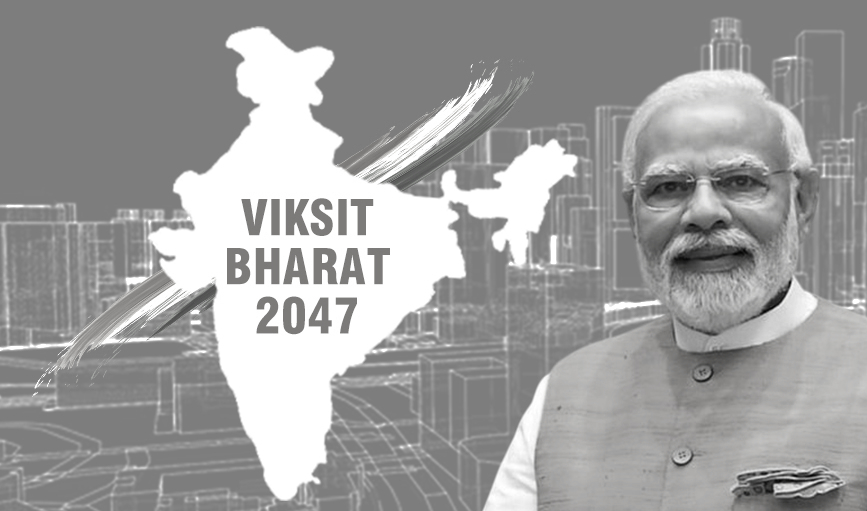
Modi’s 2047 Targets Are Set, Now Comes The Hard Part: Where Is The Implementation Roadmap?
Prime Minister Narendra Modi’s August 15, 2026 Independence Day address has given fresh shape to India’s ambition of becoming a developed nation by 2047. But while the targets are becoming clearer, one major question remains: what is the detailed implementation roadmap to get India there?
Viksit Bharat 2047 is not a single government scheme with one ministry, one budget or one implementing authority. It is a long-term national vision, formally pushed as a nationwide exercise in 2023, that brings together economic growth, technology, infrastructure, social development, energy security, defence and India's global influence.
The latest phase is organised around “Sapta Dhara”, or seven streams of strength: manufacturing; agriculture and food processing; technology and innovation; Gati Shakti and infrastructure; defence; the green and blue economy; and India's soft power.
Alongside this framework, Modi announced several concrete targets. One crore youth are to receive AI training within a year, while a nationwide system of free online coaching is planned for competitive-exam aspirants. A national sports talent hunt will identify children aged five to 15, while a modern civil-defence network is to prepare citizens for threats to critical infrastructure.
Technology and energy are central to the plan. Modi said five to eight more semiconductor plants are expected in the coming years and reiterated the target of 100 GW of nuclear power capacity by 2047. The government also wants to create six crore Lakhpati Didis, doubling the earlier target.
But these announcements do not amount to one consolidated 2047 implementation document.
Instead, responsibility is divided among ministries and agencies. MeitY and IndiaAI handle technology initiatives, while the India Semiconductor Mission drives the chip ecosystem. Nuclear expansion falls under the Department of Atomic Energy, sports under the Sports Ministry, rural women's livelihoods largely through the Rural Development Ministry, and defence manufacturing through the Defence Ministry.
NITI Aayog is simultaneously developing sector-specific strategies. In 2026, it published DPI@2047, a strategic roadmap for digital public infrastructure, while its “Roadmaps to Viksit Bharat” portfolio includes work on areas such as semiconductors and a 2035 bioeconomy roadmap.
This shows that the government is gradually moving from a broad 2047 vision towards sector-specific roadmaps. However, what remains difficult to see is a single public scorecard setting out exactly what India must achieve by 2030, 2035 and 2040 across jobs, income, manufacturing, education, healthcare, infrastructure and living standards.
That creates the biggest accountability question.
For every major promise, India will eventually need to know the target, deadline, budget, responsible agency and measurable annual milestone. It will also need to know what corrective action follows when a target falls behind.
Modi has set the destination. The government is building the individual roads. What remains to be seen is whether India gets a single, measurable map showing which road must be completed by 2030, 2035 and 2040, and who will be accountable if it is not.