
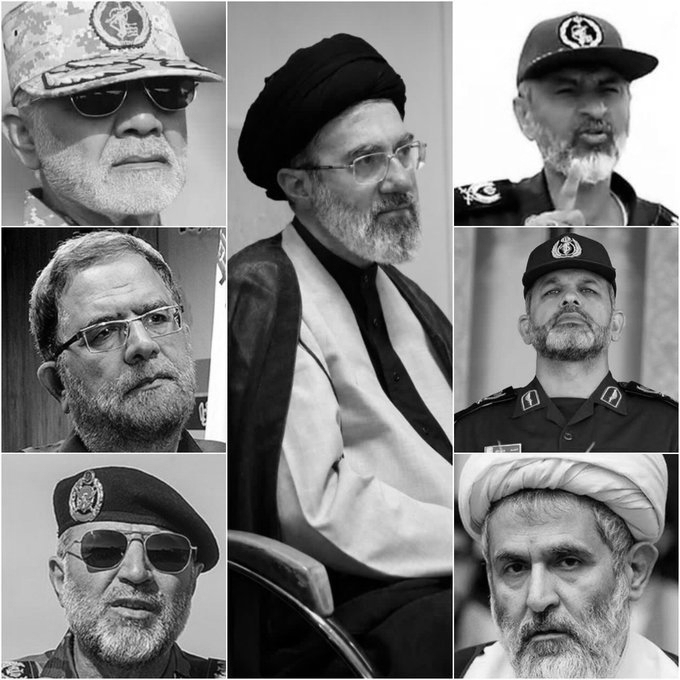
Mojtaba Khamenei Reshuffles Iran’s Security Team, Puts Hardliners In Key Posts
Iran has a new security team. And if anyone expected Supreme Leader Mojtaba Khamenei to respond to the devastating war with the United States and Israel by bringing in moderates, compromise and a softer diplomatic line, the latest appointments suggest otherwise.
Khamenei is rebuilding Iran’s military and security leadership with veteran hardliners who have spent decades inside the Islamic Revolutionary Guard Corps, the military and the intelligence system.
The message is simple: Iran may still talk, but it does not appear ready to give up its hardline security posture.
The reshuffle comes after months of war and a huge loss of senior Iranian commanders. US and Israeli strikes killed much of Iran’s top military leadership, leaving gaps across the Revolutionary Guard, the armed forces and the country’s wider security system. Several positions were filled on an acting basis during the conflict. Khamenei has now moved to turn that temporary wartime structure into a formal chain of command.
On Sunday, Khamenei made one of his biggest security moves since becoming supreme leader. He appointed former Revolutionary Guard commander Mohsen Rezaei as secretary of the Supreme National Security Council and also made him his representative on the powerful body.
The council plays a central role in Iran’s security and foreign policy decisions. Rezaei is not a newcomer to either. He commanded the Revolutionary Guard for 16 years and fought during the Iran-Iraq War. He later moved into senior political positions and ran for president four times. His return to the top of Iran’s security system puts a veteran of the Revolutionary Guard at the centre of decisions involving war, diplomacy and relations with Washington.
Rezaei has also made clear statements showing how far he is from the language of compromise. In April, he warned that US warships in the Strait of Hormuz could be targeted if Washington tried to police the waterway. He also said he did not support extending the ceasefire. In another warning, he said Iran could take US troops captive if Washington returned to war.
That makes his appointment particularly significant as Tehran and Washington struggle over the future of Hormuz.
On Monday, Khamenei appointed six senior commanders across Iran’s armed forces, the IRGC, the IRGC Navy and the Basij.
The most important appointment was Ahmad Vahidi as commander-in-chief of the Islamic Revolutionary Guard Corps. Vahidi was promoted to major general and formally took over the position from Mohammad Pakpour, who was killed in the February 28 strikes. Vahidi had already been acting as the effective IRGC commander during the war. His formal appointment now gives him full authority over one of the most powerful institutions in Iran.
Khamenei has instructed Vahidi to strengthen the IRGC’s deterrence capabilities and prepare the force for what the Iranian leadership describes as powerful offensive operations against its enemies.
Vahidi is also a deeply experienced figure in Iran’s security system. He previously served as defence minister and interior minister and was the first commander of the IRGC’s Quds Force in the late 1980s. His long career makes him part of the old security establishment rather than a new face brought in to change Iran’s direction.
Khamenei also appointed Mostafa Izadi as Vahidi’s deputy. Izadi previously headed the Cyber and New Threats Headquarters of the Khatam al-Anbiya Central Headquarters, giving him experience in areas that go beyond traditional battlefield operations.
Another major appointment went to Ali Abdollahi, who became chief of the General Staff of Iran’s Armed Forces. Abdollahi had already been running the Khatam al-Anbiya Central Headquarters, Iran’s main operational military command. During the war, he was involved in coordinating the armed forces and was one of the most visible military figures issuing warnings to the US and Israel.
His new position is especially important because Khamenei has ordered the integration of the General Staff with Khatam al-Anbiya.
The two bodies traditionally had different roles. The General Staff dealt with military policy, planning and coordination, while Khatam al-Anbiya served as the main joint operational command during war.
Bringing them closer together could give Iran a more unified military command structure and reduce the gaps exposed during the war. It also partly reverses a structure created in 2016, when the two commands were separated.
Kioumars Heydari, the former commander of Iran’s Army Ground Forces, was appointed Abdollahi’s deputy.
The changes also reached Iran’s naval forces.
Rear Admiral Ali Ozmaei was appointed commander of the IRGC Navy. He had emerged as the Guards’ naval commander during the conflict after the death of his predecessor, Alireza Tangsiri. The IRGC Navy is especially important because Iran has repeatedly used its naval forces and the Strait of Hormuz as strategic leverage against the United States.
Then came one of the most politically revealing appointments.
Hossein Taeb, the former head of the IRGC Intelligence Organization, was brought back to command the Basij, the large paramilitary organisation linked to the Revolutionary Guard.
The Basij has played a major role in domestic security and the suppression of protests.
Taeb previously headed the Basij before spending more than a decade leading the IRGC’s intelligence arm. He was removed from that intelligence position in 2022 after a series of security failures and operations inside Iran that were attributed to Israel.
His return is significant because Taeb remains closely linked to the older intelligence and security network around Mojtaba Khamenei. He was also involved in high-level security discussions during the war, including debates over negotiations with Washington.
So this is not simply a military reshuffle.
It is also about domestic control.
The Basij is one of the key tools available to the Iranian leadership when it faces unrest inside the country. Putting a trusted intelligence veteran such as Taeb back at its head suggests that internal security remains a major concern for Khamenei.
The appointments also show how much Iran's leadership structure was damaged by the war.
The losses did not stop with one commander.
Iran’s military leadership had already been hit hard in earlier fighting. The death of senior commanders created a chain of replacements, with some new leaders themselves later killed. The result was a military hierarchy that, for months, relied heavily on acting commanders rather than a fully formalised structure.
Khamenei is now trying to close those gaps.
But the choices he has made are telling.
Rather than replacing the old security establishment with younger or more moderate figures, he has relied on men with long records inside the Revolutionary Guard, intelligence services and military command.
That does not mean Iran has completely closed the door to negotiations.
President Masoud Pezeshkian remains part of the political system and Iranian officials continue to discuss diplomacy. Pezeshkian said he held a seven-hour meeting with Khamenei, showing that the political leadership remains involved in the decisions.
The appointment of Rezaei, Vahidi and Taeb therefore sends a message beyond Iran’s borders. Mojtaba Khamenei is building his own power structure around people he knows and trusts.