
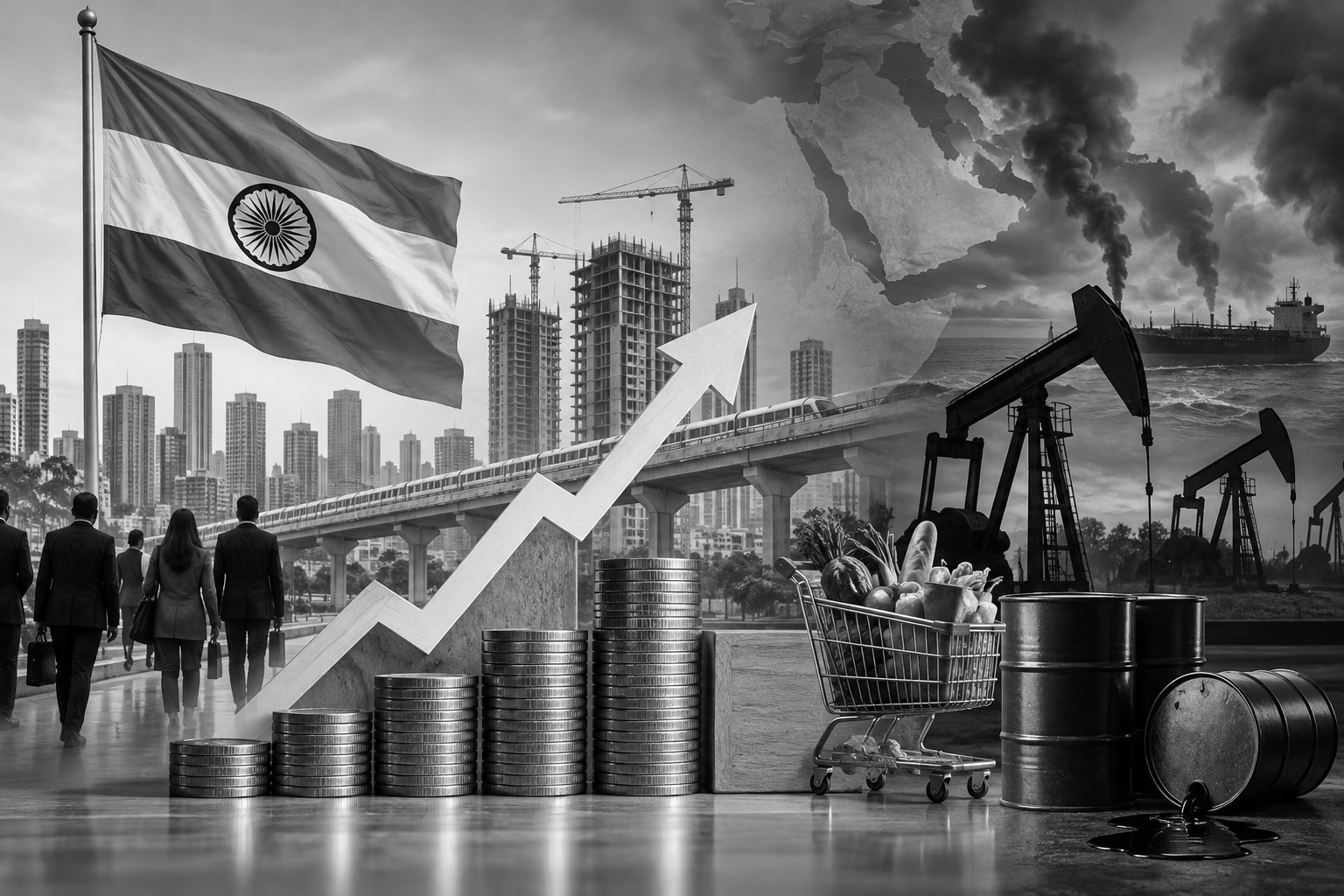
Moody’s Raises India’s FY27 Growth Forecast to 7%, Flags Inflation Risks
Moody’s Ratings has sharply raised its forecast for India’s real GDP growth in 2026-27 to 7% from 6%, citing stronger domestic demand, investment activity and the economy’s resilience to global shocks arising from the continuing Middle East conflict. The upgrade places India’s projected expansion above forecasts from several major institutions, but Moody’s has simultaneously warned that elevated crude oil prices, El Niño-related food pressures, weaker external demand and softer remittance flows could intensify inflation and eventually weigh on consumption and growth.
The revision follows stronger-than-expected economic performance in the opening quarter of FY27. India’s real GDP grew 7.8% year-on-year in April-June, while real GVA expanded 8.2%, according to official data. Investment grew 11.9%, household consumption 7.1% and exports 12%. Moody’s said real GDP growth accelerated to 8.2% in the first half of calendar 2026, compared with 7.3% for the full year in 2025, supported by private consumption, gross fixed capital formation, public infrastructure spending, a likely revival in private investment and sustained services-sector strength.
The 7% Moody’s forecast is above the RBI’s 6.7% projection for FY27, while S&P Global Ratings has forecast 6.6% and the IMF 6.4%. ICRA, a Moody’s affiliate, has separately raised its FY27 growth estimate to 7.1%, although it flagged prolonged West Asia tensions and a weak monsoon as risks.
Inflation remains the major concern. Moody’s expects average FY27 inflation at 4.8%, compared with 2.4% in FY26. India’s retail inflation rose to 4.82% in August, from 4.45% in July, while food inflation climbed to 5.95% from 5.52%. Moody’s warned that prolonged energy-price increases could push inflation above its projection, while El Niño-related disruptions could add to food-price pressures and weaken household purchasing power.
Oil is particularly important because India’s crude import dependence reached 88.2% in FY25. Higher energy and fertiliser costs could raise the import bill, widen the current account deficit and increase production and transportation costs. Moody’s also cited weaker external demand and potentially lower Middle East remittances as risks, although foreign-exchange reserves, diversified crude sourcing and strong domestic demand provide buffers.
On public finances, Moody’s expects debt reduction to remain gradual and debt affordability to stay weaker because of India’s high debt burden and interest costs. The government remains committed to reducing the central fiscal deficit to 4.3% of GDP in FY27 from 4.4% in FY26. Moody’s retained India’s Baa3 sovereign rating with a stable outlook.
The latest assessment therefore presents a stronger growth outlook alongside rising vulnerabilities. India’s ability to sustain 7% growth will depend increasingly on oil prices, food inflation, private investment, consumption and the duration of geopolitical disruptions.