
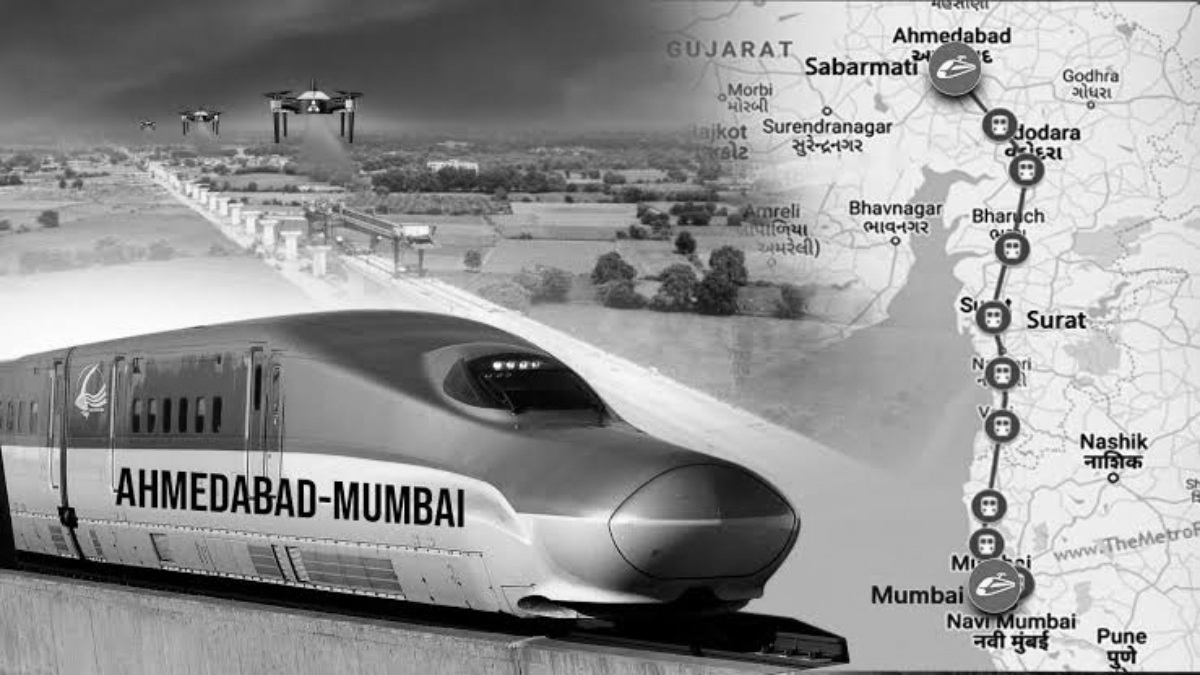
Mumbai ahmedabad bullet train faces cost questions after 80% cost surge
A political debate has erupted over the rising cost of India’s ambitious bullet train project after estimates for the country’s first high speed rail corridor surged sharply from the original figure announced nearly a decade ago. While critics have flagged the escalation as a serious concern, the implementing agency insists such revisions are part of the normal evolution of large infrastructure projects.
The controversy centres on the Mumbai Ahmedabad Bullet Train Project , which will connect Mumbai and Ahmedabad . When the project was first announced, its estimated cost stood at around ₹1.1 lakh crore . Recent reports, however, suggest the figure has climbed to about ₹1.98 lakh crore , marking an increase of nearly 80 percent .
The sharp jump triggered criticism from the Indian National Congress , which questioned the steep rise and warned that the project could turn into a financial burden. Responding to the criticism, the implementing agency National High Speed Rail Corporation Limited said the concerns were based on a selective interpretation of data. The corporation maintained that the initial estimate was prepared at a preliminary stage and that costs are typically refined once detailed engineering designs, land acquisition requirements and construction contracts are finalised.
Research on global transport megaprojects suggests that cost overruns of 30 to 45 percent are relatively common. Against that benchmark, the nearly 80 percent rise in the Mumbai Ahmedabad Bullet Train Project stands out as significantly higher than the global norm , even though it does not reach the triple digit overruns seen in some controversial international rail projects.
Globally, several high speed rail ventures have witnessed even steeper escalations. Britain’s HS2 , for instance, saw its projected cost more than double , triggering intense political scrutiny and forcing parts of the project to be scaled back. In the United States, the California High Speed Rail has also experienced dramatic increases in projected costs.
In comparison, analysts say the Mumbai Ahmedabad Bullet Train Project now sits well above the typical global overrun range for transport megaprojects , highlighting how sharply the estimate has shifted since the project was first announced.
The project involves complex engineering work, including long elevated corridors and an undersea tunnel near Mumbai , while land acquisition challenges and rising construction costs over the past decade have also pushed estimates upward.
The corporation has also emphasised that the project is being financed largely through a long term concessional loan from Japan , widely considered one of the most favourable funding arrangements for infrastructure development.
As India pushes ahead with its first high speed rail corridor, the rising estimates have inevitably brought the project under closer scrutiny.