
NCERT Faces Criticism Over Altered Depiction of Iconic Indus Valley “Dancing Girl”
A visual alteration of the iconic “Dancing Girl” bronze figurine from Mohenjo-daro in a new NCERT Class 9 arts textbook has triggered a debate over how historical artefacts should be represented in school curricula.
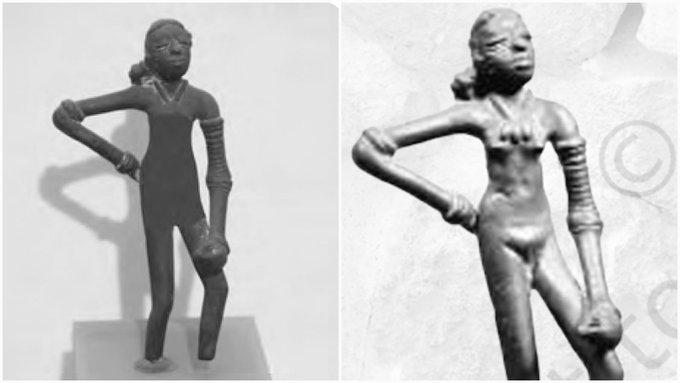
The figurine appears in the opening chapter, “History of Arts,” in NCERT’s new Class 9 textbook Madhurima . In this version, the upper torso of the 4,500-year-old Indus Valley artefact is shaded , visually obscuring anatomical details that are clearly visible in standard archaeological photographs of the original bronze sculpture.
The same figurine, however, is depicted in a more faithful form in NCERT’s Class 6 Social Science textbook, highlighting an inconsistency that has drawn criticism from academics and historians.
Michel Danino, who headed the textbook development committee for the Class 6 Social Science series, said he was informed that the image had been modified as it was deemed “not age-appropriate.” He disputed the reasoning, arguing that concerns over nudity reflect an “obsolete Victorian view” and contradict efforts to “decolonise” education.
Reacting to the altered depiction, Danino said the modification misrepresents a historical artefact , comparing it to the historical censorship of classical art, such as the addition of a fig leaf to Michelangelo’s David . He warned that altering such images without clear academic context risks distorting students’ understanding of original archaeological evidence.
The controversy has also revived broader questions about how ancient human figures should be presented in school textbooks , balancing educational sensitivity with historical accuracy. Critics argue that sanitising artefacts undermines their cultural and archaeological integrity, while others maintain that age-appropriate presentation is necessary in school education.
The textbook notes that the figurine, dated to around 2600 BCE , was created using the lost-wax casting technique , and encourages students to interpret its posture and recreate it through sketches.
NCERT has not yet issued a public statement on the matter.