
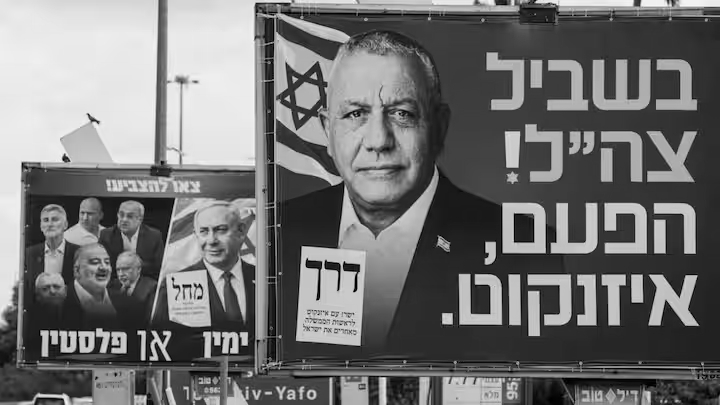
Netanyahu’s Likud Sets Conditions for Unity Government as Eisenkot Resumes Israel Coalition Talks
Israeli caretaker Prime Minister Benjamin Netanyahu's Likud party and rival Gadi Eisenkot's Yashar party resumed negotiations on Sunday over forming a national unity government, as political uncertainty continues following the October 27 elections. Representatives of the two parties met at 1 pm (local time) at the Dan Accadia Hotel in Herzliya, near Tel Aviv, for another round of discussions.
Neither political camp secured a majority in the 120-member Knesset. Netanyahu's bloc holds 53 seats, against 48 for the opposition bloc led by Eisenkot, while Arab parties secured a record 19 seats. President Isaac Herzog tasked Eisenkot with forming the next government, giving him until December 6, with a possible 14-day extension.
Likud outlined its conditions for joining a unity government on Saturday, demanding an end to political boycotts, personal attacks and what it described as incitement against Netanyahu and his ministers. It also wants a joint commitment to recognise Israel as the nation-state of the Jewish people and exclude Arab parties from the proposed coalition.
The party has sought agreement on key policy issues, including opposition to a Palestinian state, preserving Israel's achievements in the war, addressing the military-service status of ultra-Orthodox Jews and reaching consensus on security policy, an investigation into the October 7 attacks, judicial reforms, law enforcement and organised crime, including in the Arab sector. Its position also involves maintaining Israeli control over territories in Syria, Lebanon and Gaza.
Yashar described the renewed discussions as a genuine effort to explore every possible arrangement. However, Eisenkot has repeatedly ruled out serving under Netanyahu. His party has also rejected a proposed rotation arrangement between the two leaders, insisting that Eisenkot must serve as prime minister for the full term.
Former prime minister Naftali Bennett, who met Netanyahu privately last week, has also ruled out joining a Netanyahu-led government while backing a unity arrangement headed by Eisenkot. Meanwhile, Democrats chairman Yair Golan has called a minority government backed by Arab parties the only realistic alternative to replacing Netanyahu.
Eisenkot has said he will not prolong negotiations indefinitely. If talks with Likud and ultra-Orthodox parties fail, he plans to seek parliamentary approval for an emergency minority government, relying on external support from Ra'am and the Joint List. However, failure to secure a confidence vote could end his mandate and potentially give Netanyahu another opportunity to form a government.