
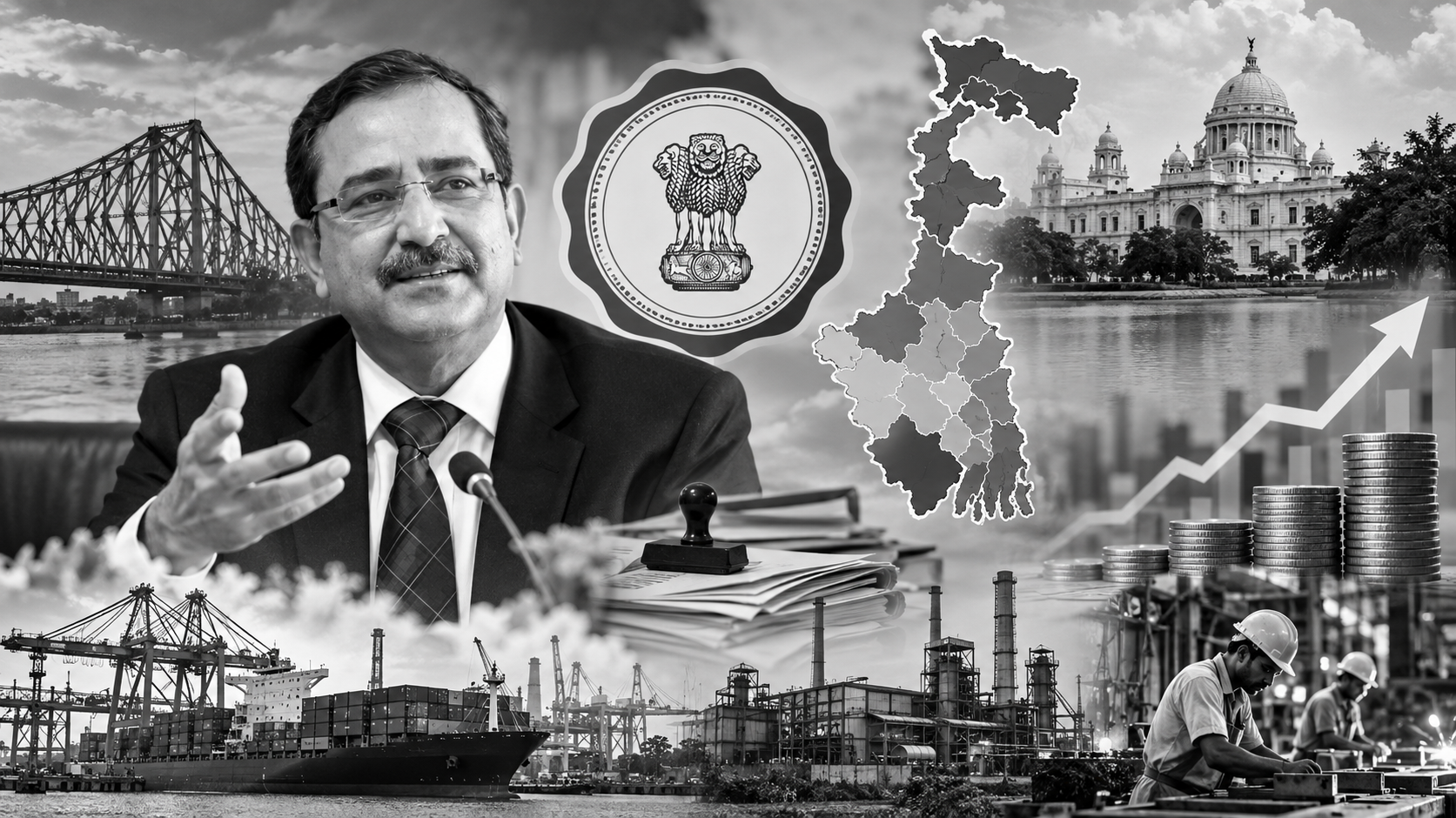
NITI Aayog Flags Bengal's Regulatory Gaps, Urges Investment Reforms
NITI Aayog Vice-Chairman Ashok Lahiri has raised concerns over West Bengal's performance in regulatory reforms, calling for a comprehensive overhaul of the state's business environment to attract fresh investments, strengthen manufacturing and accelerate economic growth. His observations have brought renewed attention to the state's investment climate, particularly against the backdrop of rising welfare commitments, persistent revenue deficits, mounting debt obligations, relatively modest foreign investment inflows and the need to expand its industrial base.
Speaking at an event organised by the Bengal Chamber of Commerce and Industry in Kolkata on October 30, Lahiri said West Bengal was not among the leading performers in regulatory reforms. He called for simplified approvals, reduced compliance burdens and a central coordinating mechanism to eliminate overlapping requirements involving land use, building permissions, labour administration and fire safety. He also advocated self-certification for low-risk activities and monetary penalties instead of imprisonment for minor procedural violations.
The concerns coincide with NITI Aayog's Investment Friendliness Index 2026, prepared by Crisil, in which West Bengal scored 41.3, ranking 24th among 36 states and Union Territories and 15th among 17 large states. The assessment identified business climate and government policy as weaknesses, despite advantages in railway connectivity, electricity supply and cold-storage infrastructure. FDI inflows declined from US181 million in 2024.
The state's economic output has expanded, with GSDP projected at ₹21.48 lakh crore in 2026–27. However, per-capita income stood at ₹1,63,467 in 2024–25, against the national average of ₹2,05,324. Its 2026–27 Budget estimates revenue receipts of ₹3,20,485 crore, including ₹1,30,670 crore in its own tax revenue, while net expenditure is projected at ₹3,84,169 crore.
Welfare commitments remain substantial, with ₹36,000 crore allocated for Annapurna Bhandar, ₹8,151 crore for old-age pensions and ₹4,625 crore for Krishak Bandhu. Outstanding liabilities are projected at ₹8.16 lakh crore, while interest payments are estimated at ₹53,034 crore. The state has also projected a revenue deficit of ₹21,984 crore and fiscal deficit of ₹62,421 crore.
A decade-long CAG assessment shows revenue expenditure growing at 8.78% annually against revenue receipts growth of 7.69%. Subsidies expanded at 16.04%, while capital expenditure grew at 6.35%. The 2026–27 capital outlay is projected at ₹40,930 crore.
West Bengal recorded merchandise exports of US$12.88 billion in 2025–26, accounting for 2.92% of India's exports. Lahiri also questioned the limited arrival of defence manufacturing investments despite ordnance facilities at Dum Dum and Cossipore. He highlighted GST, which collected ₹22.27 lakh crore nationally in 2025–26, and the Insolvency and Bankruptcy Code as important reforms.