
'Not Even a Drop': Karnataka Erupts Over Order to Release Cauvery Water to Tamil Nadu
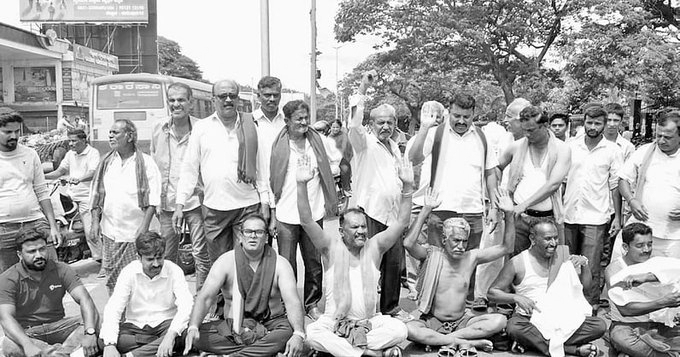
The long-running Cauvery water dispute between Karnataka and Tamil Nadu flared up once again on Wednesday as protests erupted across Karnataka following the Cauvery Water Regulation Committee (CWRC) directive asking the state to release 3,500 cusecs of water daily for 15 days to its southern neighbour. Pro-Kannada organisations, farmer groups and activists opposed the order, arguing that Karnataka itself is facing an acute water shortage due to poor monsoon rainfall.
The biggest demonstration was held near the Kuvempu statue in Bengaluru's Malleswaram, where protesters marched carrying empty pots and raised slogans against the CWRC order. Police deployed heavy security, erected barricades and detained several activists to prevent the protest from escalating. Similar demonstrations were also reported from Mandya, Mysuru and Ramanagara, all key regions in the Cauvery basin.
Protest leaders termed the CWRC's decision " unscientific ", claiming that water inflows into the Krishna Raja Sagar (KRS) Dam have remained far below normal despite the monsoon season. They argued that the available water should be reserved for drinking purposes, agriculture and livestock, and questioned how Karnataka could release nearly 4.5 TMC of water when many parts of the state are already facing shortages.
The protesters warned that the agitation would intensify if the state government proceeds with releasing water to Tamil Nadu.
The political row also deepened, with the BJP accusing the Congress government led by Chief Minister D.K. Shivakumar of failing to effectively defend Karnataka's interests before the CWRC. BJP state president B.Y. Vijayendra alleged that the state's legal team did not adequately present the ground realities, including the rainfall deficit and farmers' distress.
Later, Shivakumar announced that the Karnataka government would challenge the CWRC order before the Cauvery Water Management Authority (CWMA), maintaining that the state cannot compromise its drinking water needs. Officials have also pointed out that to ensure 3,500 cusecs reaches Biligundlu on the Karnataka-Tamil Nadu border, the state may actually have to release 6,000-7,000 cusecs because of transmission losses.
With legal action now underway and protests gathering momentum, the politically sensitive Cauvery dispute appears set for another phase of confrontation as both states continue to grapple with below-normal rainfall and shrinking reservoir levels.