
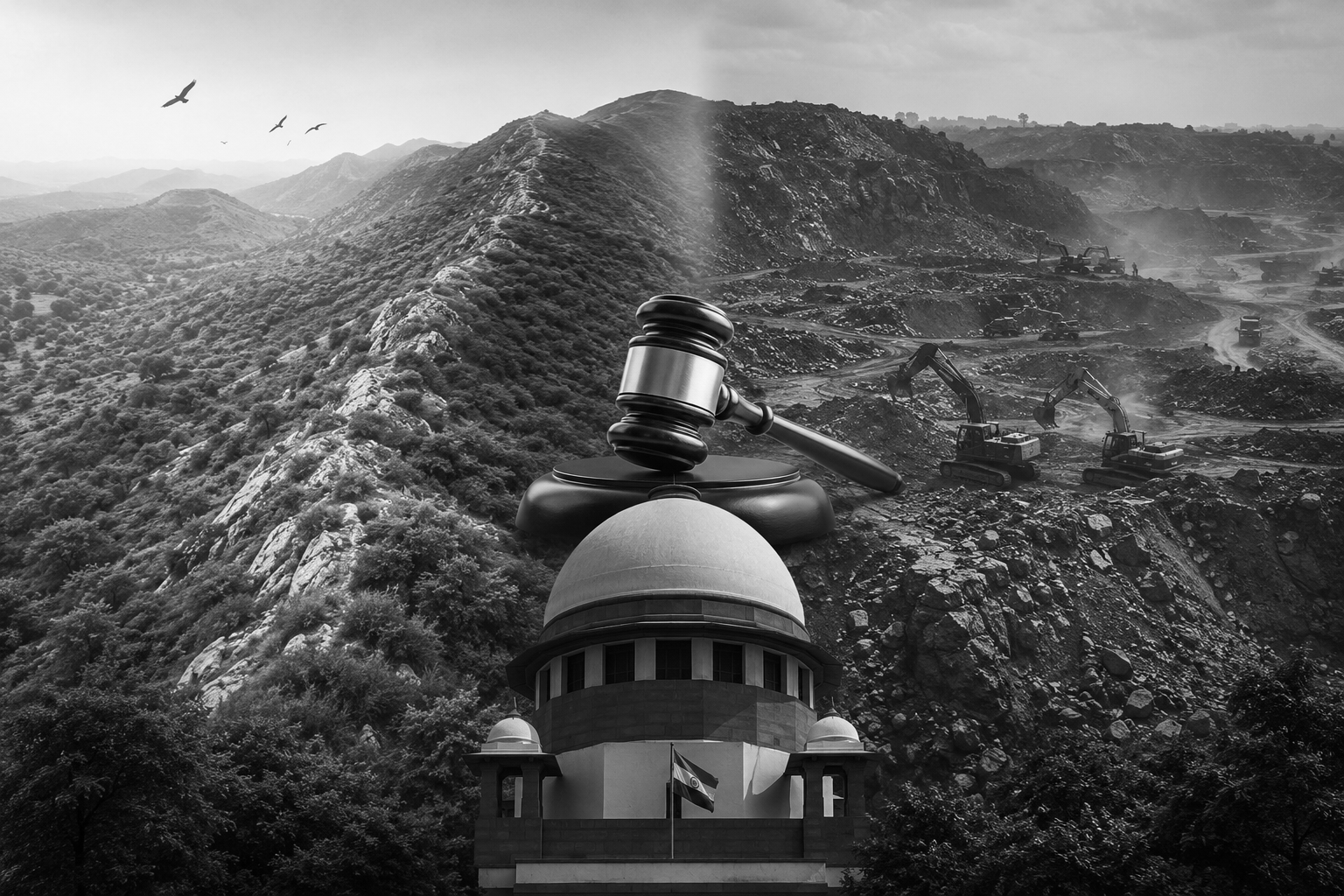
Not Satisfied With Its Own Order, SC Now Forms Independent Panel to Settle the Aravalli Question
The battle over how to define and protect one of the world's oldest mountain ranges has taken yet another turn. On Wednesday, the Supreme Court constituted a fresh five member High Powered Committee (HPC) to independently re-examine the definition and delineation of the Aravalli hill range , a move that lays bare just how contested and unresolved this issue remains.
The trouble began when the Supreme Court, hearing long pending cases on illegal mining in the Aravallis, constituted a committee in May 2024 to recommend a uniform definition, since different states were following inconsistent criteria while granting mining permissions. Under the definition that eventually emerged, an Aravalli hill was described as any landform with a minimum elevation of 100 metres above local relief , and a range as two or more such hills lying within 500 metres of each other. The Supreme Court, in November 2025 , approved this elevation linked definition for classifying landforms as part of the Aravalli range.
The approval, however, triggered immediate controversy. Environmental groups and opposition parties argued that the height based criterion could exclude large portions of the ancient mountain system from protection, potentially allowing regulated mining in low lying but ecologically sensitive areas. The ruling sparked protests across several districts of Rajasthan , including Udaipur, Jodhpur, Sikar and Alwar . In December 2025 , the court took note of concerns raised by environmental groups and civil society organisations. On December 29 , it stayed its own order and called for a fresh independent review of the definition.
Now, six months later, that committee has finally been constituted. The newly formed HPC, headed by Kanchan Devi , Director General of the Indian Council of Forestry Research and Education (ICFRE), will examine the environmental, geological and ecological implications of the parameters adopted for identifying the Aravalli range and submit its report by August 31, 2026 . The panel brings together expertise in geology, forestry, biodiversity, ecology and geo mapping.
The court has flagged several key concerns for the committee to address. Among them is whether the 500 metre gap rule and the 100 metre elevation threshold would leave vast stretches of the Aravallis without legal protection, effectively opening the door to mining activities. The panel will also verify claims that only 1,048 of Rajasthan's 12,081 hills satisfy the prescribed elevation criterion.
Scientists have repeatedly warned that the Aravallis' ecological importance lies in the continuity of the range itself. Acting as a barrier against desert expansion, supporting wildlife movement, sustaining grassland habitats and recharging groundwater reserves, the mountain chain performs functions that extend far beyond the height of individual hills. For a geological system believed to be nearly 2.5 billion years old , the stakes could hardly be higher.