
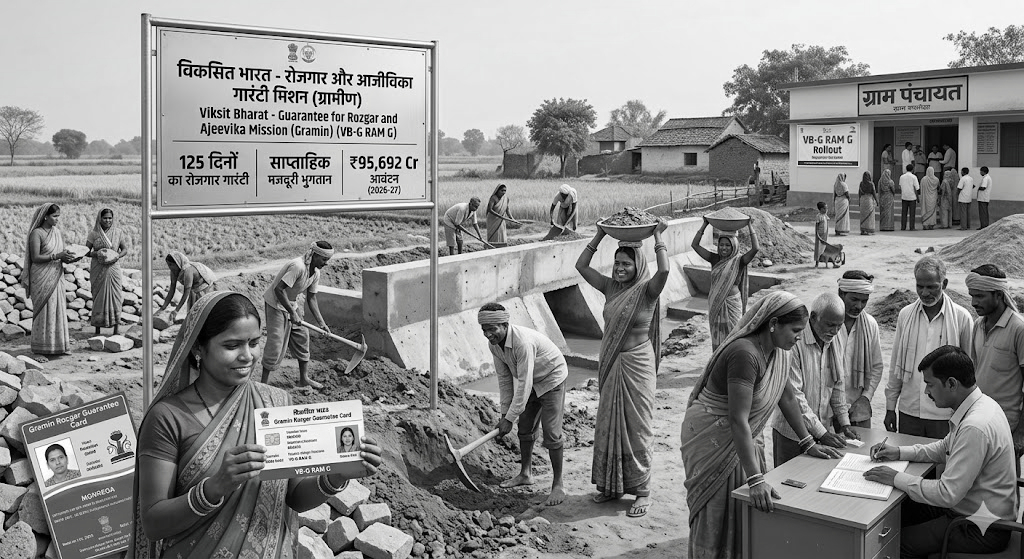
Out With MGNREGA, In With G RAM G: Rural Jobs Overhaul from July 1, ₹95,692 Cr Allocation for 2026-27
India’s rural employment framework is set for its most significant overhaul in two decades as the Centre’s new Viksit Bharat – Guarantee for Rozgar and Ajeevika Mission (Gramin) , or VB-G RAM G , comes into force from July 1, 2026, formally replacing the Mahatma Gandhi National Rural Employment Guarantee Act (MGNREGA) that has governed rural wage employment since 2005.
The VB-G RAM G Act, 2025 received Presidential assent on December 21, 2025, after being passed by Parliament on December 18-19, and was formally notified on May 11, 2026. The most significant structural change is the expansion of guaranteed employment days. Rural households whose adult members volunteer for unskilled manual work will now be entitled to 125 days of wage employment annually , up from the earlier 100-day guarantee under MGNREGA.
Union Minister Shivraj Singh Chouhan chaired a high-level video conference with state rural development ministers to review rollout preparedness. Chhattisgarh received an interim allocation of ₹3,354.85 crore, with funds being transferred directly to Gram Panchayats. He issued a strict directive that no worker should be left without employment for even a single day and warned that any disruption in registration, wage disbursal, or labour rights compliance would not be tolerated. He also announced that a National Rural Development Conference will be held on June 28-29 at the Pusa Institute in New Delhi.
For the financial year 2026-27, the Centre has allocated ₹95,692.31 crore , described as the highest ever Budget Estimate for a rural employment programme. Including state contributions, the total outlay is projected to exceed ₹1.51 lakh crore. The scheme will cover around 2.80 lakh Gram Panchayats across the country. Funding will continue under the 60:40 Centre State sharing pattern , with higher central assistance for Northeastern and Himalayan states and full central funding for Union Territories without legislatures.
Chouhan urged lagging states including Jharkhand, Karnataka, Telangana, and Mizoram to expedite their matching financial contributions and said he would personally write to their chief ministers. He also praised Mizoram, Puducherry, and Andhra Pradesh for already issuing state level notifications to align with the new framework.
All ongoing MGNREGA works until June 30, 2026 will continue without interruption and will be integrated into the new system. Existing e KYC verified job cards will remain valid until new Gramin Rozgar Guarantee Cards are issued. Wage payments will be made weekly or within 15 days of muster roll closure, with workers eligible for compensation in case of delay.
The transition has sparked criticism from opposition and labour groups. The Congress described the move as a “headline driven exercise,” alleging it reflects centralisation and weakens the rights based nature of rural employment guarantees. Activists under the NREGA Sangharsh Morcha called it a “death knell” for the earlier framework, arguing that it shifts employment from a demand driven legal right to a more command driven administrative programme introduced without sufficient public consultation.