
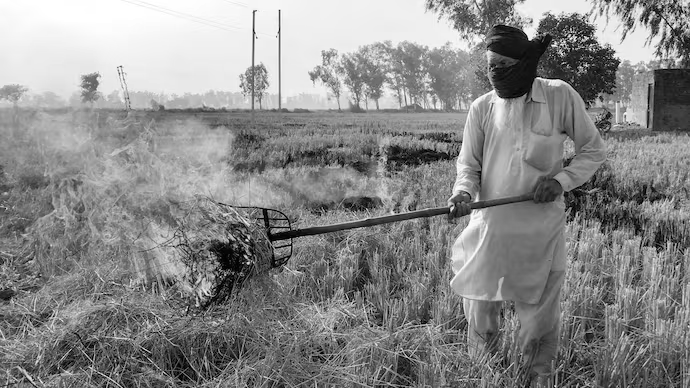
Paddy Stubble Burning Declines 26.63% Across Seven States, Punjab Accounts for Nearly Half of Cases
Paddy stubble-burning incidents across seven states declined by 26.63 per cent to 3,316 cases between September 15 and November 1, 2026, according to satellite-based data from the Indian Council of Agricultural Research (ICAR). However, Punjab continued to account for nearly half of the reported incidents, highlighting the challenges in eliminating the practice.
Punjab recorded the highest number of cases at 1,514, followed by Rajasthan (671), Madhya Pradesh (566), Uttar Pradesh (345), Uttarakhand (176), Haryana (42) and Delhi (2).
In Punjab, Amritsar, Firozpur, Kapurthala, Sangrur, Bathinda, Faridkot, Patiala, Barnala and Fazilka reported the highest number of incidents. Rajasthan's affected districts included Baran, Bundi, Ganganagar, Hanumangarh, Kota and Sawai Madhopur, while Sheopur, Sehore, Narmadapuram, Guna, Datia and Ashoknagar recorded more cases in Madhya Pradesh.
The data was generated through satellite remote sensing during the Kharif 2026 season by the CREAMS Laboratory under ICAR-Indian Agricultural Research Institute (IARI).
The primary reason behind stubble burning is the short interval between paddy harvesting and wheat sowing. Farmers generally have only 10–25 days to clear their fields and prepare them for the next crop. Delayed wheat sowing can affect yields, making quick field clearance essential.
Burning remains the cheapest and fastest option, particularly for farmers who cannot afford or access residue-management machinery. Mechanised harvesting also leaves considerable quantities of straw and stubble, while manual removal involves additional labour, time and expenses.
However, burning releases harmful pollutants and greenhouse gases, worsens air quality, particularly in Delhi-NCR, and damages soil health by affecting beneficial microorganisms.
The Centre's Crop Residue Management Scheme provides a 50 per cent subsidy to individual farmers and 80 per cent financial assistance to cooperatives, FPOs and entrepreneurs for purchasing machinery such as Happy Seeders, Super Seeders, balers and mulchers.
The government is also promoting Custom Hiring Centres and alternative uses of paddy straw, including biomass pellets, briquettes and power generation.
The Commission for Air Quality Management (CAQM) is using satellite monitoring and enforcement teams to curb violations. Crop diversification away from paddy is also being encouraged to reduce residue generation.
Despite the decline, making affordable alternatives accessible to farmers remains crucial to controlling stubble burning while protecting agricultural productivity and air quality.