
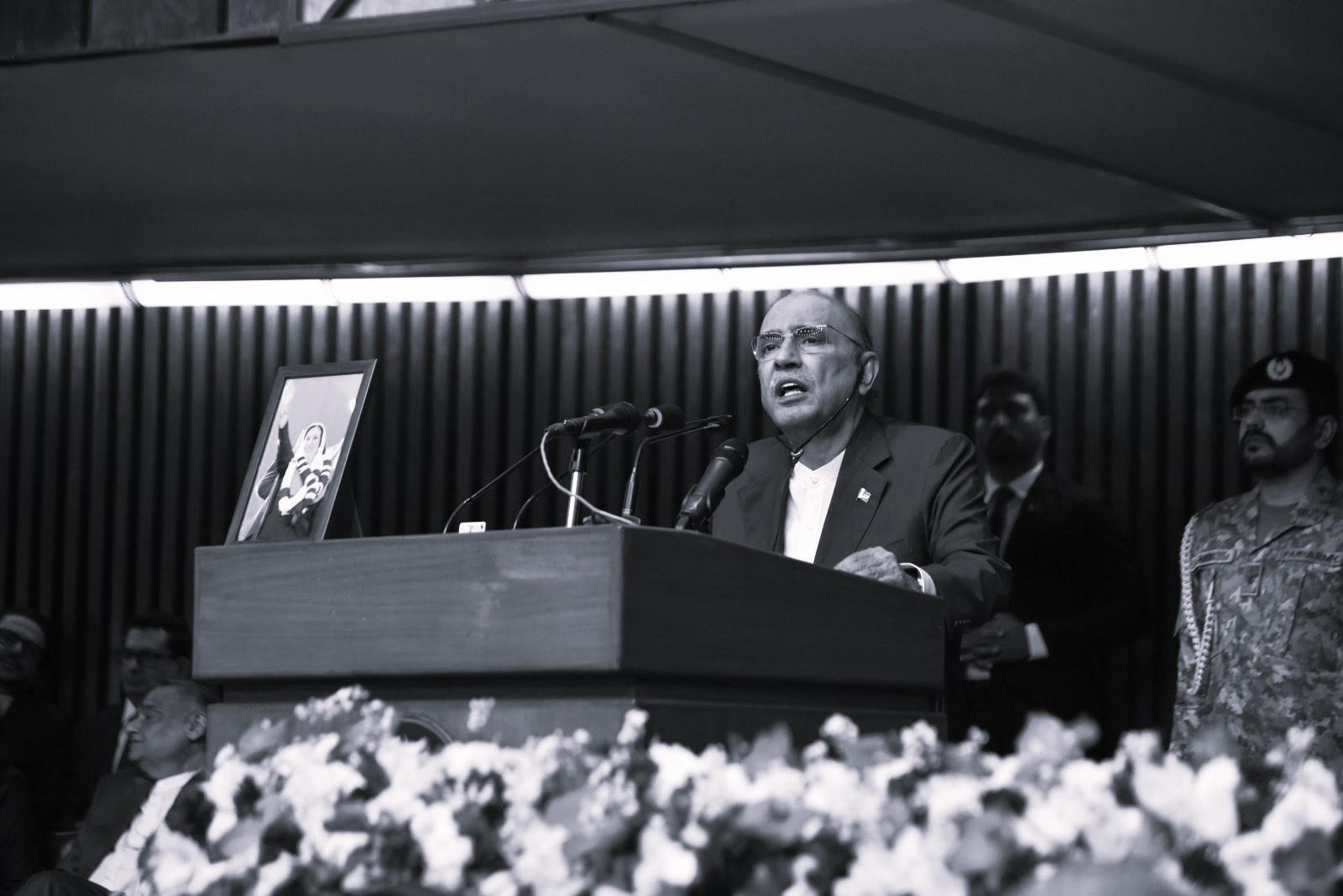
Pakistan Will Not Tolerate Cross-Border Destabilisation: Zardari
President Asif Ali Zardari on Monday said Pakistan would not allow any domestic or foreign entity to use neighbouring territory to destabilise the country, stressing that the nation’s sovereignty and territorial integrity remain non-negotiable.
Addressing a joint sitting of Parliament amid strong protests and sloganeering by opposition members, Zardari said a recent UN report had described the presence of terrorist groups in Afghanistan as an extra-regional threat. He warned that if such issues are ignored, any country could face a catastrophic attack in the future.
He stated that until last week, Pakistan had pursued “every possible form of diplomacy” to prevent an outbreak of military response to terrorist incursions from Afghanistan. However, he alleged that despite multiple diplomatic engagements and assurances, the Afghan de facto regime continues to provide safe sanctuaries to terrorist groups .
According to him, commitments made in Doha particularly the promise not to allow terror groups to operate from Afghan soil have not been honoured. He urged the Afghan authorities to dismantle groups that survive on conflict and a war-driven economy and warned against allowing Afghanistan to become a battlefield for the ambitions of other countries.
Zardari also condemned ongoing conflicts and attacks in West Asia. He expressed concern over the war being waged while negotiations were underway and reaffirmed Pakistan’s support for the sovereignty and territorial integrity of Iran , describing it as a brotherly nation. He further condemned attacks targeting countries such as the UAE, Bahrain, Jordan, Kuwait, Qatar and Saudi Arabia , and condoled the assassination of Iran’s Supreme Leader Ayatollah Ali Khamenei.
On regional issues, the President reiterated Pakistan’s continued diplomatic and moral support to the people of Jammu and Kashmir , asserting that peace and security in South Asia cannot be achieved until Kashmiris attain their rights. He criticised India’s reported move to place the Indus Waters Treaty in abeyance , calling it “hydro-terrorism” and alleging that water flows were being weaponised to exert political pressure.
Turning to Palestine, Zardari said Pakistan would persist in supporting the creation of an independent and undivided Palestinian state based on pre-1967 borders, with Al-Quds Al-Sharif as its capital .
This was his ninth address to a joint session of Parliament as President. The speech was marked by protests from Pakistan Tehreek-e-Insaf members who chanted slogans such as “Go, Zardari, go” and “Khan ko reha karo (Free Imran Khan).” Despite the uproar and disruptions, Zardari continued and completed his address.