
Parliament Monsoon Session Ends: ₹175 Cr, 7,000 Min Wasted As LS Productivity At 19%, Among Worst In Over A Decade
Parliament's Monsoon Session ended on Thursday with both Houses adjourned sine die after 19 sittings, marked by repeated disruptions and a sharp political divide over the government's legislative record and the Opposition's demand for greater debate.
The session ran from July 20 to August 13. The Lok Sabha was adjourned after all six stanzas of Vande Mataram were sung, with Prime Minister Narendra Modi, Home Minister Amit Shah and Leader of Opposition Rahul Gandhi present. There was no discussion on the final day. Rajya Sabha Chairman C P Radhakrishnan expressed "deep concern" over repeated disorder.
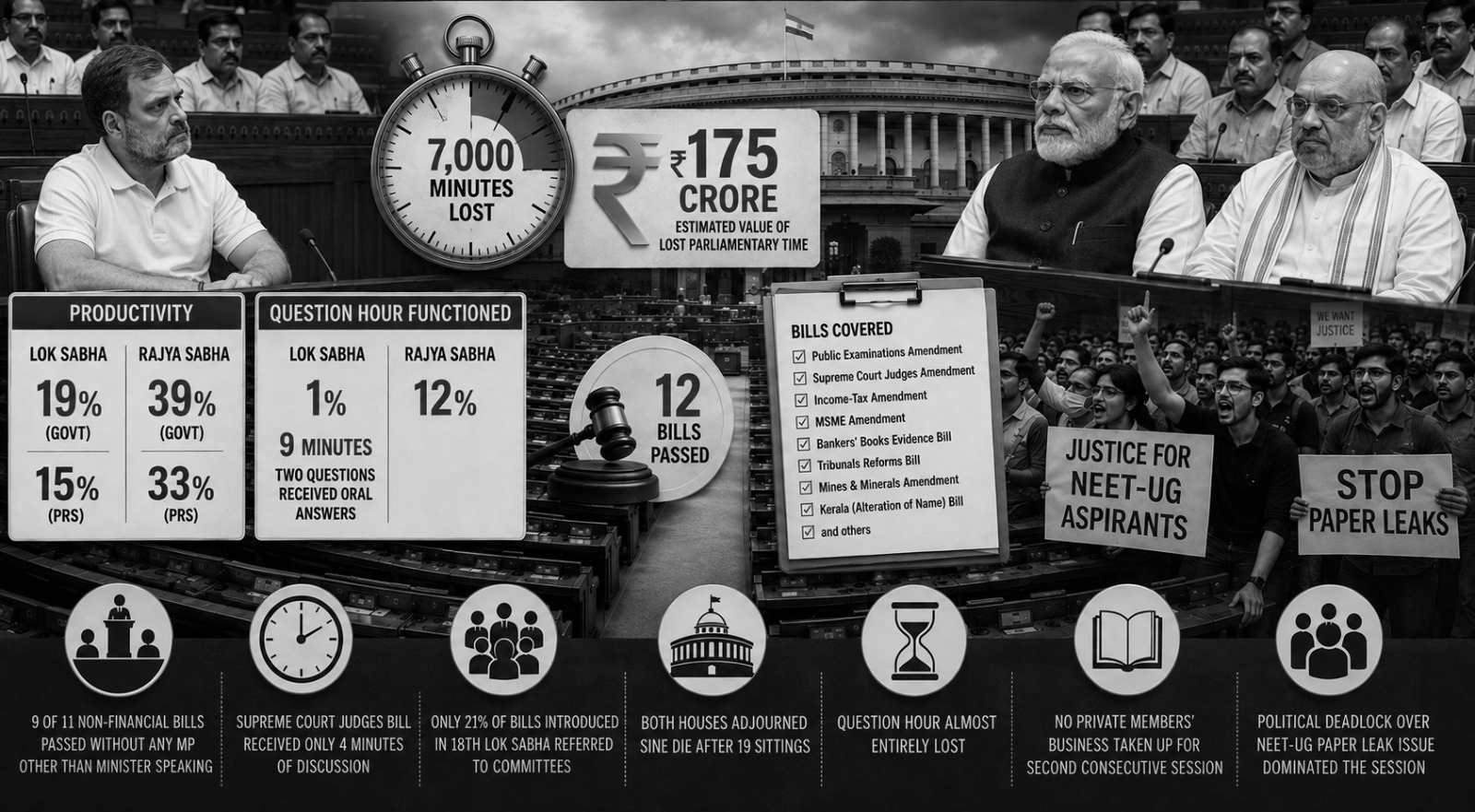
Parliamentary Affairs Minister Kiren Rijiju said Lok Sabha productivity was 19 per cent and Rajya Sabha productivity 39 per cent, while PRS Legislative Research put the figures at 15 per cent and 33 per cent, respectively. The Lok Sabha's performance was among its weakest in more than a decade, though the 2010 Winter Session remains the lowest at 5 per cent.
The disruptions also carried a substantial estimated financial cost. At the commonly cited parliamentary operating cost of around ₹2.5 lakh per minute, about 7,000 minutes of lost parliamentary time would amount to nearly ₹175 crore. This is an estimated value of the lost time, rather than an officially declared cost of the Monsoon Session.
Question Hour was hit particularly hard, functioning for just 1 per cent of scheduled time in the Lok Sabha and 12 per cent in the Rajya Sabha. The Lok Sabha's Question Hour lasted only nine minutes across the entire session, with two questions receiving oral answers. No Private Members' Business was taken up for the second consecutive session.
Despite the disruptions, the government passed 12 Bills covering examinations, the judiciary, taxation, MSMEs, banking, tribunals, mining and other areas. These included the Public Examinations Amendment Bill, Supreme Court judges amendment, Income-Tax amendment, MSME amendment, Bankers' Books Evidence Bill, Tribunals Reforms Bill, Mines and Minerals amendment and Kerala (Alteration of Name) Bill.
The Public Examinations Amendment Bill received the most scrutiny, with nearly 11 hours of Lok Sabha debate and more than six-and-a-half hours in the Rajya Sabha. It provides tougher penalties, faster investigations and special courts for examination-related malpractice and has received President Droupadi Murmu's assent.
Most other Bills, however, received little debate. PRS found that nine of 11 non-financial Bills it tracked were passed in the Lok Sabha without any MP other than the minister speaking. The Supreme Court judges Bill, which raises the court's sanctioned strength from 34 to 38 judges amid a backlog of more than 92,000 cases, received just four minutes of discussion.
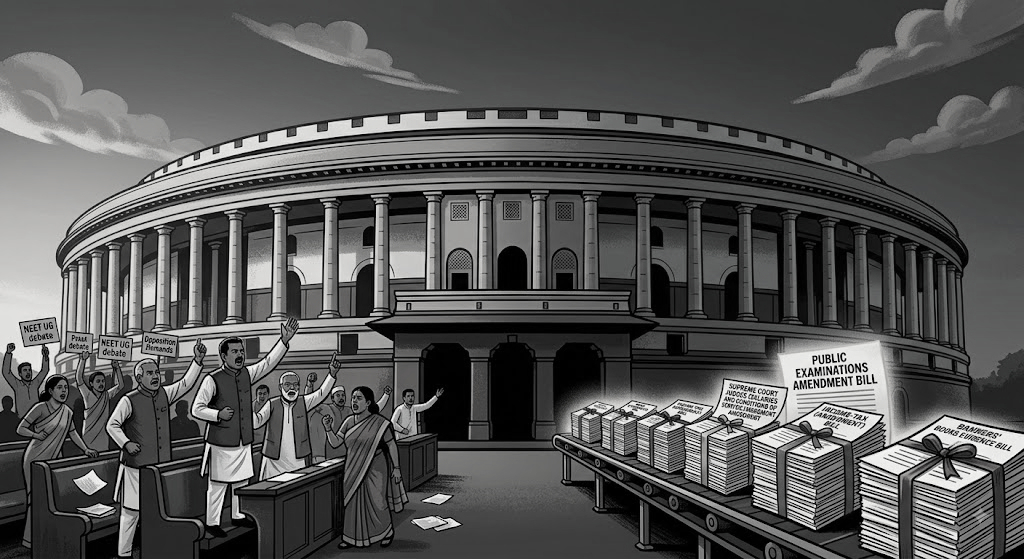
The political deadlock largely centred on the July 20 police action against students protesting at Jantar Mantar over the NEET-UG paper-leak issue, including allegations of pellet-gun use. INDIA bloc and NDA MPs staged competing protests on the final day, with the Opposition demanding answers and the government accusing it of avoiding debate. Amit Shah had offered to participate in a discussion on the issue.
Rijiju accused the Congress and its allies of "running away from discussions", while Opposition leaders said the government had failed to address their concerns. TMC MP Saugata Roy said ensuring the House functions was the government's responsibility, while Congress MP Gurjeet Singh Aujla defended the Opposition's role in raising issues.
Several major proposals remained pending. The Foreign Contribution (Regulation) Amendment Bill, 2026 was sent to a Joint Parliamentary Committee, while the Viksit Bharat Shiksha Adhishthan Bill, 2025, which seeks to replace the UGC, AICTE and NCTE with a single regulator, awaits its JPC report.
PRS also noted that only 21 per cent of Bills introduced during the 18th Lok Sabha have been referred to parliamentary committees, highlighting a longer-term decline in legislative scrutiny.