
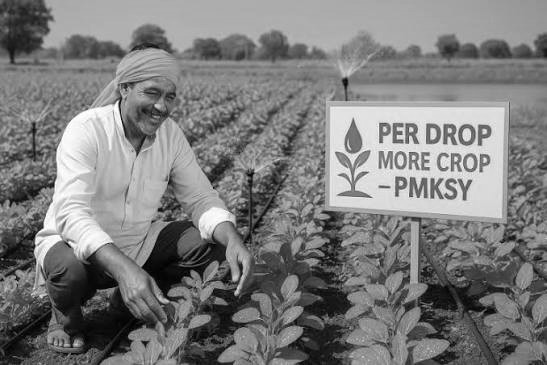
Per Drop More Crop: How Micro-Irrigation Is Saving Water and Raising Farm Returns
I ndia’s push to make agriculture more water-efficient is gaining scale through Per Drop More Crop (PDMC), which promotes drip and sprinkler irrigation to deliver water closer to crops and reduce losses. Since inception, the scheme has brought 115 lakh hectares under micro-irrigation as of July 2026, equal to about 8.11% of India’s net sown area. Maharashtra, Karnataka, Andhra Pradesh, Tamil Nadu, Gujarat and Rajasthan have recorded the highest coverage.
The scheme provides financial assistance of 55% for small and marginal farmers and 45% for other farmers, covering up to five hectares per beneficiary. Some states add their own top-up subsidies. Farmers can receive assistance again for the same land after seven years. The government has also used direct benefit transfer and digital implementation to improve transparency and access.
The measurable benefits extend beyond water conservation. A NITI Aayog evaluation found water-use efficiency improvements of 30%–70% and income gains ranging from 10% to 69%. The Economic Survey 2020-21 reported 20%–48% water savings, 10%–17% energy savings, 30%–40% lower labour costs and 11%–19% fertilizer savings. Crop yields were reported to rise by 20%–38%. Independent assessments therefore point to simultaneous gains in resource efficiency, productivity and farm returns.
PDMC has also evolved to address local water-security needs. Under revised guidelines, states and Union Territories can fund diggings, farm ponds and water-harvesting systems under the “Other Interventions” component, supporting both individual and community projects. Earlier, such spending was capped at 20% of allocations for general states and 40% for North-Eastern and Himalayan states, Jammu and Kashmir, and Ladakh. These limits can now be exceeded according to local requirements.
To widen access, subsidy calculations also factor in 25% higher unit costs for North-Eastern and Himalayan states and 15% higher costs for states with low micro-irrigation penetration. Since 2022-23, PDMC has operated under PM-RKVY, giving states greater flexibility. It is especially relevant as groundwater stress intensifies nationwide. The result is a broader water-smart farming strategy: subsidising efficient irrigation while strengthening local storage, conservation, productivity and farmer incomes