
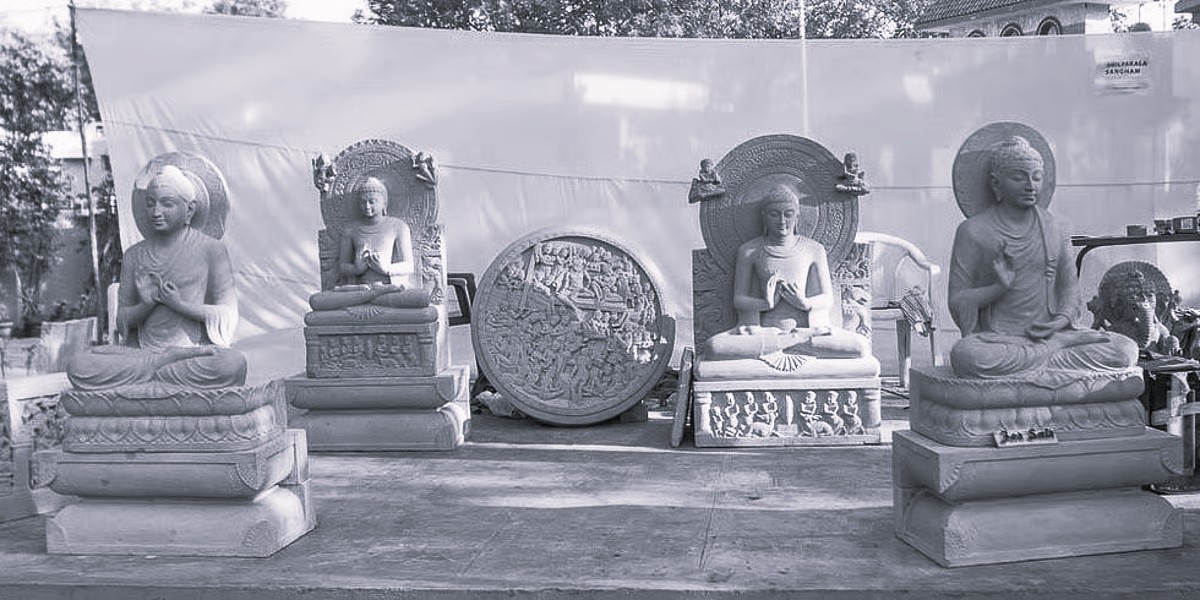
Phanigiri: A Peerless Buddhist Heritage Site
Aiming to attract global tourists, Telangana Tourism has recently shifted its focus toward Phanigiri as a major tourist destination. The state government recently included Phanigiri in the Buddhist Circuit as part of its "Vision 2047" strategic plan.
Located in the Nagaram Mandal of Suryapet district, the Phanigiri Buddhist Monastery is set to write a new chapter in the history, culture, and tourism sectors of the state. The site is situated atop a hill famously known as the "Snake Hood Hill," a name derived from the hill's unique shape. Phanigiri boasts a glorious history dating back 2,000 years. This ancient grandeur is visible through the Buddhist relics, Chaityagrihas (prayer halls), and Stupas found here. Additionally, the Sri Ramachandra Swamy temple on the site is a must-visit. The structures here were built with remarkable strength and high architectural standards.
Global Recognition:
In the "Tourism Vision 2047" plan, the Telangana government has given Phanigiri a pivotal role. It is being developed into an international tourist hub alongside other famous sites like Kondapur, Dhulikatta, Nelakondapalli, and Gajulabanda.
Phanigiri Sculptures in International Exhibitions:
The artistic brilliance of Phanigiri has crossed international borders. Two exquisite sculptures were selected for an international exhibition at the Chhatrapati Shivaji Museum in Mumbai. Due to their immense value—estimated at ₹2 crores —the government paid a heavy insurance premium of ₹8.50 lakhs for their safety.
New York Exhibition:
Previously, three artifacts from Phanigiri were selected for a Buddhist art exhibition in New York: a Jataka tale panel, a Torana Jataka wheel on an elephant mount, and a welcome Jataka wheel on a lion mount. Representatives from 18 countries witnessed the splendor of Phanigiri during these global showcases.
The Rare Six-Foot Buddha Statue
Excavations on the Phanigiri hill unearthed an extremely rare, six-foot-tall statue dating back to the 3rd century (Ikshvaku period). This statue represents Siddhartha in the 'Bodhisattva' stage, the phase before he attained enlightenment to become the Buddha.
Unlike the typical serene and simply-clad Buddha statues, this limestone sculpture features elaborate royal attire, reflecting Siddhartha’s status as a prince. It includes:
An intricate turban, heavy ear ornaments ( Kundalas ), necklaces and bracelets carved with extreme precision, Fabric folds and body proportions that blend the Gandhara and Amaravati schools of art.
Historical Significance: The First Krishna Inscription
Phanigiri made headlines in the archaeological world with the discovery of an inscription from the 18th regnal year of the Ikshvaku King Ehuvala Chamtamula . Previously, records only suggested an 11-year reign for this king.
More importantly, this inscription contains a reference to Lord Krishna , making it one of the earliest epigraphical mentions of Krishna in South India. This suggests that Phanigiri was a melting pot of cultures where Buddhism and the Bhagavata (Vaishnava) faith coexisted.
Archaeological Find:
A gold coin from the era of the 10th Roman Emperor, Septimius Severus , weighing 7.3 grams, was also discovered here. This proves that Phanigiri was once part of an international trade route.
A Center for Meditation
Historically, Phanigiri lay on a national highway connecting North and South India. The hill served as a major meditation center for Buddhist monks. The serene environment was ideal for spiritual practice. Monks followed a rigorous discipline, descending the hill daily to bathe in the 'Beere Vaagu' stream before returning to the monastery for meditation and chanting.
Sri Sita Ramachandra Swamy Temple
Phanigiri is also home to the Sri Sita Ramachandra Swamy Temple, often referred to as the "Second Bhadradri" of Telangana. Dating back to the Kakatiya period, this temple was once a thriving center for festivals and rituals. The complex features massive stone pillars, a Kalyana Mandapam (marriage hall), a Koneru (sacred tank), and shrines for Lord Anjaneya and Lord Shiva, all surrounded by lush greenery.
How to Reach Phanigiri
By Road110–120 km from Hyderabad via the Warangal Highway (NH 163). 45 km from Suryapet via Nagaram.By RailJangaon is the nearest major station (35–40 km). Taxis and buses are available from there.By AirRajiv Gandhi International Airport (Hyderabad) is the closest, roughly a 3-hour drive.
Traveler’s Tip:
There are stairs to climb the hill. Since facilities on the hilltop are limited, it is advisable to carry sufficient drinking water and snacks.