
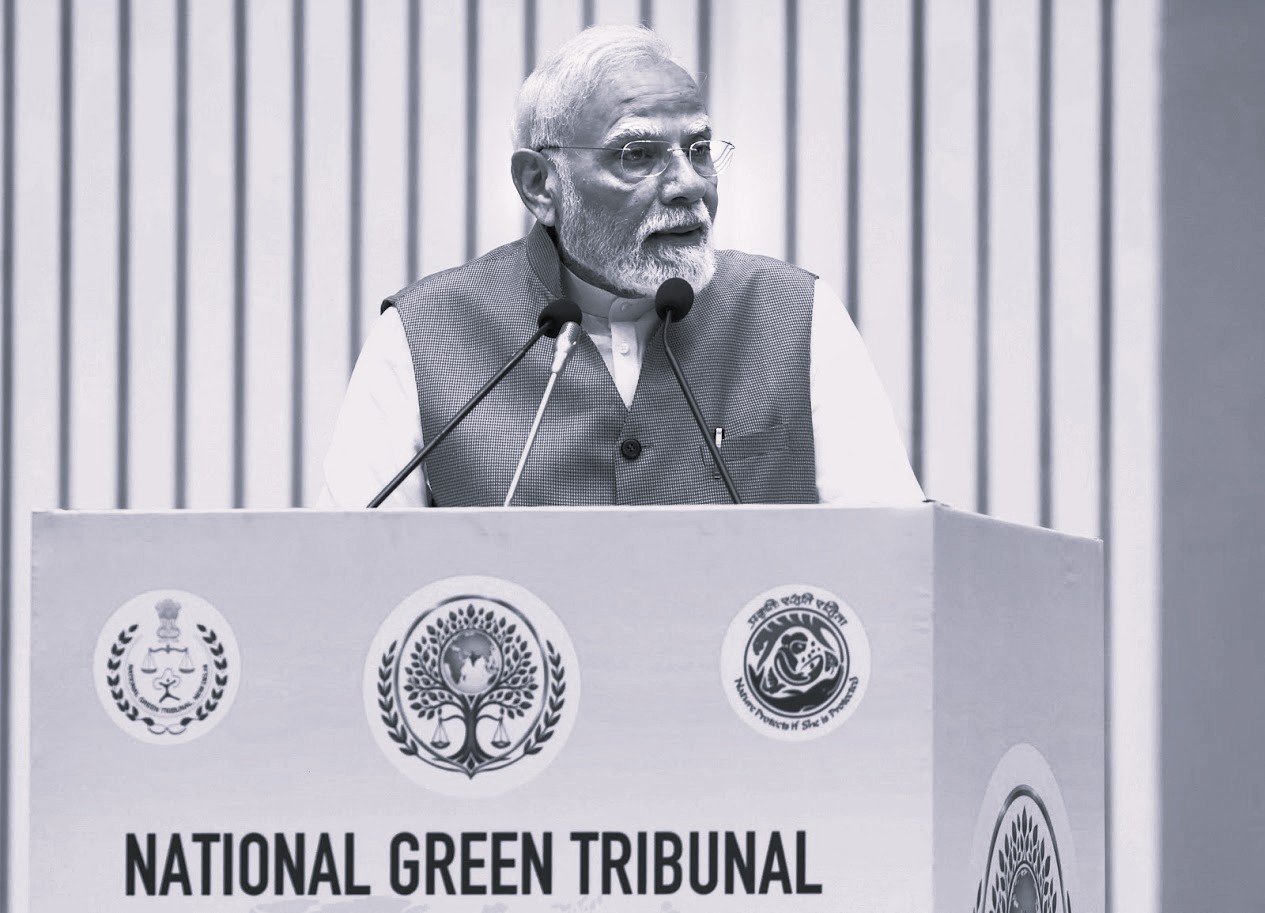
PM Modi Flags Climate Inequality, Says Developed Nations Emit 6 Times More Per Capita
Prime Minister Narendra Modi on Saturday highlighted the deep inequality in global carbon emissions, saying developed nations emit six times more carbon per capita than India even as developing countries are often held responsible for climate change. Addressing the International Conference on “The Future of Environment and Climate Dynamics” at Vigyan Bhawan, Modi said India’s per-capita carbon emissions remain less than half the global average and argued that climate responsibility must be viewed through historical emissions, population and differing levels of development.
Modi said India has made significant progress across environmental sectors over the past 12 years, with renewable energy emerging as a major focus. He said India is the only G20 country to have fulfilled its Paris Agreement commitments ahead of schedule, while emphasising that the country’s development is both “speedy” and “sustainable”.
India’s latest climate roadmap sets a 47 per cent reduction in emissions intensity of GDP by 2035, compared with 2005, alongside a target for 60 per cent of installed electricity capacity from non-fossil sources and a 3.5-4 billion-tonne carbon sink through forests and tree cover. India has already reduced emissions intensity by 37.38 per cent between 2005 and 2022, while the non-fossil share of installed capacity crossed 50 per cent in June 2025 and reached 54.18 per cent by June 2026.
Solar power has been central to the transition. Modi said capacity rose from 2 GW to more than 160 GW over 12 years, while the latest government data puts it at 168.04 GW by August 2026. Total renewable capacity stood at 295.55 GW, with non-fossil capacity, including nuclear, reaching 304.33 GW. Under the PM Surya Ghar Muft Bijli Yojana, more than 50 lakh households have installed rooftop solar systems, with assistance of up to ₹80,000 per household.
Modi also highlighted a threefold rise in wind capacity, hydropower expansion and efforts to increase nuclear generation, including greater private participation. India’s nuclear capacity stood at about 8.78 GW. He also cited the rise in EV sales from around 3,000 before 2014 to nearly 25 lakh last year, the expansion of metro networks beyond 1,000 km across more than 20 cities and near-total railway electrification.
On conservation, Modi cited more than 70,000 Amrit Sarovars, nearly 1.5 crore rainwater-harvesting structures, natural-farming clusters across 12.5 lakh hectares and around 3,000 climate-resilient crop varieties. He said very dense forest cover has increased by more than 22 per cent in 12 years.
However, coal remains central to India’s electricity system, accounting for around 71 per cent of generation in 2025. With electricity demand projected to grow strongly, India’s climate challenge will involve expanding renewables while strengthening grids, storage, nuclear power and other low-carbon technologies.
Modi also highlighted initiatives including the International Solar Alliance, Global Biofuel Alliance and Coalition for Disaster Resilient Infrastructure, arguing that India’s climate action should contribute to a sustainable future while ensuring development needs and greater recognition of climate equity.