
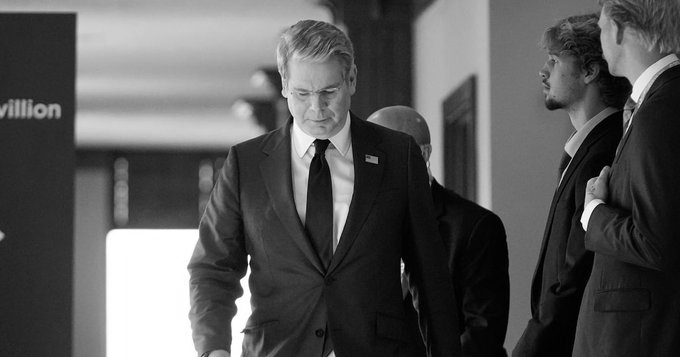
Protect Your Citizens’ Jobs: Bessent Urges G20 To Follow Trump’s Tariff Playbook
US Treasury Secretary Scott Bessent has urged G20 countries to consider tariffs and other trade measures to protect domestic industries and jobs from a surge of cheap imports, particularly from China.
Speaking after the two day G20 Finance Ministers and Central Bank Governors meeting in Asheville, North Carolina, Bessent said he had warned other countries at the beginning of President Donald Trump’s second term that the US tariff wall would divert Chinese goods into their markets. He argued that those concerns had now materialised.
Bessent said other nations should examine ways to protect manufacturing bases and domestic jobs, warning that unchecked imports could encourage production to move offshore. He described large trade imbalances created by non market economies as a problem that was draining growth from other parts of the global economy.
The latest G20 discussions gave Bessent some support. Nineteen of the 20 G20 members agreed that persistent cheap exports from non-market economies are unsustainable and should be addressed, while China was the lone dissenter. The US chair’s statement called for countries with large trade surpluses to reduce domestic distortions and excessive dependence on exports.
China’s position highlights the growing dispute over its export driven economic model. Beijing has faced criticism over industrial overcapacity and expanding exports of products including electric vehicles and semiconductors, while weak domestic demand has increased its reliance on overseas markets.
Bessent also met Chinese officials during the summit but did not disclose details of those discussions. He has stressed that Washington does not want to completely separate from China but instead wants to “de risk” the economic relationship.
He also pointed to areas where Washington and Beijing share interests, saying both countries oppose Iran obtaining a nuclear weapon and support freedom of navigation in the Strait of Hormuz.
Bessent has repeatedly criticised China’s record trade surplus, which reached a record $1.2 trillion in 2025, arguing that it represents a barrier to balanced global growth.
At the same time, Washington’s own tariff strategy remains controversial. Critics say US tariffs have increased costs for consumers and strained relations with trading partners. The Tax Foundation estimated that tariffs imposed during 2025 raised retail prices of imported consumer goods by roughly 7% compared with pre tariff trends.
The US Supreme Court also ruled in February that Trump’s sweeping global tariffs imposed under an emergency powers law were unconstitutional. The administration has since been reshaping its tariff strategy and is considering an additional 7.5% tariff on Chinese imports following investigations into alleged Chinese industrial overcapacity and forced labour practices.
The G20 meeting also took place against a backdrop of mounting debt concerns. Global debt has reached an estimated $353 trillion, while US government debt touched $40 trillion in August. Despite concerns about a potential sell off in US Treasury bonds, Bessent said he did not believe the bond market was facing a dire situation.