
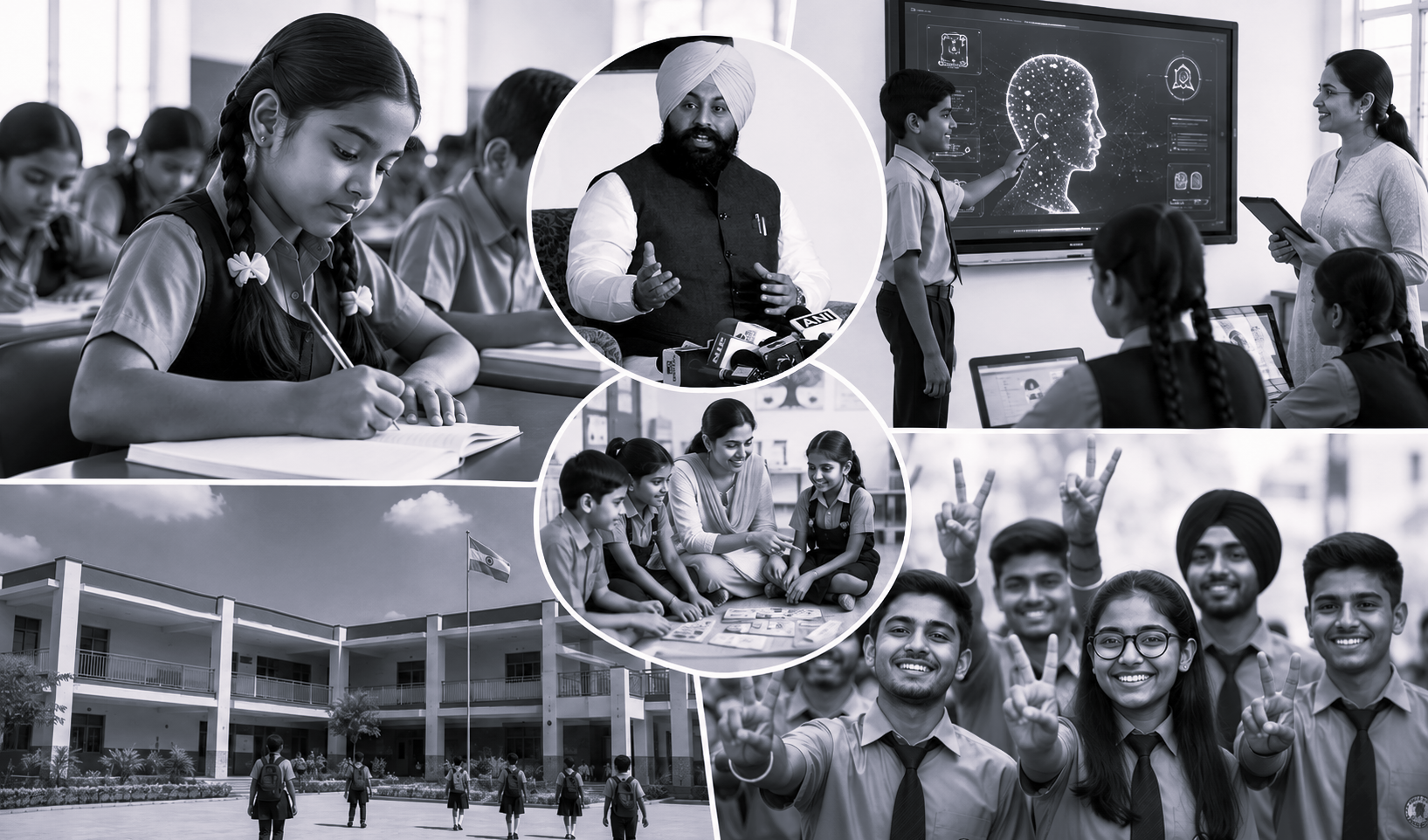
Punjab Overtakes Kerala to Top NITI School Index with AI, Learning Reforms
Punjab has emerged as the top-performing state in the NITI Aayog School Education Quality Index (SEQI) 2026, overtaking long-time leader Kerala after a sweeping overhaul of its public education system that combined infrastructure upgrades, competency-based teaching, technology integration and future-ready learning. The achievement marks a major milestone for the state, which just four years ago was grappling with poor school infrastructure, learning gaps and delayed academic resources.
Speaking in the Punjab Assembly during a discussion on an education-related resolution moved by MLA Jaswant Singh Gajjanmajra, Education Minister Harjot Singh Bains said the transformation reflects reforms introduced after the AAP government assumed office in 2022. He recalled that an initial survey had revealed over 8,000 government schools without boundary walls, nearly 3,200 schools lacking functional toilets, and around four lakh children sitting on the floor. Textbooks, he said, often reached schools only in October or November, disrupting the academic calendar.
According to Bains, the government has since addressed these shortcomings by ensuring textbooks reach district headquarters by February 15 and are distributed to schools by March 31. He also visited more than 2,000 government schools, including those in border villages and remote areas, to monitor implementation of reforms.
At the heart of Punjab's education model is Mission Samarth, one of India's largest foundational learning programmes. Instead of teaching students solely according to their grade, the initiative assesses their actual learning levels and groups them accordingly. The competency-based approach, similar to the globally recognised Teaching at the Right Level (TaRL) model, focuses on strengthening reading, writing and arithmetic before students progress further. The programme now covers nearly 12 lakh students and engages over 70,000 teachers annually. Bains said many Class 8 students who initially struggled with basic literacy and numeracy were taught from Class 3 learning levels, helping them gradually bridge learning gaps.
Punjab has also become the first state in India to introduce Artificial Intelligence as a core subject from Classes 1 to 12 under the Sarbat.AI initiative. The curriculum goes beyond theoretical instruction, exposing students to coding, AI ethics, machine learning, project-based learning, digital literacy and real-world problem-solving, while aligning with UNESCO's Ethical AI framework to prepare them for emerging technologies.
The reforms have also strengthened teacher training, digital classrooms and data-driven governance. Schools increasingly monitor attendance, textbook distribution and student performance through technology, enabling early interventions for struggling learners. The government has complemented these measures with the Punjab Academic Coaching for Excellence (PACE) programme, which provides structured coaching for competitive examinations.
The results are already visible. The number of NEET-UG qualifiers from government schools has risen sharply from 80 in 2021 to 882 in 2026, reflecting improved academic standards and access to quality coaching. Punjab's performance also aligns with the key parameters of the NITI Aayog SEQI, which evaluates states on learning outcomes, access, equity, governance, infrastructure and educational quality, placing strong emphasis on measurable student learning rather than enrolment alone.
Education experts say Punjab's experience demonstrates that lasting improvements require more than infrastructure spending. A combination of strong governance, foundational literacy, teacher capacity-building, technology adoption, timely academic planning and continuous assessment can significantly improve learning outcomes, offering a roadmap for other states seeking to strengthen public education.