
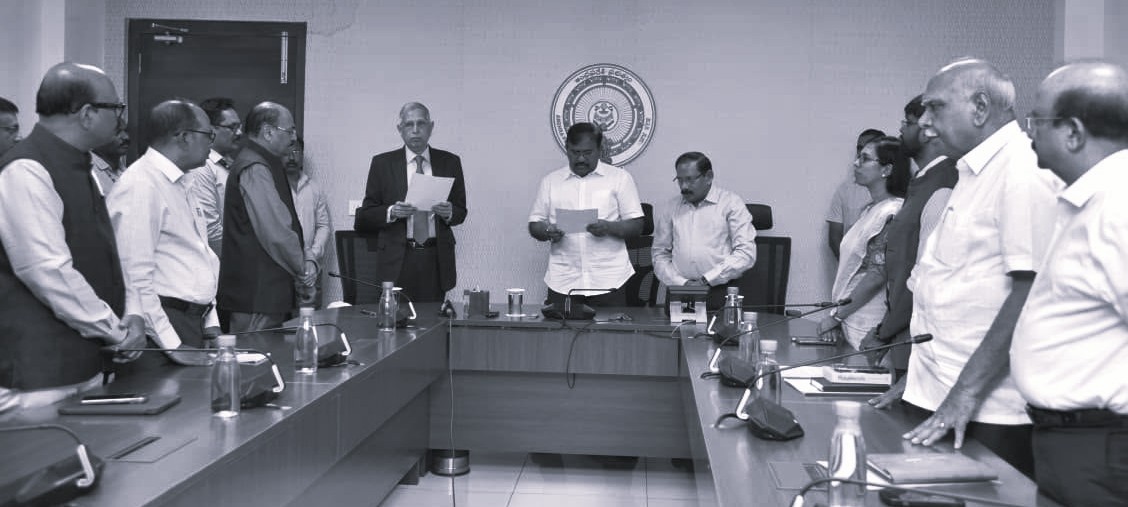
Retired IAS Officer Binoy Kumar Sworn In as AP Electricity Regulatory Commission Chairman
Retired IAS officer Binoy Kumar was sworn in as the new Chairman of the Andhra Pradesh Electricity Regulatory Commission (APERC) on Thursday, marking his formal entry into the state's electricity regulatory leadership. Chief Secretary G. Sai Prasad administered the oath of office at the Chief Secretary's Camp Office in Vijayawada in the presence of senior government officials and representatives of various power sector organisations.
The Andhra Pradesh government had appointed Binoy Kumar to the post through G.O. Ms. No. 87, issued on November 3. According to the appointment order, he will serve as APERC Chairman for a period of five years from the date of assuming office or until he attains the age of 70, whichever is earlier. His appointment is expected to strengthen the administrative leadership of the state's electricity regulatory body.
Following the swearing-in ceremony, Chief Secretary G. Sai Prasad congratulated the newly appointed chairman and presented him with a bouquet. K. Vijayanand, Special Chief Secretary to the Energy Department and Special Chief Secretary to the Chief Minister, was among the senior officials who extended their wishes to Binoy Kumar on taking up the new assignment.
Several senior representatives from Andhra Pradesh's power sector attended the ceremony, reflecting the significance of the appointment for the state's electricity administration. Those present included Nagalakshmi, Managing Director of APGENCO; P. Pulla Reddy, Chairman and Managing Director of APCPDCL; and Surya Sai Praveen Chand, Joint Managing Director of APTRANSCO.
PVR Reddy, a member of APERC, also attended the programme, along with Kamalakar Babu, Vice-Chairman and Managing Director of AP NREDCAP, and P. Krishna, Secretary of APERC. Other officials from the government and power sector were also present.
The APERC plays an important role in regulating the electricity sector in Andhra Pradesh. Its responsibilities include overseeing tariff-related matters and ensuring regulatory compliance among power utilities. The commission also serves as an important institutional mechanism for balancing the interests of electricity consumers, distribution companies and other stakeholders in the state's power sector.