
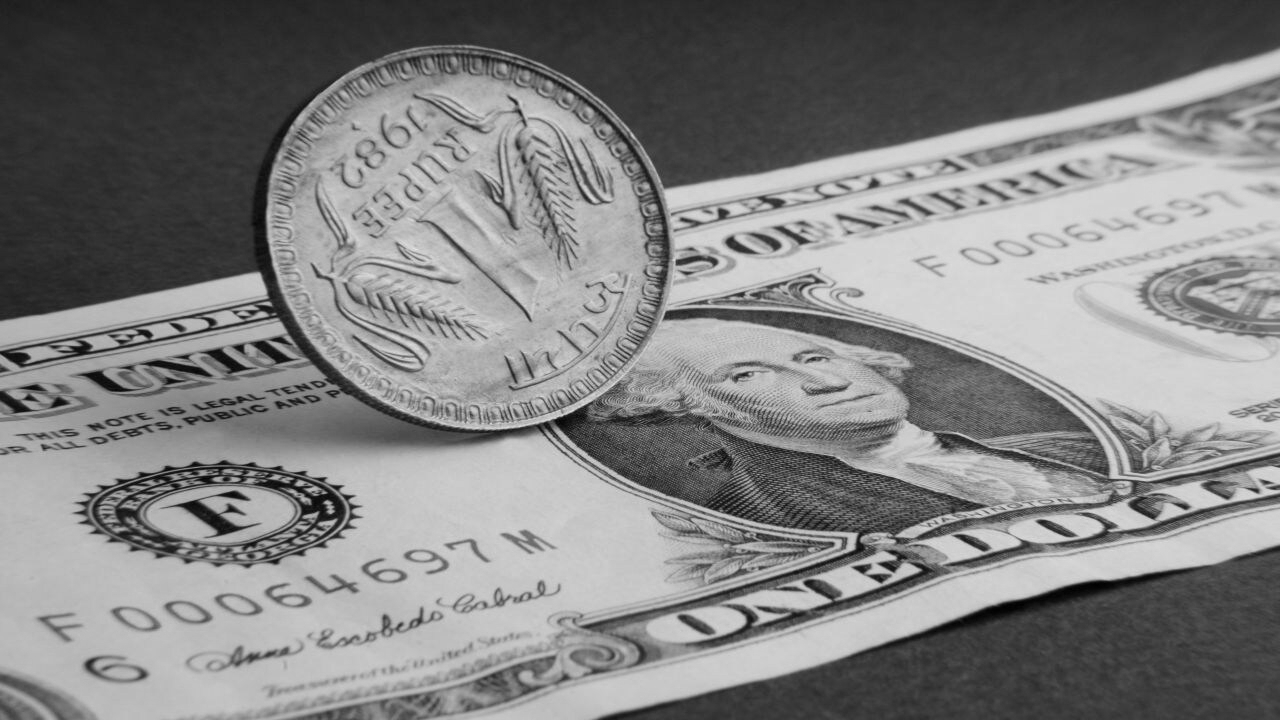
Rupee crashes 41 paise to settle at 91.49 against US dollar
The rupee declined sharply by 41 paise to settle at 91.49 against the US dollar on Monday amid rising global risk aversion after intensified US and Israeli military strikes on Iran triggered a surge in crude oil prices and strengthened demand for the greenback.
The domestic currency opened at 91.23 , touched an intraday low of 91.65 , and eventually closed at 91.49 , registering a steep fall from its previous close of 91.08 . Forex traders said the pressure on the rupee stemmed largely from escalating geopolitical tensions and heavy selling in equity markets.
According to analysts, the attack by US and Israeli forces on targets across Iran including ballistic missile sites and reported military assets fuelled uncertainty in global markets. The escalation led to a sharp rise in Brent crude prices, which jumped nearly 7.88 per cent to $78.61 per barrel in futures trade , raising concerns over India’s import bill.
Experts noted that India meets around 85 per cent of its fuel requirement through imports , making the economy vulnerable to spikes in international crude prices. Rising oil costs are expected to widen the import bill and current account deficit , further weighing on the currency.
Market participants also pointed to significant foreign institutional investor (FII) outflows , with overseas investors offloading equities worth ₹3,295.64 crore . Heavy selling pressure in domestic markets added to the weakness in the rupee.
On the equity front, the Sensex tumbled 1,048.34 points or 1.29 per cent to settle at 80,238.85 , while the Nifty fell 312.95 points or 1.24 per cent to close at 24,865.70 in early trade. The broad-based decline reflected cautious sentiment among investors amid global uncertainty.
Forex traders said the Reserve Bank of India (RBI) was reportedly active around the 91.46/47 levels , helping prevent further sharp depreciation and protecting the currency near the 91.50 mark against the dollar.
Meanwhile, the US dollar index strengthened by 0.82 per cent to 98.41 , reinforcing pressure on emerging market currencies. Analysts said the rupee witnessed its sharpest one-day drop since late January, driven by the combined impact of geopolitical tensions, rising oil prices, and capital outflows.
Market experts cautioned that the rupee is likely to trade with a negative bias in the near term as global risk-off sentiment persists and volatility in crude oil markets continues to influence currency movement.