
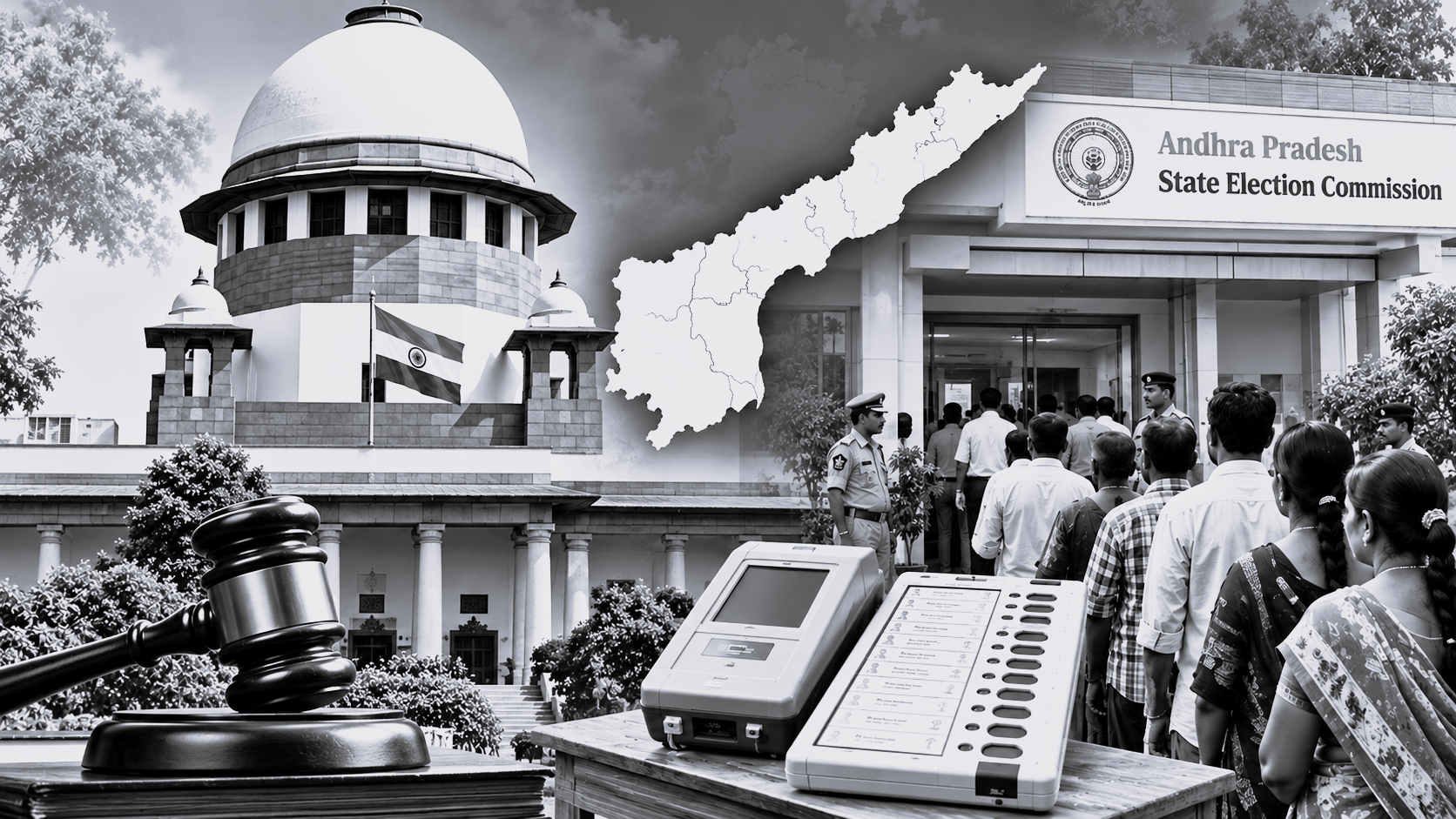
SC Calls AP State Election Commission to Account Over Nomination Row, Defers Final List to Oct 25
The Supreme Court has put the Andhra Pradesh State Election Commission (SEC) under scrutiny over its handling of the urban local body election nomination process, questioning the adequacy of safeguards amid allegations that ruling Telugu Desam Party (TDP) supporters used violence and intimidation to prevent opposition candidates from filing their papers. Reminding the commission of its constitutional duty to ensure free and fair elections, the court directed it to examine complaints of obstruction, decide on extending the nomination deadline by October 22 and defer publication of the final candidates' list until October 25.
A bench comprising Justice Joymalya Bagchi and Justice V. Mohana found that the opposition YSR Congress Party (YSRCP) had established a prima facie case warranting judicial intervention. During the hearing, Justice Mohana questioned whether issuing further police directions was sufficient when complaints of violations had already surfaced, asking, “Is that all?”
SEC's Handling of Complaints Under Scrutiny
The court's intervention followed serious allegations that opposition candidates faced physical attacks, threats and deliberate obstruction during nominations, raising questions about the effectiveness of the safeguards provided by the State Election Commission and police.
The YSRCP alleged that nearly 63% of its candidates were prevented from filing nominations, potentially allowing ruling-party candidates to secure uncontested victories in several wards.
The party accused TDP supporters of disrupting nominations in Punganur, Rayachoti, Kadapa and Tirupati on October 16. Nomination papers were allegedly snatched and torn in Kadapa, while candidates in Tirupati were reportedly assaulted or blocked from reaching nomination centres.
Nine Tirupati candidates submitted affidavits supporting the allegations. The YSRCP also placed representations and video footage before the court, alleging that its complaints had not received an adequate response.
The State Election Commission maintained that it had already issued police protection directions and taken steps to safeguard the process. The Andhra Pradesh government disputed the opposition's allegations, accusing YSRCP supporters themselves of instigating violence.
Supreme Court Questions Limits of Judicial Restraint
The YSRCP had approached the Andhra Pradesh High Court before nominations began, seeking preventive safeguards against anticipated violence. Its initial petition was dismissed on October 15, while a subsequent request to extend the nomination deadline was rejected on October 18 on the ground that such intervention would disrupt the electoral process.
The Supreme Court, however, stressed that judicial restraint cannot prevent constitutional courts from intervening when illegal practices threaten electoral fairness.
“Instilling confidence in the election process is vital for the maintenance of constitutional democracy,” the bench observed.
Referring to Article 243ZA, the court emphasised that the State Election Commission's constitutional responsibility includes ensuring that candidates can file nominations freely and without obstruction. It noted that courts cannot remain powerless when alleged coercion or muscle power threatens the integrity of elections.
Police Protection Ordered, Compliance Reports Sought
The Supreme Court directed the commission to examine complaints, affidavits and electronic evidence before deciding whether candidates prevented from filing nominations should receive another opportunity. Wherever an extension is granted, candidates must be allowed at least 48 hours to submit their papers.
The court also directed the Andhra Pradesh Director General of Police to ensure adequate protection for candidates, police deployment and CCTV surveillance at nomination centres.
The State Election Commission and state authorities must submit compliance reports, with the next hearing scheduled for October 27.
Following the court's directions, State Election Commissioner Anil Chandra Punetha ordered a halt to the election process across all 100 urban local bodies pending examination of complaints and evidence. District officials were instructed to review reported incidents and submit findings before a decision on reopening nominations.
The Supreme Court has left the decision on extending nominations with the State Election Commission, while placing its response to the alleged obstruction under judicial scrutiny.