
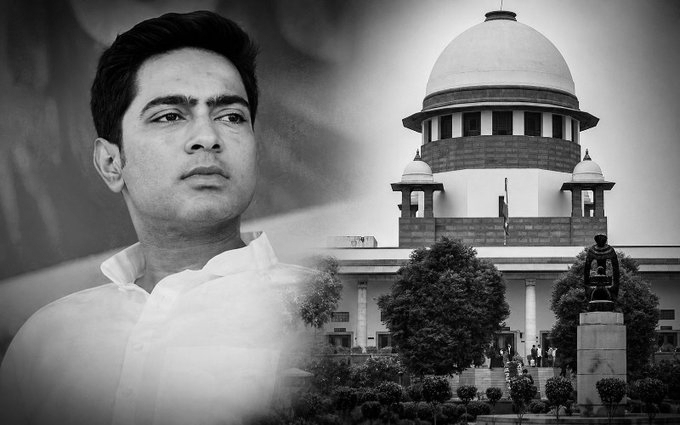
SC Clears Abhishek Banerjee’s 3-Week Trip Abroad for Eye Treatment After HC Setback
The Supreme Court on Monday allowed Trinamool Congress MP Abhishek Banerjee to travel abroad for three weeks for eye treatment, after the Calcutta High Court had earlier rejected his request, citing his failure to appear before a medical board.
A bench headed by Chief Justice of India Surya Kant, along with Justices Joymalya Bagchi and V Mohana, passed the order while hearing Banerjee’s challenge to the August 5 Calcutta High Court decision.
The High Court had asked Banerjee to appear before a medical board at the state-run SSKM Hospital to assess his condition and determine whether overseas treatment was genuinely required. However, the court noted that Banerjee was unwilling to appear before the board and rejected his plea.
Banerjee subsequently approached the Supreme Court, which had on August 3 directed the High Court to take up his plea within a week. The apex court has now permitted him to travel for three weeks, despite the earlier medical-board issue.
Banerjee has reportedly been receiving eye treatment in the United States for around a decade, with his counsel telling the High Court that he has been consulting the same doctor there. However, the exact eye condition and specific procedure involved in the current treatment have not been publicly disclosed.
The Supreme Court's permission comes against the backdrop of an ongoing investigation, requiring Banerjee to obtain judicial approval before travelling abroad. The court has imposed safeguards to ensure that his trip does not affect the probe.
He has been directed to provide details including his travel itinerary, foreign address, hospital or treatment facility and flight information to the concerned authorities. He is also required to travel on his diplomatic passport and has given an undertaking that he does not hold another operational passport.
During the hearing, the State questioned the genuineness of the medical documents and sought an independent medical assessment. The Supreme Court, however, allowed Banerjee to travel, observing that any concerns regarding the authenticity of medical documents could be addressed separately.
The court also emphasised that seeking treatment for a personal medical condition falls within the right to privacy, while ensuring that the ongoing investigation remains unaffected.