
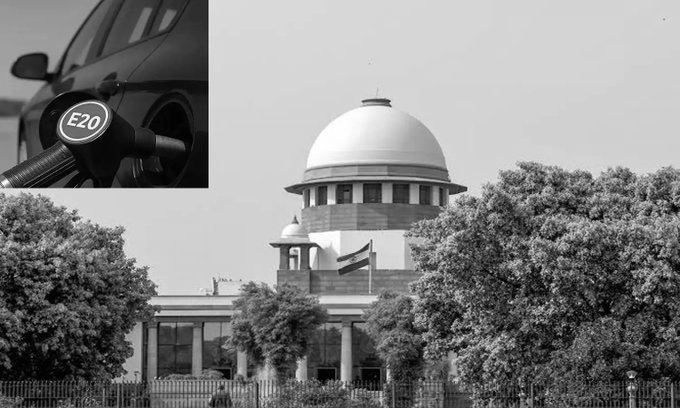
SC Hearing on Aug 31 Over Mandatory Disclosure of Ethanol Content in Petrol
The Supreme Court is set to hear on August 31 a petition seeking mandatory disclosure of ethanol content in petrol at all fuel stations, amid concerns over vehicle compatibility, fuel efficiency and the wider impact of the E20 blending programme.
According to the apex court’s causelist, a bench comprising Justices M M Sundresh and Prasanna B Varale will hear the plea filed by Narendra Kumar Goswami.
The petition seeks directions to the Centre and other authorities to ensure that every petrol dispensing nozzle clearly and uniformly displays the exact percentage of ethanol in the fuel being sold. It has also sought a mandate for fuel invoices to prominently mention the ethanol content.
The plea further calls for an official, publicly accessible vehicle-wise compatibility database, searchable by manufacturer, model, engine type and year of manufacture. The database would indicate whether different ethanol blends are suitable for specific vehicles.
The petitioner has also sought the formation of an independent expert committee comprising representatives from the Petroleum and Natural Gas Ministry, Road Transport and Highways Ministry, Bureau of Indian Standards and independent automobile engineers.
The committee has been asked to examine the real-world compatibility of E20 fuel across India’s existing vehicle fleet and assess its potential impact on fuel efficiency, engine life, maintenance costs, warranties and insurance.
The petition also seeks an assessment of E20’s environmental footprint, including tailpipe emissions and water consumption linked to ethanol production, as well as concerns over food security and diversion of crops for fuel production.
It further seeks a national consumer disclosure protocol for ethanol-blended petrol and asks authorities to place relevant policy documents, technical studies and compatibility reports before the court.
The plea has also called for a transparent transition framework for older or incompatible vehicles, including consideration of lower-ethanol petrol availability wherever feasible.