
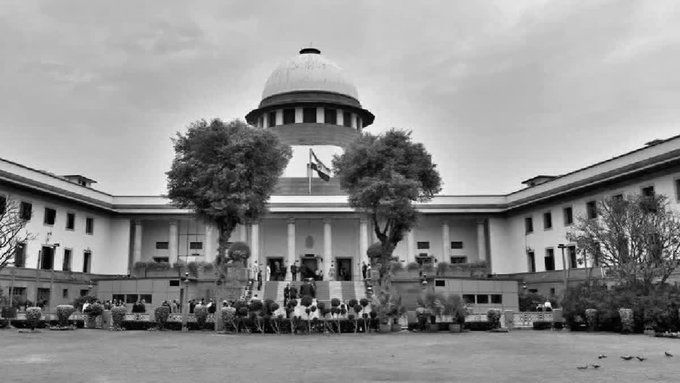
SC Upholds Gram Panchayat Rights Over 436 Bighas of Gurugram Common Land
The Supreme Court has restored the ownership of more than 436 bighas of land in Gurugram to the Gram Panchayat, Wazirabad, overturning a 2007 Punjab and Haryana High Court judgment that had recognised private ownership claims. The ruling is being seen as a landmark decision reinforcing the legal status of village common lands (shamilat deh) while strengthening the role of local self-governance.
A Bench comprising Justices Sanjay Kumar and K. Vinod Chandran held that the disputed land qualified as "shamilat deh" under the Haryana Common Lands (Regulation) Act, 1961, and therefore vested in the Gram Panchayat. The Court observed that the High Court had erred in treating the land as privately owned merely because revenue records contained the names of village pattis (proprietary groups).
Setting aside the High Court's August 24, 2007 judgment, the apex court upheld the September 13, 1955 mutation in favour of the Gram Panchayat, Wazirabad, with the title now enuring to its successor, the Municipal Corporation Gurugram. The dispute centred on 436 bighas and 18 biswas of land in the uninhabited village of Haiderpur, adjoining Wazirabad in present-day Gurugram. Individuals claiming rights through village proprietors had challenged the 1955 mutation, arguing that the land belonged to private pattis and never vested in the panchayat.
Rejecting these claims, the Supreme Court held that no partition of the land had taken place before January 26, 1950, meaning it retained its character as village common land and legally vested in the Gram Panchayat under the 1961 Act. The Bench further ruled that entries such as "hasab rasad" or the recording of proprietors' names in revenue records did not alter the essential character of land already classified as shamilat deh.
Describing land as the " new gold," particularly in rapidly urbanising regions such as Gurugram, the Court underlined the importance of protecting village commons from private encroachment. The judgment also traced the historical evolution of common lands in Punjab and Haryana, emphasising that post-Independence legislation was intended to preserve such lands for the collective benefit of village communities. The ruling is expected to have significant implications for land disputes involving village commons, while reaffirming the authority of gram panchayats and reinforcing the constitutional objective of strengthening local self-governance through the protection of community assets.