
SEMICON India 2026 Ends With 15 New Pacts, Indigenous Chips And Big Semiconductor Skills Push
SEMICON India 2026 concluded at Yashobhoomi with 15 new announcements and collaborations, putting the spotlight on indigenous chip technology, sovereign computing, semiconductor manufacturing and the skills needed to build a larger domestic electronics ecosystem.
The concluding session brought together government institutions, industry, academia, startups and skilling organisations, with initiatives covering everything from home-grown processors and fab automation to artificial intelligence, quantum technologies and semiconductor workforce development.
A major highlight was the Digital India RISC-V Grand Challenge, organised under the Chips to Startup programme. It drew 1,236 teams and 5,045 participants from across India, with three teams sharing Rs 60 lakh in prize money. The winning team from SASTRA University developed an autonomous water-surface cleaning robot using the indigenous SHAKTI processor developed by IIT Madras. The second-placed team created a digital stethoscope using the indigenous VEGA processor, while the third developed a forest-environment monitoring system, also using VEGA.
The government also launched the Bharat AI-SoC Challenge 2026-27, aimed at students and working professionals in artificial intelligence and system-on-chip design. Meanwhile, the Semi-Conductor Laboratory in Mohali unveiled an indigenous Device Manufacturing Integrated System to manage wafer-fabrication operations from order booking through packaging.
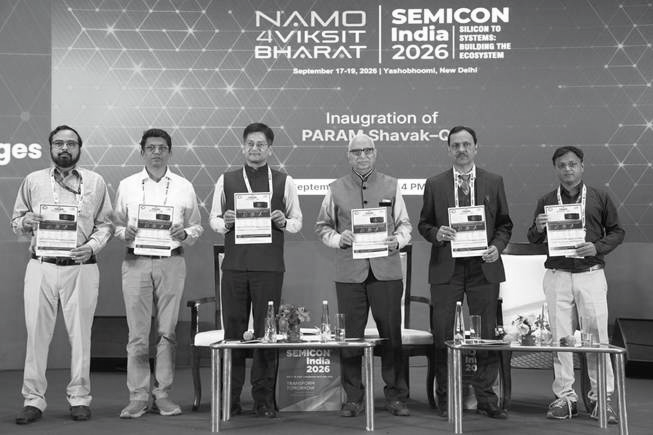
The push extended beyond chips. C-DAC announced partnerships with NLC India and Bharat Electronics for indigenous data-centre, high-performance computing and AI solutions. It also launched PARAM Vidya, an AI lab-in-a-box for universities, research institutions, startups and MSMEs, alongside PARAM Shavak-QS, a compact quantum simulation platform.
A significant part of the closing session focused on manpower. Partnerships involving the Electronics Sector Skills Council of India, Maitrio Labs, Truechip Solutions, SEMI, Peachtree Elevate and NIELIT will target semiconductor manufacturing, circuit design, verification, testing and ATMP training. NIELIT also announced a Digital Twin for Semiconductor Manufacturing.
The startup ecosystem was another focus, with 3,808 teams from 881 colleges registering for the SEMICON India Hackathon. Under Startup Mitra, 11 startups pitched to more than 20 venture capital investors.
The event also saw the launch of an EY-ISEA report projecting India's semiconductor market could grow from nearly $64 billion in 2026 to $200 billion by 2035, while outlining a roadmap from capacity creation towards wider ecosystem development.
The concluding announcements took the total number of announcements and MoUs at SEMICON India 2026 to 56, according to the PIB release, reflecting an effort to connect chip design, manufacturing, research, infrastructure, startups and specialised talent into a broader semiconductor ecosystem.