
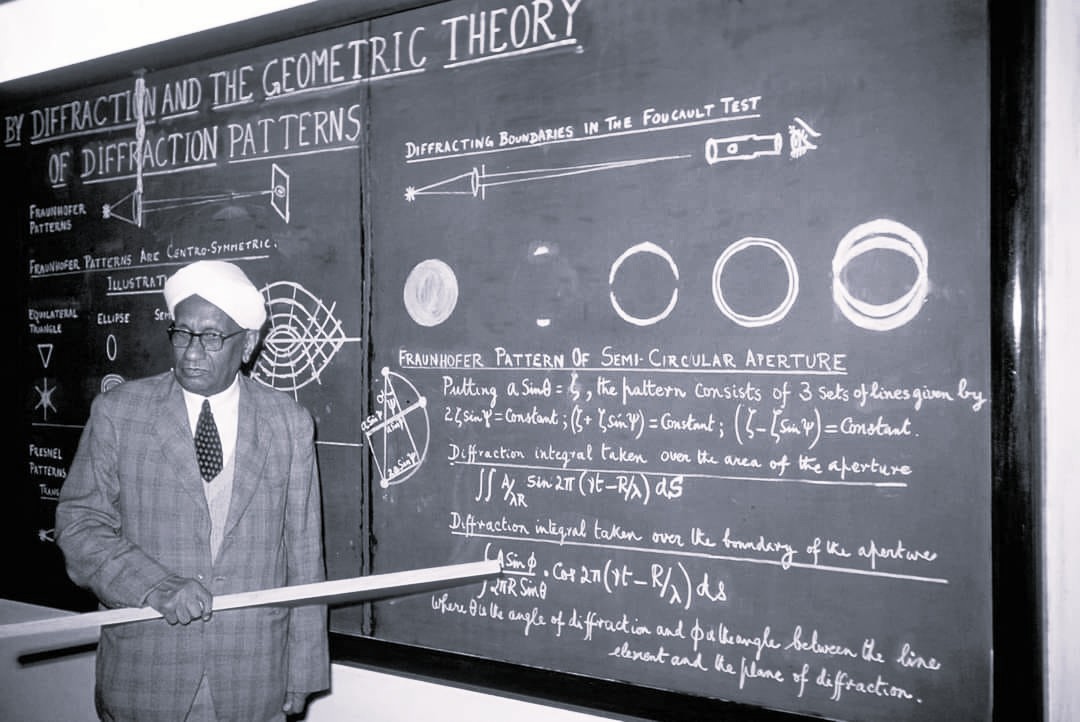
Sir C. V. Raman: The Light That Lit India’s Scientific Renaissance
A review of India’s scientific history places Sir C. V. Raman at the forefront of those who carried Indian intellect to the global stage through determination, originality, and perseverance. During the colonial era, despite limited facilities and inadequate laboratories, his pioneering research demonstrated to the world the capabilities of Indian scientists.
Raman shattered the notion that pathbreaking physics research could emerge only from foreign laboratories. By deeply investigating the nature of light and uncovering its hidden properties, he not only proposed a scientific breakthrough but also secured India’s place on the global scientific map.
Early Life, Family Background, and Education
Born on November 7, 1888, in Tiruchirappalli, Tamil Nadu, Raman hailed from a traditional Brahmin family. His father, Chandrasekhara Iyer, was a schoolteacher and later a professor of physics at A.V. Narasimha Rao College in Visakhapatnam. His mother, Parvathi Ammal, was deeply interested in music and played the veena with great skill. This intellectually and culturally rich environment nurtured Raman’s interests in both science and the arts. The second of eight siblings, he distinguished himself early as a disciplined and brilliant student.
After completing his schooling in Visakhapatnam, he earned a gold medal in physics at a young age. At just 18, he published a research paper on the properties of light in an international journal, a testament to his exceptional talent. Though health reasons prevented him from travelling to England for higher studies, he later remarked that this proved beneficial to his life and career.
He married Ammal after completing his education. Despite family responsibilities, he received unwavering support from his wife and parents, enabling him to pursue research with dedication.
A Life Dedicated to Science
Although Raman secured a position in the Finance Department equivalent to the Indian Civil Service his passion for physics never diminished. By day he worked in a government office; by evening he conducted experiments at the Indian Association for the Cultivation of Science in Calcutta. With limited resources, he carried out pioneering studies on light, sound, and musical instruments. For Raman, government service was a livelihood; physics was life itself.
The Discovery of the Raman Effect
Why does the sea appear blue? Why does the sky change colour? What happens when light interacts with matter? These questions formed the basis of his research. On February 28, 1928, Raman announced his groundbreaking discovery that when light passes through a transparent substance, its wavelength undergoes a change. This phenomenon, later known as the “Raman Effect,” introduced a new dimension to the theory of light scattering. He demonstrated that light interacting with molecules exchanges energy, resulting in a measurable shift. The scientific community worldwide was astonished.
Nobel Prize: A Milestone for Asia
For this discovery, Raman was awarded the Nobel Prize in Physics in 1930 not merely a personal honour but recognition for the entire Asian continent. At a time when India was under colonial rule, this achievement instilled immense national confidence. His address at the Nobel ceremony in Stockholm reflected the depth and dignity of Indian scientific thought. From that moment, Raman’s name became permanently inscribed in the annals of physics.
Raman Research Institute: Realising a Vision
Recognising the need for an independent research platform, Raman established the Raman Research Institute in Bengaluru. More than an institution, it symbolised India’s scientific self-reliance. Research there has spanned crystal optics, coloured materials, acoustics, and astrophysics.
Today, the institute remains one of India’s premier centres for fundamental research. Located on a sprawling green campus in Bengaluru and functioning under the Department of Science and Technology, it enjoys full academic autonomy. Research areas include condensed matter physics, optics and photonics, quantum communication, astronomy, astrophysics, and biophysics. The institute focuses on doctoral and postdoctoral research rather than conventional classroom teaching and maintains global collaborations through joint projects and scientist exchanges.
Teacher, Visionary, and Bharat Ratna
Raman was not only a distinguished scientist but also an inspiring teacher. He believed science was not confined to textbooks but began with questioning nature itself.
In addition to the Nobel Prize, he received numerous honours, including the Bharat Ratna in 1954. While universities conferred honorary doctorates upon him, he regarded the satisfaction of discovery as his greatest reward.
National Science Day
February 28, marking the discovery of the Raman Effect, is celebrated annually in India as National Science Day. Schools across the country observe it with assemblies, speeches, exhibitions, quizzes, debates, and model demonstrations. The day aims to cultivate scientific temper, curiosity, and innovation among students, often guided by an annual theme announced by the government. Scientists and professionals are invited to inspire young minds and discuss career opportunities in science.
Enduring Legacy
Though Raman passed away on November 21, 1970, his legacy continues to illuminate modern science. Raman spectroscopy remains an indispensable tool in chemistry, biology, medicine, and materials science.
Sir C. V. Raman’s life symbolises self-confidence, intellectual independence, and devotion to knowledge. His story carries a timeless message: question, observe, and explore for every great discovery begins with a simple question.