
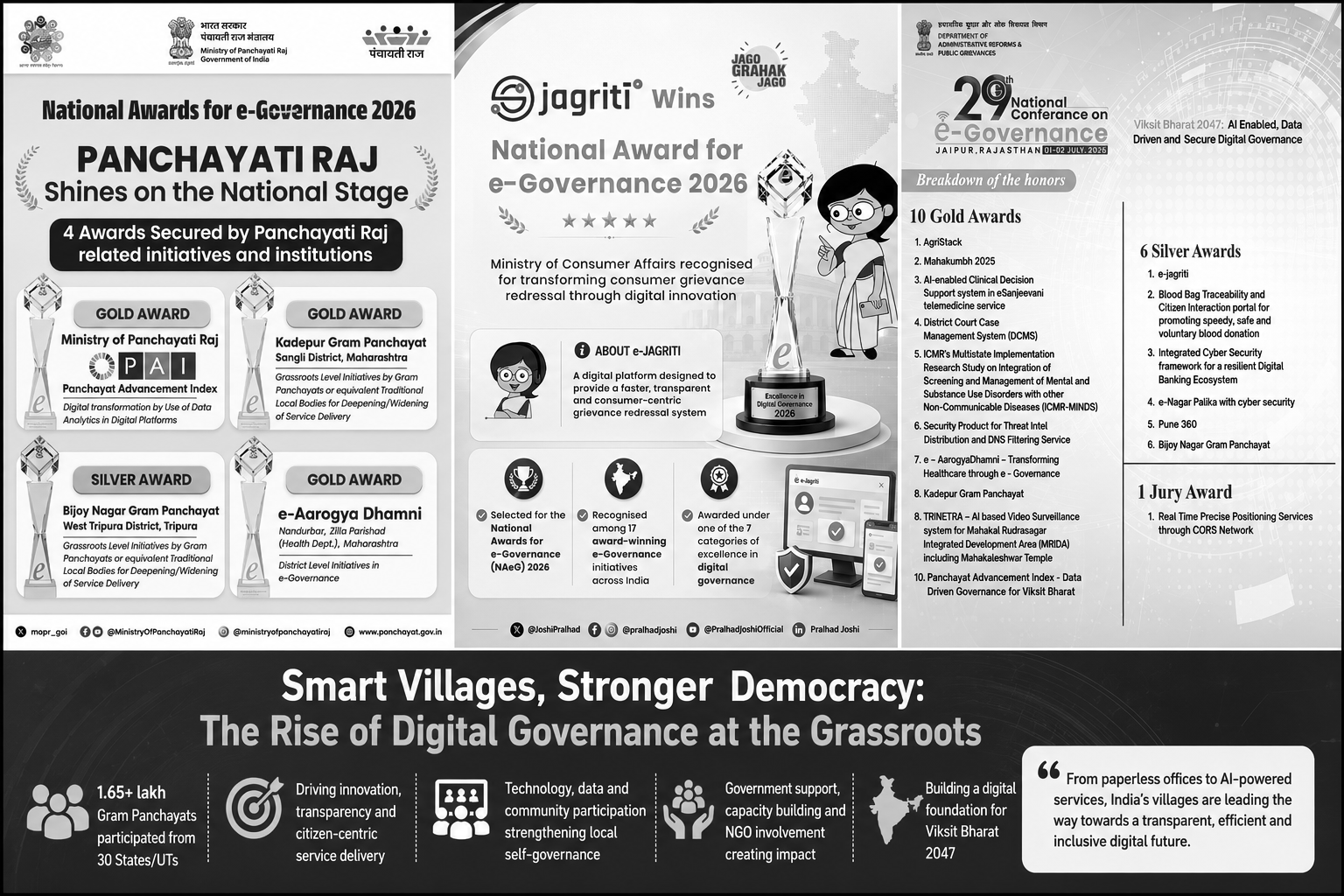
Smart Villages, Stronger Democracy: The Rise of Digital Governance at the Grassroots
For generations, governance in rural India was synonymous with long queues, paper files, manual registers, and repeated visits to government offices. Today, however, a quiet transformation is reshaping the country's villages. Armed with digital tools, data-driven decision-making, and citizen-centric service platforms, Gram Panchayats are increasingly emerging as the frontline of India's governance revolution.
The latest evidence of this shift comes from the National Awards for e-Governance (NAeG) 2026 , where four Panchayati Raj-related initiatives secured national recognition. The awards highlight how digital innovation is no longer confined to metropolitan cities or state capitals but is steadily reaching the grassroots, where governance directly touches citizens' lives.
The awards will be presented during the 29th National Conference on e-Governance in Jaipur on July 1-2, 2026. Organized jointly by the Department of Administrative Reforms and Public Grievances (DARPG) , the Ministry of Electronics and Information Technology (MeitY) , and the Government of Rajasthan, the conference carries the theme "Viksit Bharat 2047: AI-Enabled, Data-Driven and Secure Digital Governance."
Among the 17 projects selected across seven categories, Panchayati Raj-linked initiatives secured three Gold Awards and one Silver Award, reflecting the growing role of local governments in India's digital transformation journey.
Recognition for Rural Innovation
Although the National Awards for e-Governance have existed since 2003, a major turning point came in 2025 when the Ministry of Panchayati Raj successfully advocated for a dedicated category recognizing Gram Panchayats for digital service delivery and governance innovation.
The move acknowledged an emerging reality: some of India's most innovative governance practices were being developed in villages rather than cities.
The response was overwhelming. More than 1.45 lakh entries from 26 States and Union Territories were received in the inaugural year. Participation expanded further in 2026, with over 1.65 lakh Gram Panchayats from 30 States and Union Territories taking part.
The numbers reflect the growing acceptance of digital governance as an essential component of local administration rather than a supplementary initiative.
The Winners Leading Change
Among this year's standout winners was the Panchayat Advancement Index (PAI) , which received the Gold Award under the category of Digital Transformation through Data Analytics.
Developed by the Ministry of Panchayati Raj, PAI serves as a national performance measurement framework for Gram Panchayats. It assesses local governance through indicators aligned with the Localized Sustainable Development Goals (LSDGs) and provides policymakers with a data-backed understanding of development outcomes at the village level.
The index represents a significant shift from perception-based governance to evidence-based governance.
Another major winner was Kadepur Gram Panchayat in Maharashtra's Sangli district, which secured a Gold Award for grassroots-level digital governance.
Kadepur has built one of the country's most advanced village-level digital ecosystems. The Panchayat delivers more than 1,355 services online , serves over 4,300 beneficiaries through a fully paperless administration system, and operates an advanced e-Office platform supported by eight AI-powered applications.
The village also uses Blockchain-based record management and GIS-enabled property mapping , technologies that are typically associated with large urban administrations. Significantly, Kadepur is reportedly the only Gram Panchayat in India with formally approved policies relating to Artificial Intelligence, Blockchain, Nanotechnology, Biotechnology, and Robotics .
The Silver Award in the same category went to Bijoy Nagar Gram Panchayat in Tripura.
Bijoy Nagar demonstrated how digital governance can strengthen both administration and citizen participation. The Panchayat improved its Panchayat Advancement Index score by 38 percent , achieved a Grade-A rating, increased its own-source revenue by nearly 194 percent, and now delivers more than 100 services online.
Perhaps most notably, it has achieved 100 percent digital literacy among women , illustrating how technology can become a tool for social empowerment rather than merely administrative efficiency.
Meanwhile, the Health Department of Zilla Parishad Nandurbar in Maharashtra secured a Gold Award for e-Aarogya Dhamni , a healthcare initiative that leverages digital technologies to provide quality medical services in tribal and remote regions where access to healthcare has historically remained a challenge.
Maharashtra's Growing Leadership
The awards also reveal an emerging pattern in India's digital governance landscape.
Since the dedicated Gram Panchayat category was introduced in 2025, Maharashtra has consistently emerged as the strongest performer. The state won the Gold Award through Rohini Gram Panchayat in 2025 and repeated the achievement through Kadepur in 2026.
Tripura has also established itself as a notable performer, securing Silver Awards in consecutive years through West Majlishpur Gram Panchayat and Bijoy Nagar Gram Panchayat.
These achievements suggest that states are increasingly investing in governance reforms, digital infrastructure, and local capacity building to improve the performance of their Panchayats.
Beyond Awards: Building a Digital Village Ecosystem
The success of these Panchayats did not happen overnight.
Behind every award-winning initiative lies years of investment in training, technology adoption, and community engagement.
The Ministry of Panchayati Raj has actively promoted digital governance through initiatives such as the e-Gram Swaraj platform , the National Gram Swaraj Campaign , and extensive capacity-building programmes conducted through State Institutes of Rural Development and Panchayati Raj training centres.
Thousands of elected representatives and local officials are trained annually in digital accounting, online service delivery, project monitoring, asset management, and data-driven planning.
The awards themselves have become a powerful tool for encouraging innovation. Gold Award winners receive ₹10 lakh , while Silver Award winners receive ₹5 lakh , enabling local bodies to reinvest in public welfare projects and digital infrastructure.
More importantly, the awards create a culture of healthy competition. Successful Panchayats become national models whose practices can be replicated elsewhere.
How Technology Is Reaching Rural India
The technologies recognized through the awards are increasingly finding practical applications in village administration.
Artificial Intelligence can help automate citizen services, process applications, manage grievances, and provide information in local languages through chatbots.
Blockchain technology can secure land records, property registers, and official certificates, reducing disputes and enhancing transparency.
Geographic Information Systems (GIS) enable Panchayats to map roads, water bodies, schools, healthcare centres, and public assets, helping improve planning and monitoring.
Data Analytics allows local governments to identify gaps in service delivery, monitor development indicators, and allocate resources more effectively.
Similarly, Internet of Things (IoT) devices can monitor water levels, track utility systems, and provide real-time information on public infrastructure.
Together, these technologies help transform governance from a reactive process into a proactive and data-driven system.
The Missing Link: Community Participation
Technology alone, however, cannot transform governance.
Experts emphasize that digital governance succeeds only when citizens actively use and trust the systems being introduced.
This is where non-governmental organizations (NGOs) , self-help groups, and civil society organizations often play a critical role.
Across rural India, NGOs support digital literacy programmes, train citizens in accessing online services, facilitate community participation, and help spread awareness about government initiatives.
In villages like Bijoy Nagar, where women have achieved complete digital literacy, community mobilization efforts are often as important as technological infrastructure.
NGOs also contribute to healthcare awareness, financial inclusion, water management, education, and social audits—areas that frequently overlap with the objectives of award-winning Panchayats.
Their involvement helps bridge the gap between technology and citizens, ensuring that digital tools translate into meaningful improvements in people's lives.
A Blueprint for Viksit Bharat
The National Awards for e-Governance are increasingly becoming more than a recognition platform. They are evolving into a roadmap for how governance can function in a rapidly digitizing India.
By rewarding innovation, transparency, accountability, citizen participation, and measurable outcomes, the awards encourage Panchayats and state governments to continuously improve their performance.
As India moves toward its vision of Viksit Bharat 2047 , the transformation of governance will not be determined solely by developments in major cities. It will depend equally on how effectively technology empowers the country's villages.
The stories emerging from Kadepur , Bijoy Nagar , Nandurbar , and the Panchayat Advancement Index demonstrate that the future of governance is already taking shape at the grassroots. What was once considered the last mile of administration is increasingly becoming the first frontier of digital innovation, offering a blueprint for a more transparent, efficient, and citizen-centric India.