

SpaceX’s Starship Completes Historic Orbital Flight With 26 Starlink Satellites
SpaceX’s giant Starship reached orbit for the first time and successfully deployed 26 next-generation Starlink satellites on Monday, marking a major breakthrough for the company’s reusable rocket programme and its ambitions for future Moon and Mars missions.
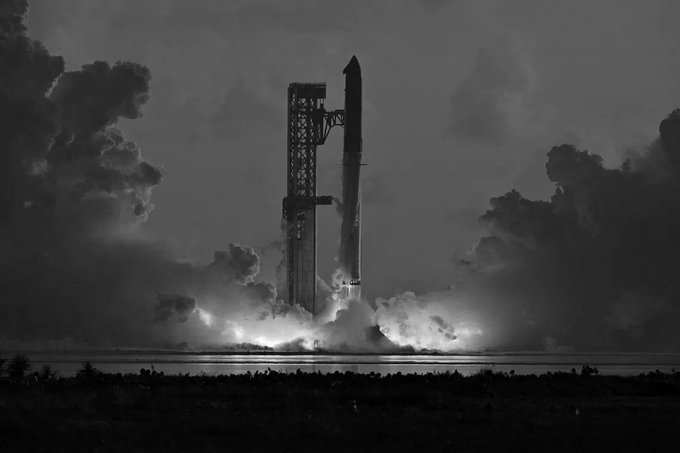
The 407-foot spacecraft lifted off from SpaceX’s Starbase facility in South Texas on its 14th full-scale flight. After 13 previous tests that remained suborbital, Flight 14 became the first Starship mission to achieve orbital flight.
The mission carried 26 Starlink V3 satellites, marking the first time Starship has deployed an operational satellite payload. SpaceX later confirmed that all 26 satellites had been deployed and were in contact with ground stations. The new-generation satellites are designed to significantly increase the capacity of the Starlink network.
The flight was not without problems. One of Starship’s six Raptor engines shut down unexpectedly during the mission. Despite the engine issue, the spacecraft continued along its orbital trajectory and completed the satellite deployment sequence.
The original flight plan called for Starship to circle Earth approximately six times over nearly 10 hours. Mission controllers instead brought the spacecraft home earlier than planned after it had completed about two orbits. Starship conducted its atmospheric re-entry and ended the mission with a controlled soft splashdown in the Pacific Ocean, demonstrating another important capability of the reusable spacecraft.
The Super Heavy first-stage booster also completed its own flight objectives. Booster 21 separated from Starship, carried out its return manoeuvres and splashed down in the Gulf of Mexico, giving SpaceX additional data on the recovery system.
Flight 14 also provided valuable information about Starship’s thermal-protection system. Several Starlink satellites were equipped with cameras to observe the spacecraft’s heat shield during the mission, potentially giving engineers new data on how the vehicle performs during the extreme conditions of atmospheric re-entry.
The successful orbital flight represents a significant step toward SpaceX’s larger objective of making Starship a fully reusable heavy-lift launch system capable of carrying large satellite payloads and eventually transporting humans beyond Earth.
The achievement also has direct implications for NASA’s Artemis programme. NASA plans to use 2027’s Artemis III as an Earth-orbit demonstration mission to test rendezvous and docking procedures involving commercial lunar landers developed by SpaceX and Blue Origin. NASA currently targets Artemis IV in 2028 for the first crewed lunar landing of this revised sequence.
For SpaceX, Flight 14 therefore represents more than another test flight. Starship has now demonstrated orbital flight, satellite deployment and controlled atmospheric return in a single mission, providing engineers with critical data for the next generation of flights and the company’s longer-term lunar ambitions.