
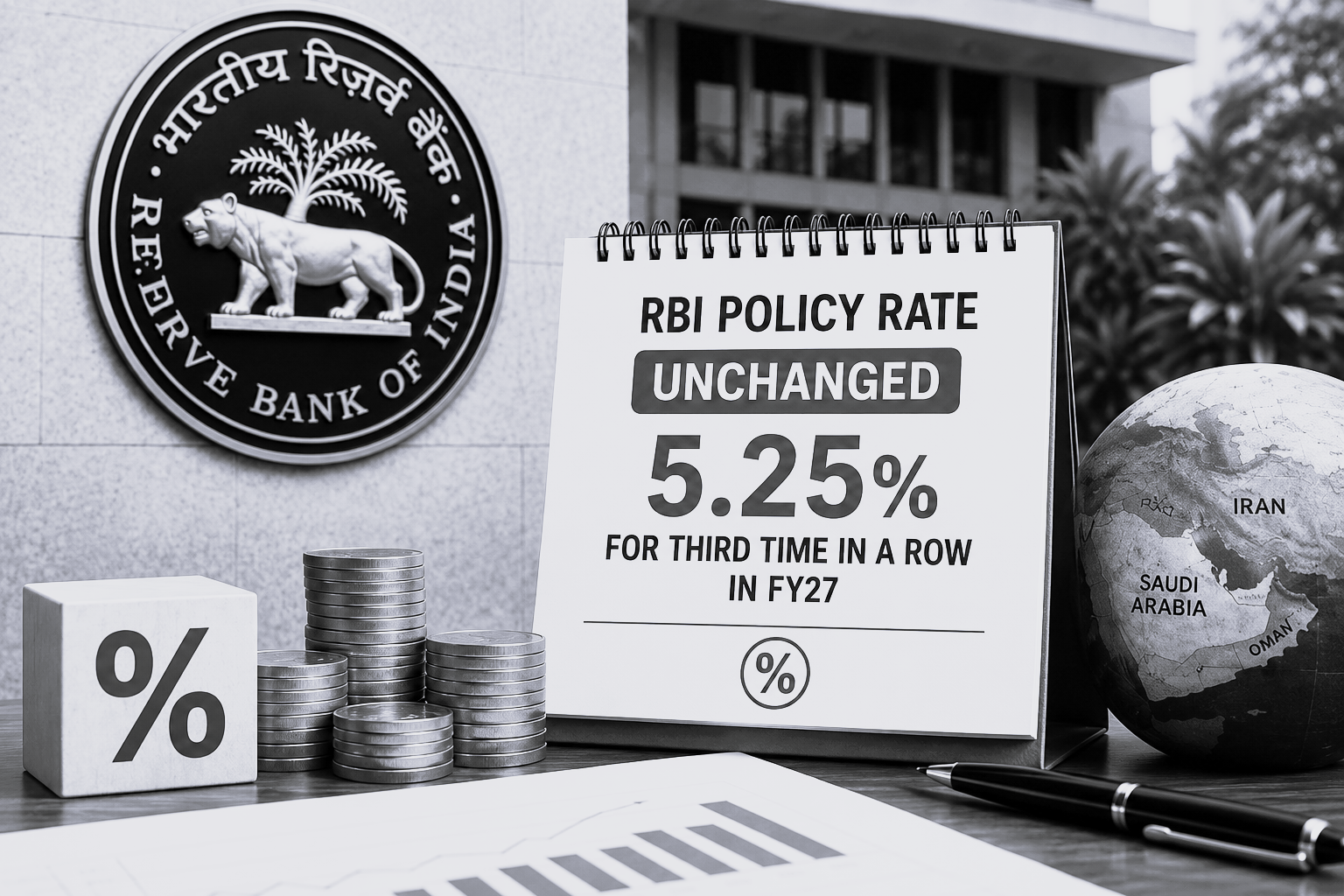
Stability Over Bold Move: RBI Keeps Policy Rate Unchanged for Third Time in a Row Amid West Asia Crisis
The Reserve Bank of India (RBI) has once again chosen caution over aggression, keeping the repo rate unchanged at 5.25 per cent for the third consecutive monetary policy meeting in FY27. At first glance, the decision may disappoint borrowers hoping for lower EMIs or surprise those expecting a rate hike after retail inflation climbed to 4.38 per cent, above the RBI's 4 per cent target. But a closer look reveals that the central bank's latest move is less about avoiding action and more about preserving stability in an increasingly uncertain global environment.
The RBI finds itself walking a tightrope. On one side is inflation, which remains above its preferred target and continues to threaten household budgets. On the other is economic growth, which the central bank believes remains resilient enough to withstand external shocks. Rather than taking a bold step in either direction, the Monetary Policy Committee (MPC) has chosen a wait-and-watch approach, signalling that this is a time for measured decisions rather than dramatic policy shifts.
The biggest factor influencing the RBI's thinking is the West Asia crisis. Any escalation could push crude oil prices higher, disrupt global supply chains and increase imported inflation for a country like India, which relies heavily on oil imports. At the same time, the Indian rupee has remained under pressure, making imports more expensive and adding another layer of risk. Cutting interest rates in such a situation could have weakened the currency further, while raising rates might have slowed investment and consumption at a time when the economy is still navigating global headwinds.
Interestingly, the RBI's confidence in India's economic fundamentals remains intact. It has raised its GDP growth forecast to 6.7 per cent for FY27 while lowering its full-year inflation projection to 5 per cent, indicating that it expects price pressures to moderate over time despite current challenges. This suggests the central bank believes today's inflation is being driven more by external geopolitical factors than excessive domestic demand, making patience a more effective strategy than immediate intervention.
For ordinary citizens, the decision means home loan EMIs, vehicle loans and personal loan repayments are unlikely to change immediately, while fixed deposit (FD) investors can continue to enjoy relatively attractive returns. Businesses, too, benefit from predictable borrowing costs, although companies hoping for cheaper credit will have to wait longer.
Ultimately, the RBI has chosen stability over a bold move. It has resisted the temptation to either stimulate the economy with a rate cut or aggressively tackle inflation with a rate hike. Instead, it has kept every future option open, betting that global uncertainties will ease and inflation will gradually soften. Whether this cautious strategy proves successful will depend not only on domestic economic performance but also on how the West Asia conflict, crude oil prices and the global financial landscape evolve in the months ahead.