
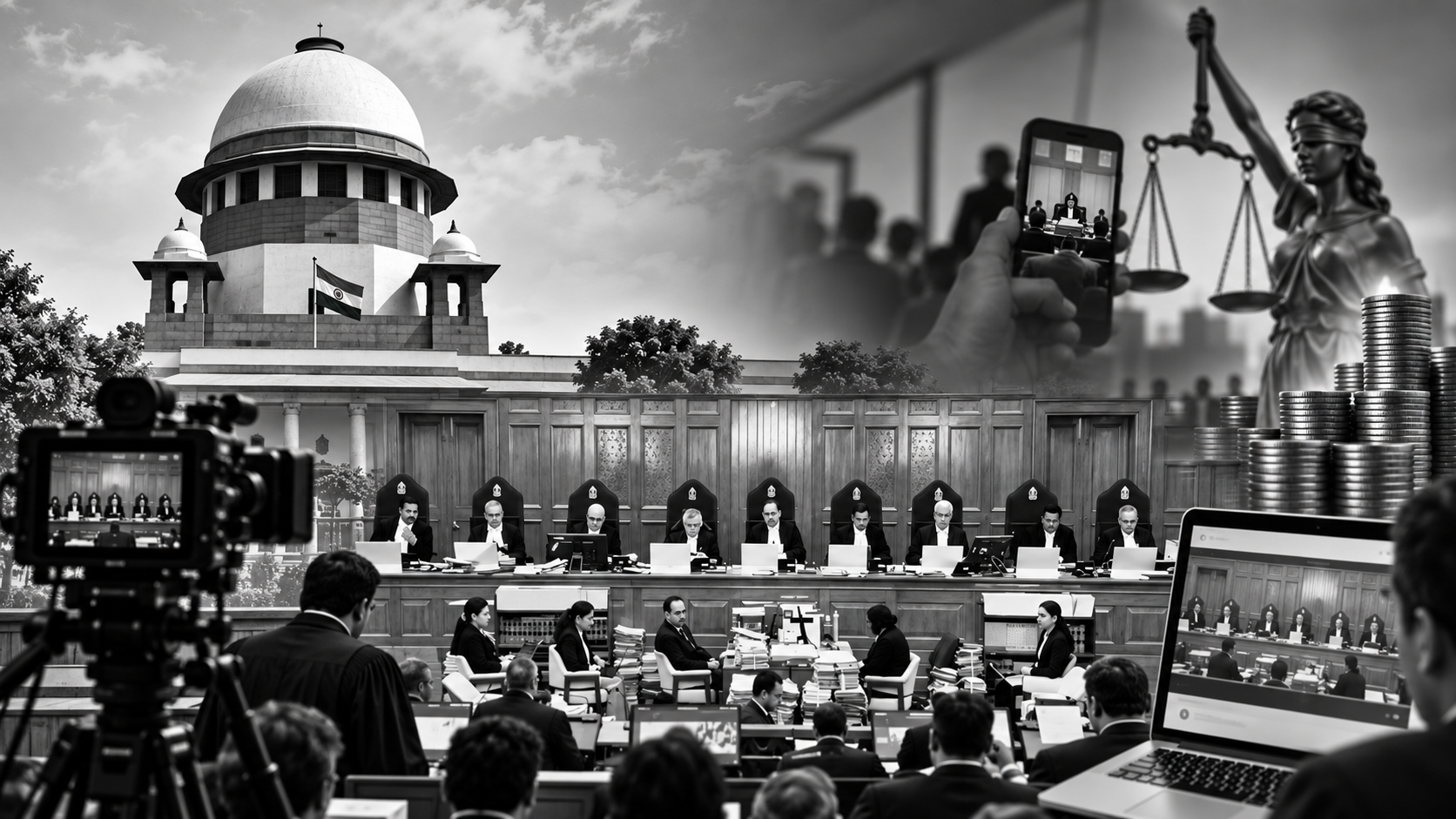
Supreme Court Balances Judicial Transparency with Safeguards Against Video Misuse
The Supreme Court has reiterated that live-streaming of judicial proceedings should not be restricted in the name of preventing misuse, while warning that unauthorised commercial exploitation, misleading edits and the use of courtroom videos for personal promotion could undermine public understanding of the justice system.
A Bench comprising Chief Justice of India Surya Kant and Justices Joymalya Bagchi and V Mohana made the observations on October 9 while hearing a plea concerning the unauthorised extraction and monetisation of courtroom recordings. The Bench clarified that there was no question of gagging criticism or restricting live-streaming, but stressed that recordings intended to inform the public should not be exploited for commercial gain.
The Court granted the Centre two weeks to submit its response and proposals incorporating suggestions received from different High Courts and stakeholders. Existing restrictions on unauthorised sharing of courtroom clips will remain in force until further orders.
The observations revive debate over open justice, a principle that enables citizens to understand judicial reasoning, scrutinise proceedings and access justice beyond physical courtrooms. In its landmark 2018 judgment in Swapnil Tripathi v. Supreme Court of India, the apex court recognised live-streaming as a means of improving transparency and public access, subject to safeguards protecting privacy and sensitive proceedings.
However, the circulation of selectively edited videos on digital platforms has raised concerns about misleading captions, distorted judicial remarks and commercial monetisation. Senior advocate Gopal Sankaranarayanan highlighted the circulation of misleading courtroom clips, while Justice Bagchi expressed concern over lawyers using recordings for personal promotion and professional gain.
Advocate Mathews J Nedumpara argued that people have a right to know what happens in court and opposed restrictive live-streaming. The Chief Justice agreed that criticism should not be gagged but emphasised that commercial exploitation and misrepresentation required safeguards. Solicitor General Tushar Mehta, representing the Centre, said some YouTube channels continued uploading proceedings despite court orders.
The dispute follows interim directions issued on July 24, 2026, restricting unauthorised extraction, dissemination and monetisation of courtroom recordings. A clarification on July 31 allowed recognised news organisations to report judicial proceedings while maintaining restrictions on reproducing audio-video clips without complying with the Court's directions.
Justice Bagchi said the judiciary was arranging adequate storage, including cloud-based facilities, to preserve official recordings, which could be accessed through appropriate mechanisms, including the Right to Information (RTI) framework.
The proposed guidelines are expected to address permissions, misleading edits and commercial reuse while preserving legitimate public-interest reporting. The challenge, the Bench indicated, is to ensure that judicial transparency remains accessible without allowing courtroom proceedings to be misrepresented or commercially exploited.