
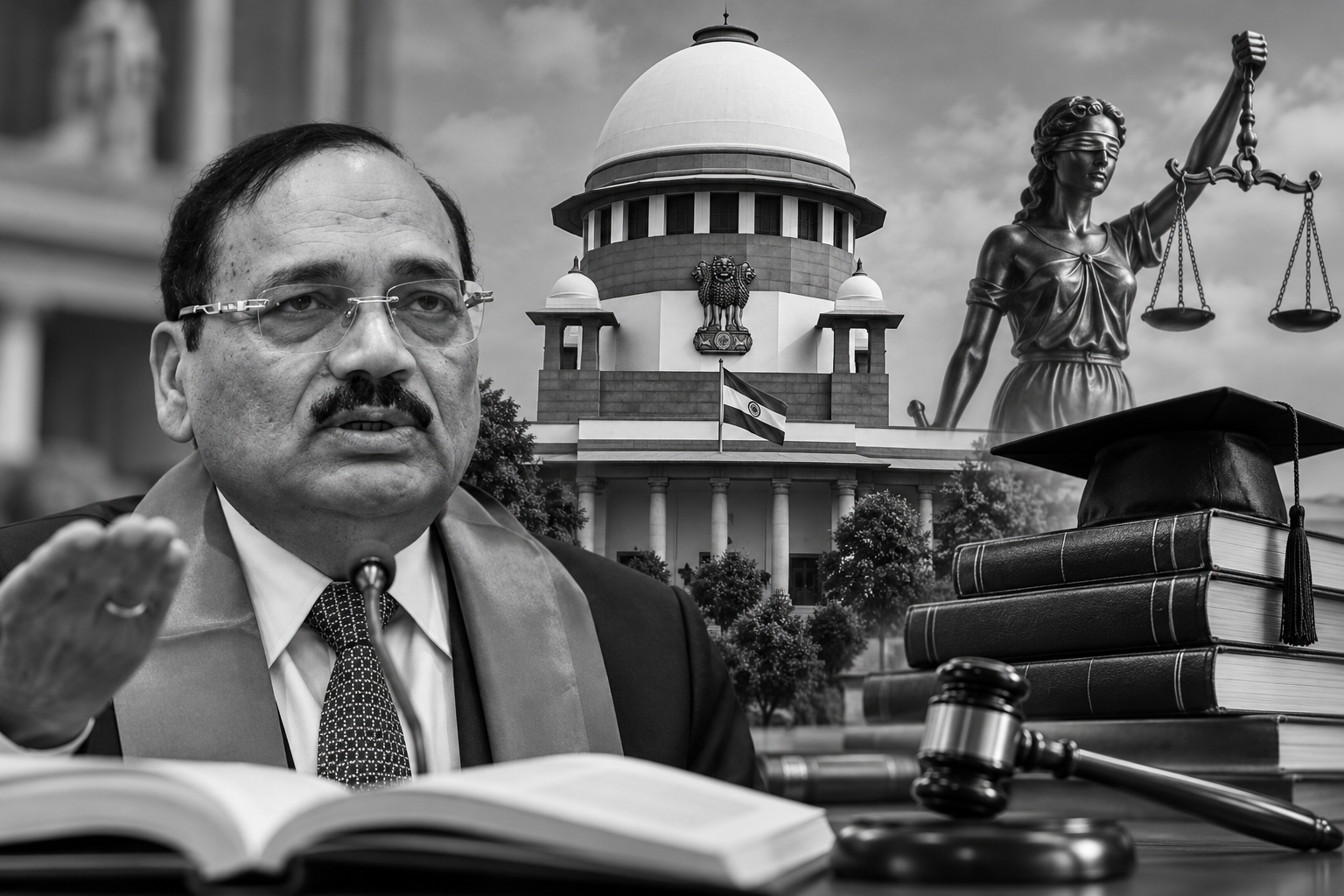
Supreme Court Questions BCI’s Power to Regulate Law Colleges
The Supreme Court on Wednesday questioned the extent of the Bar Council of India’s (BCI) authority over legal education, asking whether the statutory body responsible for regulating the legal profession can also exercise direct control over law colleges and universities. A Bench comprising Chief Justice Surya Kant and Justices Joymalya Bagchi and V. Mohana said it would examine whether the BCI has the legal power to control and regulate institutions imparting legal education, while questioning whether the Council itself is the appropriate expert body for academic matters. The Bench issued notice to the BCI and sought its response within two weeks.
The observations came while hearing petitions challenging the functioning of the BCI-PEARL FIRST Trust and the establishment of law colleges by the Trust. CJI Surya Kant questioned how the BCI could be considered an expert academic regulator when law scholars and academicians are better placed to deal with educational matters. The Bench indicated that the BCI could prescribe broad requirements, including course duration and general curriculum standards, but questioned whether those powers extend to controlling universities and colleges. The observations were oral and do not constitute a final ruling.
Under the Advocates Act, 1961, the BCI is empowered under Section 7(1)(h) to promote legal education and lay down its standards. Section 7(1)(i) allows it to recognise universities whose law degrees qualify graduates for enrolment as advocates and to inspect universities. The present dispute is therefore about the extent of these powers, rather than whether the BCI has any role in legal education.
The case also concerns the Trust established in 2020, after the BCI decided in 2016 to abolish an earlier trust and transfer its funds. Advocate Prashant Bhushan, representing petitioner Girish Mittal, alleged that 11 managing trustees were initially made permanent trustees and that the Trust subsequently established law colleges in Goa and Andhra Pradesh. Petitioners have also questioned arrangements under which 27 of 35 Executive Council members were allegedly nominated by the BCI. These remain allegations before the Court.
The BCI has said there would be no lifetime trustees, with their tenure co-terminus with BCI membership.
The dispute follows the Supreme Court’s 2023 Bonnie Foi Law College judgment, which recognised the BCI’s role in maintaining professional standards while acknowledging universities’ role in imparting legal education. The Court had earlier also examined declining standards in legal education and the need for mechanisms such as the All India Bar Examination.
Separately, a plea challenges BCI Chairman Manan Kumar Mishra’s tenure, citing Rule 12(2), which prescribes a two-year term, and questioning the April 21, 2025 notification extending his tenure until 2030. The Supreme Court’s eventual ruling could clarify the boundary between professional regulation, academic standard-setting and institutional control.