
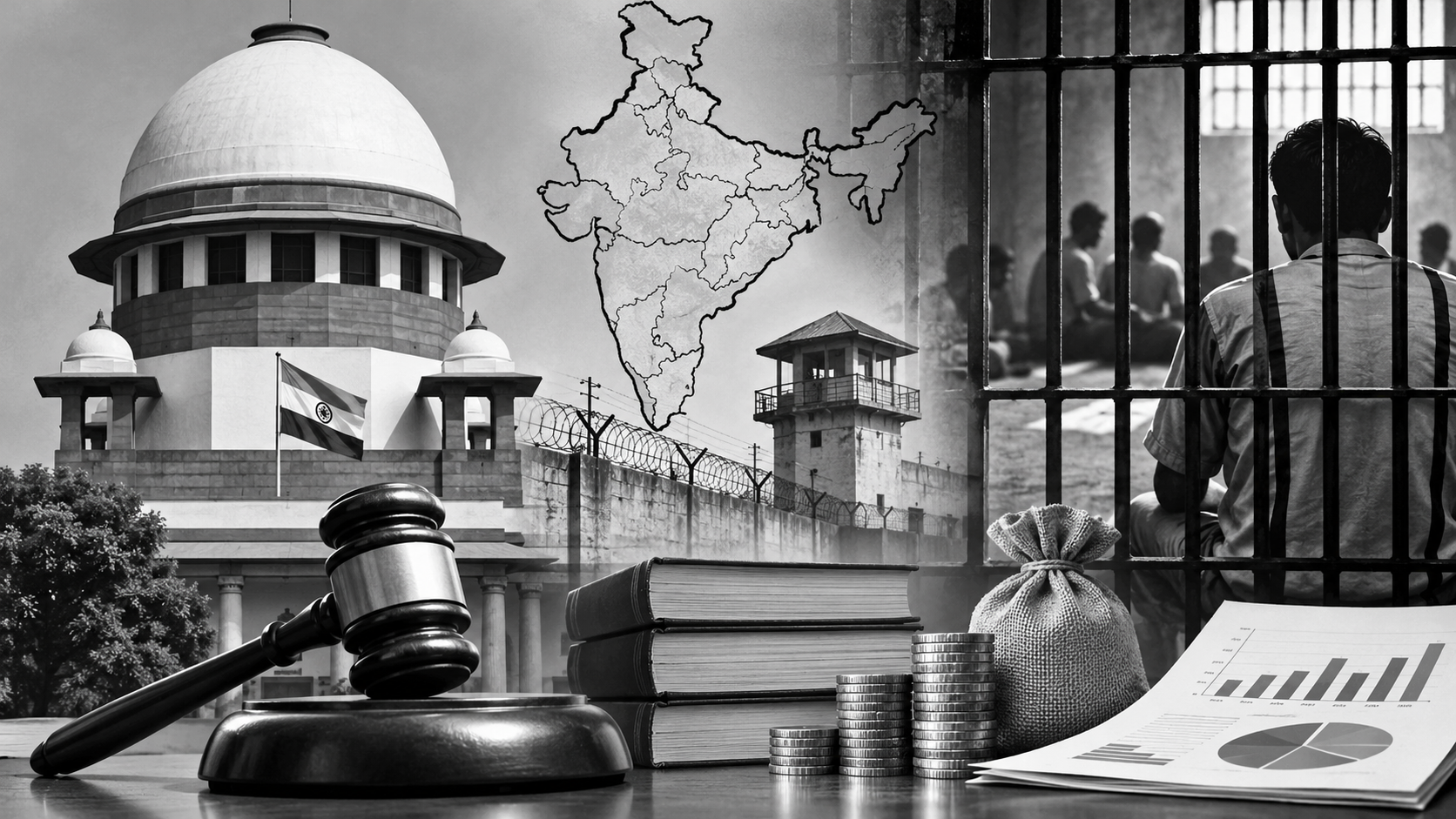
Supreme Court Raps 23 States Over Caste-Based Discrimination in Prisons
The Supreme Court on Tuesday expressed serious disappointment over the failure of 23 states and Union Territories to respond to information sought by the Centre on measures taken to eliminate caste-based discrimination inside prisons. Describing the delay as "very sad", the court granted the governments one final opportunity to submit their responses, warning that Chief Secretaries and Principal Secretaries could be summoned personally if they failed to comply with its directions.
A bench comprising Justices J B Pardiwala and Manmohan was hearing the suo motu case, In Re: Discrimination Inside Prisons in India. The proceedings follow the landmark October 2024 judgment in Sukanya Shantha v. Union of India, which declared discriminatory provisions in the prison manuals of 10 states unconstitutional. The court addressed caste-based allocation of manual labour, segregation of barracks and prejudice against Denotified Tribes and habitual offenders, citing violations of Articles 14, 15, 17, 21 and 23 of the Constitution.
The judgment directed states to revise prison rules, remove caste references from inmate registers and prevent discriminatory work allocation. Following the ruling, the Union Home Ministry amended the Model Prison Manual, 2016, and the Model Prisons and Correctional Services Act, 2023, on December 30, 2024. The revisions prohibit caste-based segregation, manual scavenging and hazardous sewer cleaning.
On July 30, 2026, the Supreme Court directed every state and UT to establish district-wise Boards of Visitors, headed by respective Principal District Judges, within four weeks. However, subsequent compliance proceedings exposed delays, with only a few districts reportedly constituting the boards. The Centre's latest report also flagged pending information on police regulations, prison reforms and implementation measures. The next hearing is scheduled for January 13, 2027.
Meanwhile, NCRB data highlights the financial scale of prison administration. The sanctioned national prison budget increased from Rs 6,093.4 crore in 2018-19 to Rs 11,442 crore in 2024-25, while actual expenditure rose from Rs 5,308.1 crore to Rs 9,437.6 crore. In 2023-24, inmate expenditure included Rs 1,457.09 crore for food, Rs 113.50 crore for medical services and just Rs 9.51 crore for vocational and educational training. In 2024-25, training expenditure stood at Rs 9.17 crore, against Rs 1,501.50 crore for food.
The Centre's Rs 950-crore Modernisation of Prisons Project (2021-22 to 2025-26), including a Rs 300-crore allocation in 2025-26, aims to improve security, infrastructure and rehabilitation. With prison administration primarily a state responsibility, the latest proceedings highlight the gap between financial allocations, institutional reforms and actual implementation of constitutional safeguards.