
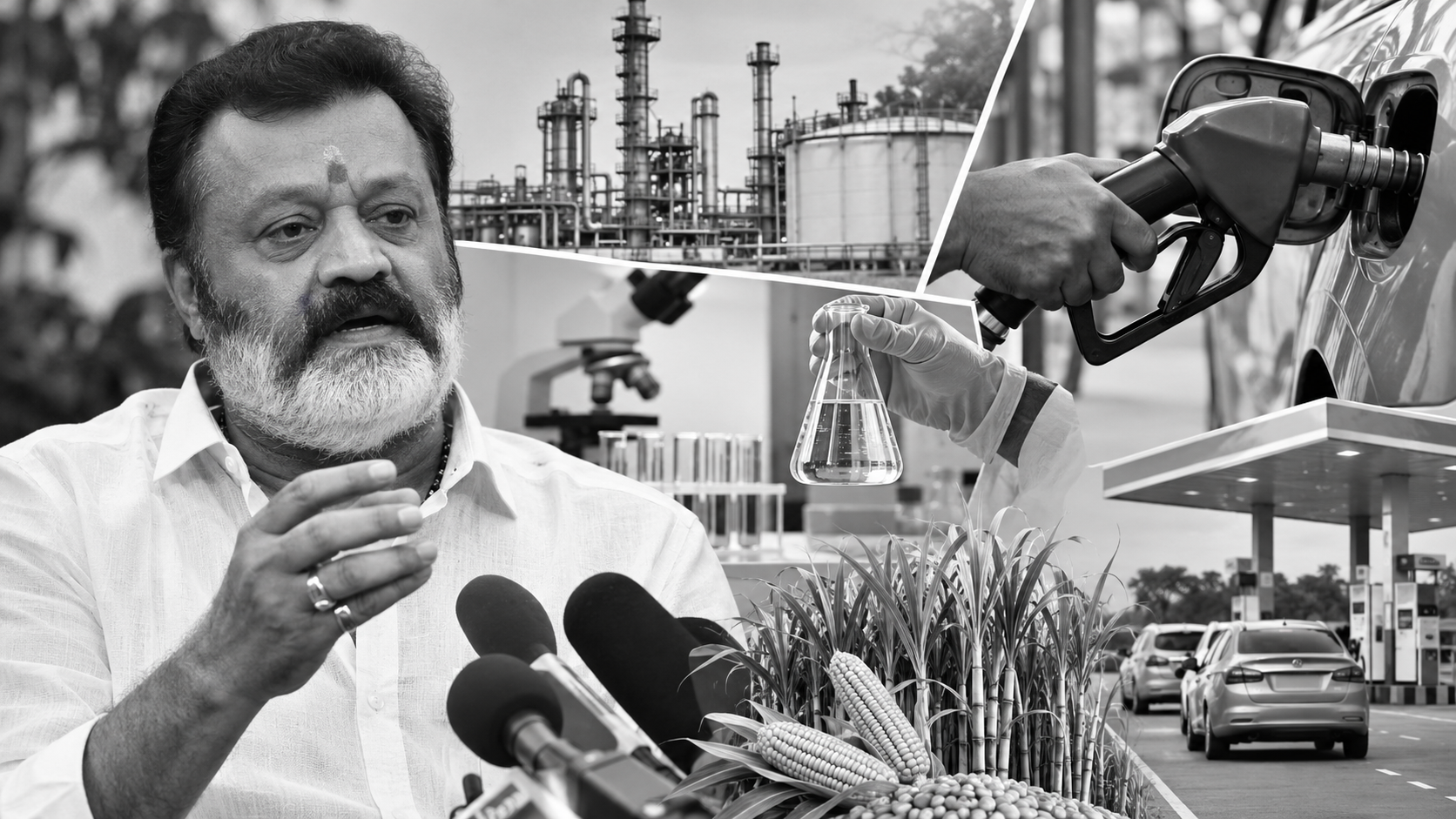
Suresh Gopi Questions Karnataka's E20 Tests, Defends Ethanol Blending
Union Minister of State for Petroleum and Natural Gas Suresh Gopi on Monday questioned the testing methodology adopted by the Karnataka government to detect excessive ethanol content in petrol, describing reported levels of 27–28 per cent as unacceptable and defending the Centre's E20 fuel programme amid growing concerns over fuel quality, vehicle compatibility and consumer interests.
Responding to reporters, Gopi questioned whether the samples had been collected directly from refineries, pointing out that petrol passes through transportation and underground storage tanks before reaching consumers. He said possible irregularities at different stages needed examination and stressed that oil companies were responsible for maintaining prescribed standards through periodic inspections. He also supported Keralam's decision to conduct independent tests, saying the findings could be submitted in court.
The controversy intensified after Karnataka's Food and Civil Supplies Minister Rizwan Arshad alleged that 63 samples collected from seven districts showed excessive ethanol content, with the highest reported reading reaching 31.2 per cent. The state claimed four out of five petrol pumps surveyed supplied fuel exceeding the prescribed limit.
However, Indian Oil Corporation, Bharat Petroleum Corporation and Hindustan Petroleum Corporation disputed the findings. The Petroleum Ministry said a separate exercise covering 893 samples across 27 States and Union Territories found all samples within the prescribed 19–21 per cent range. The 56 samples tested in Karnataka recorded 19–20 per cent, averaging 19.30 per cent.
The Centre questioned Karnataka's sampling procedures, citing requirements under the Motor Spirit and High Speed Diesel Control Order, 2005, and Marketing Discipline Guidelines, 2024. These mandate six one-litre samples, joint signatures and designated laboratory testing. Differences in reported density readings and the absence of specified testing procedures in Karnataka's certificates were also flagged.
India's Ethanol Blended Petrol Programme aims to reduce crude oil imports, support farmers and promote cleaner energy. The government advanced its 20 per cent blending target from 2030 to 2025-26, achieving the milestone during that supply year. Since 2014-15, the programme has reportedly saved over ₹1.97 lakh crore in foreign exchange, substituted 316 lakh metric tonnes of crude oil and reduced 952 lakh metric tonnes of carbon dioxide emissions. Farmers received over ₹1.66 lakh crore through ethanol procurement.
However, motorists have raised concerns about mileage and older vehicles. Government estimates indicate efficiency reductions of 1–2 per cent in E20-calibrated vehicles and 3–6 per cent in certain older models. Ethanol production also raises concerns over agricultural land, water use and food security.
Meanwhile, amendments notified on October 26, 2026, facilitated certification of E85 and E100 flex-fuel vehicles. Gopi suggested blending could eventually reach 30–40 per cent, subject to scientific assessment. The Centre has not approved any nationwide blending mandate beyond E20. It maintains that higher concentrations require appropriate vehicle technology and regulatory safeguards.