
Swachh Bharat Mission: How India Is Turning Urban Waste Into Clean Energy
For years, urban waste in India was largely seen as something that had to be collected, transported and dumped away from populated areas. But that approach is gradually changing. Across the country, discarded vegetables, kitchen waste, cattle dung and agricultural residue are increasingly being treated as valuable resources that can produce biogas, compressed biogas, electricity and organic manure.
This change is emerging as an important part of the evolution of the Swachh Bharat Mission, launched in October 2014. Scientific management of municipal solid waste has remained one of its key objectives. The second phase, Swachh Bharat Mission-Urban 2.0, launched on October 1, 2021, expanded the focus to source segregation, door-to-door collection, scientific processing of waste and remediation of legacy dumpsites.
The scale of India's waste challenge explains why such a shift is important. According to the Ministry of Housing and Urban Affairs, urban India was generating 1,62,162 tonnes of municipal solid waste every day as of January 2026, while around 1,31,837 tonnes per day was being processed. The proportion of urban waste being processed has increased from 16% in 2014 to 81.30%, indicating a significant change in the country's waste-management infrastructure.
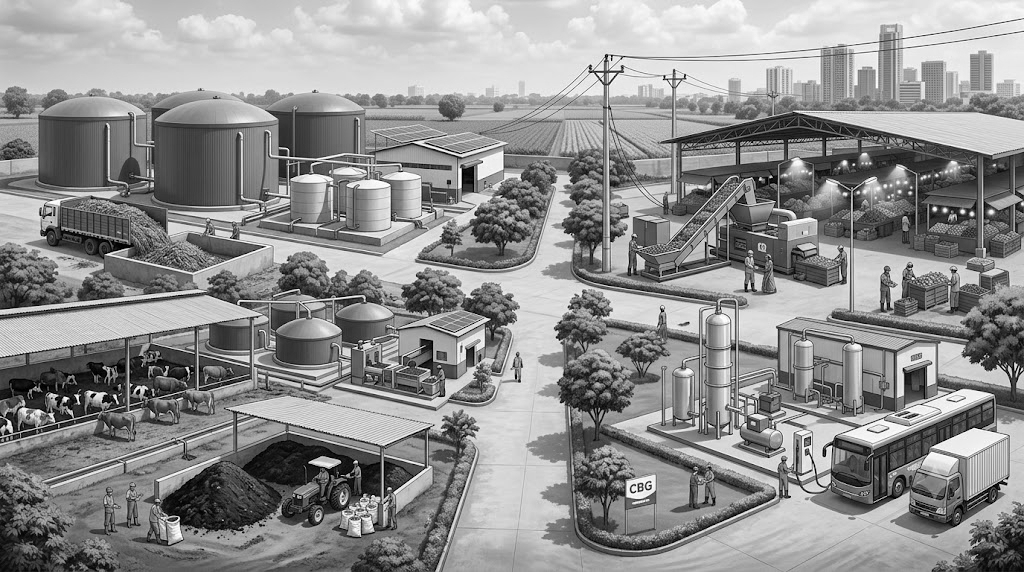
Organic waste has a particular advantage because it can be treated through anaerobic digestion. During this process, microorganisms break down organic material in the absence of oxygen and produce biogas. The gas can be used for cooking or converted into electricity and compressed biogas, while the remaining slurry can be processed into organic fertiliser. This creates more than one useful product from what would otherwise be discarded waste.
Government support has also expanded for such projects. Waste-to-energy and waste-to-biogas projects worth ₹23,549.42 crore have been approved under the relevant waste-management component, with a central share of ₹8,662.28 crore. Such investments are intended to strengthen India's capacity to process waste scientifically while promoting alternative sources of energy.
One example comes from the Shrimati Manekba Vinay Vihar Educational Complex near Adalaj in Gandhinagar, Gujarat. The campus kitchen prepares food for more than 500 people every day, including around 250 hostel students and 15 staff families living on the premises. Instead of depending entirely on LPG, the institution now meets its cooking-fuel requirement through biogas.
The Vasumati Charitable Trust, which manages the campus, operates two biogas plants with a combined capacity of 90 cubic metres per day. The main feedstock is dung from 222 cows housed in the trust's cowshed. Kitchen waste and agricultural residue from nearby fields are also added to the system.
The resulting biogas meets the campus's entire cooking-fuel requirement. Without the plants, the institution would have required around 30 LPG cylinders every month. The process also produces nutrient-rich slurry that can be used as organic manure, helping reduce dependence on chemical fertilisers and giving the waste another productive use.
Gujarat has been supporting similar institutional initiatives through its Institutional Biogas Plant Scheme and the Gujarat Energy Development Agency. According to government information, around 193 institutional biogas plants have been established in the state over the past five years. The Gandhinagar example shows how even an individual institution can use locally available organic waste to become more energy self-reliant.
In Prayagraj, Uttar Pradesh, the idea has been taken to a much larger scale. A multi-feedstock Bio-CNG plant can process 343 tonnes of organic waste every day and produce around 21 tonnes of Bio-CNG. Unlike plants that depend on a single source of waste, the facility uses wet waste, paddy straw, cattle dung and poultry litter.
This approach provides a productive use for different types of organic waste while also creating an alternative use for agricultural residue. By providing another avenue for paddy straw, such systems can contribute to efforts to reduce crop-residue burning.
The Prayagraj facility operates under a public-private partnership model and receives bulk organic waste from hotels, restaurants and apartment complexes. The quantity of wet waste reaching the facility has increased substantially, from around 7–8 tonnes a day during the initial period to approximately 125 tonnes a day.
The plant produces around 28 tonnes of compost every day, which is made available to local farmers. The Bio-CNG is sold under the CBG-City Gas Distribution Synchronisation Scheme and is currently used for city transport. The project is also expected to eventually provide clean gas access to around 45,000 households through piped networks and reduce carbon emissions by approximately 57,000 tonnes annually, according to the PIB backgrounder.
Gwalior provides another example, this time centred on cattle dung. Adarsh Gaushala in Laltipara, described as Gwalior's largest cowshed, is home to more than 10,000 cattle. A 100-tonnes-per-day CBG plant was inaugurated there on October 2, 2024.
The ₹31-crore project, developed in collaboration with Indian Oil Corporation and spread over five acres, is designed to convert around 100 tonnes of cattle dung into two tonnes of compressed biogas every day. The plant can also process vegetable and fruit waste collected from markets and households.
CBG is not the only product generated at the facility. The plant produces around 10–15 tonnes of dry bio-manure every day, which can provide an affordable agricultural input for farmers in nearby districts. In this way, the project connects cattle management, renewable energy and agriculture within a single waste-processing system.
The experience at Gwalior also demonstrates how waste-to-energy infrastructure can create local economic opportunities. The facility requires people with skills in waste handling, plant operation and other green-energy activities, linking scientific waste management with employment and skill development.
Hyderabad's Bowenpally Vegetable Market offers perhaps one of the most visible examples of waste being converted into energy at the place where it is generated. The market produces roughly 10–12 tonnes of vegetable and fruit waste every day. Much of this waste previously ended up in landfills, but an on-site biogas plant now puts almost all of it to productive use.
The plant uses technology developed by CSIR-Indian Institute of Chemical Technology (CSIR-IICT). Under the process, discarded vegetables are chopped, shredded and converted into slurry before being fed into anaerobic digesters. The resulting biogas is collected and used to generate electricity and cooking fuel.
The facility generates around 400–500 units of electricity every day, according to the PIB backgrounder. The electricity is used for the market's streetlights, stalls, administration building and water-supply network. Around 30 kg of biofuel is also produced daily and supplied to the market's commercial kitchen.
CSIR-IICT has identified the technology used at Bowenpally as an Anaerobic Gas Lift Reactor system. The institute has highlighted the project as an example of its waste-to-wealth technology, demonstrating how organic waste generated in a busy urban market can be converted into useful energy instead of being transported to a landfill.
The financial impact has also been significant. The biogas plant has reduced the market's electricity bill by roughly half, from an earlier average of about ₹3 lakh a month. The leftover slurry is converted into liquid bio-manure and used as fertiliser, creating another useful output from the same waste.
The project has also created employment opportunities for women at the market. Women workers are involved in activities such as waste segregation, machinery operation and administrative work. Following the experience at Bowenpally, funding has been provided for similar plants at Gudimalkapur, Gaddiannaram, Erragadda, Alwal and Saroornagar.
What connects these projects is not the technology alone, but the idea that waste can remain within a productive cycle. Vegetable waste can become electricity, cattle dung can become CBG, kitchen waste can become cooking fuel and agricultural residue can become an energy feedstock. Even the material left after the digestion process can return to farms as organic manure.
This approach represents a broader change in the way cities can think about waste management. Instead of focusing only on how quickly waste can be removed from residential areas and markets, the emphasis is increasingly shifting towards segregation, processing, resource recovery and productive use of waste.
The transformation also supports several objectives at the same time. Waste processing can reduce pressure on landfills, renewable gas can replace part of the demand for conventional fuels, organic manure can provide an alternative to some chemical inputs, and waste-processing facilities can create local employment.
However, the success of such systems depends heavily on proper segregation and a reliable supply of suitable waste. Organic material mixed with plastic, metal or other contaminants can make processing more difficult and expensive. For waste-to-energy projects to expand successfully, households, markets, institutions and local bodies therefore need to participate in segregation and collection systems.
India's cities are expected to continue generating large quantities of waste as urban populations and consumption increase. The challenge will be to build systems that can keep pace with that growth while reducing dependence on landfills.
The experiences of Gandhinagar, Prayagraj, Gwalior and Bowenpally offer different examples of how that challenge can be addressed. Their models operate at different scales and use different kinds of organic waste, but they point towards the same possibility — that waste management can become part of the energy, agricultural and economic systems of a city.
The larger story of the Swachh Bharat Mission's waste-to-energy efforts is therefore not simply about cleaner streets. It is about changing the way waste is viewed. What was once considered something to be thrown away can, with proper segregation and scientific processing, become fuel, electricity, fertiliser and a source of livelihood.
As more cities experiment with such models, India's waste-management journey is increasingly moving from a “collect and dispose” approach towards a “recover and reuse” system. The long-term success of this transition will depend on technology, investment, policy support and, equally importantly, people's participation in separating waste at its source.