
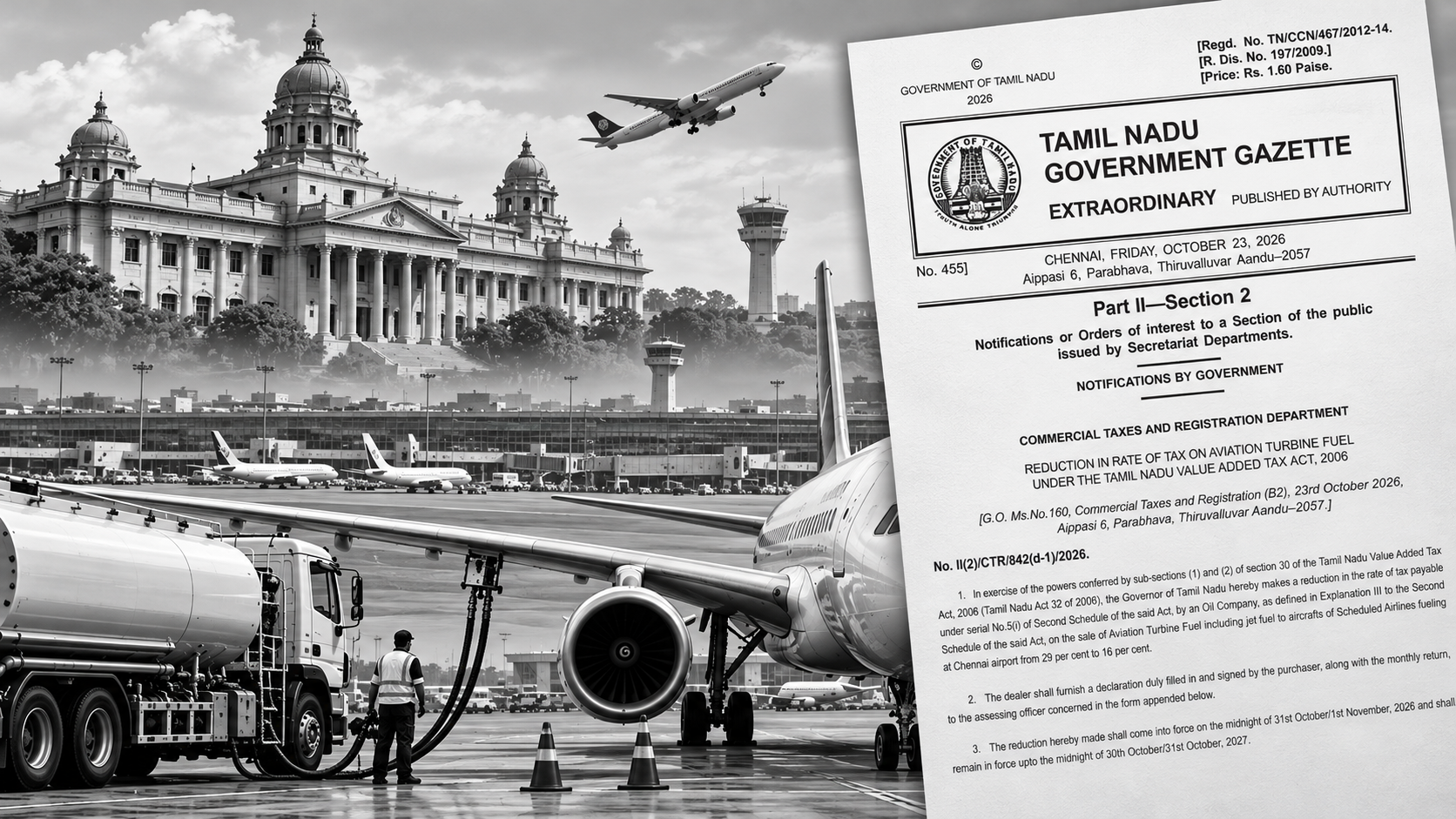
Tamil Nadu Cuts Aviation Turbine Fuel Tax to 16% at Chennai Airport, 1% at Other Airports
Tamil Nadu's decision to sharply reduce Value Added Tax (VAT) on Aviation Turbine Fuel (ATF) has drawn appreciation from the Union government, highlighting the growing importance of state-level tax reforms in controlling airline operating costs and improving air connectivity. The move aims to make the state's airports more competitive, support regional aviation and potentially improve affordability for passengers.
Under the revised structure, VAT on ATF supplied to scheduled airlines at Chennai airport will fall from 29 per cent to 16 per cent, while the rate at other airports across Tamil Nadu will be reduced to 1 per cent. The changes will take effect on November 1, 2026, and remain in force until October 31, 2027, according to a notification issued by the Commercial Taxes and Registration Department. A separate concession reduces VAT from 5 per cent to 1 per cent for eligible smaller scheduled aircraft weighing below 40,000 kilograms at airports outside Chennai.
Union Civil Aviation Minister Ram Mohan Naidu Kinjarapu welcomed the decision and thanked Tamil Nadu Chief Minister C. Joseph Vijay in a post on X. The minister described the reduction as a positive step for aviation, emphasising that making air travel more affordable requires cooperation between the Centre and state governments, with passengers remaining the shared priority.
The Centre had previously urged states to rationalise ATF taxes. In March 2025, Naidu highlighted Tamil Nadu's 29 per cent rate while calling for reductions to ease pressure on airlines. The latest decision addresses a long-standing industry grievance over Chennai's comparatively high refuelling costs.
Airlines purchase ATF from oil marketing companies such as Indian Oil, BPCL and HPCL, rather than from state governments. Suppliers collect the applicable VAT on eligible fuel sales and remit it to the state. Tamil Nadu's notification requires prescribed purchaser declarations to be submitted with monthly tax returns.
For example, on a taxable fuel purchase worth ₹10 crore, VAT falls from ₹2.9 crore at 29 per cent to ₹1.6 crore at 16 per cent in Chennai, an illustrative saving of ₹1.3 crore. At other airports, the 1 per cent rate would mean ₹10 lakh in VAT on the same taxable value.
Tamil Nadu's revised rates bring it closer to lower-tax states. Andhra Pradesh, Uttar Pradesh and several northeastern states have 1 per cent rates, while Gujarat and Odisha levy 5 per cent. Telangana's rate was listed at 16 per cent in the Union government's March 2026 schedule. Goa subsequently announced a reduction from 15 per cent to 7 per cent in October 2026.
Airlines have welcomed Tamil Nadu's decision, citing potential savings and improved connectivity. Lower taxes could support additional routes, regional tourism and business travel, particularly through Coimbatore, Madurai and Tiruchirappalli. However, cheaper tickets and new flights are not guaranteed, as airlines also consider demand, fuel prices and operational costs.
The immediate benefit is a lower tax burden on eligible fuel purchases. The longer-term success will depend on whether the concession attracts more aviation activity, improves regional connectivity and delivers tangible benefits to passengers.