
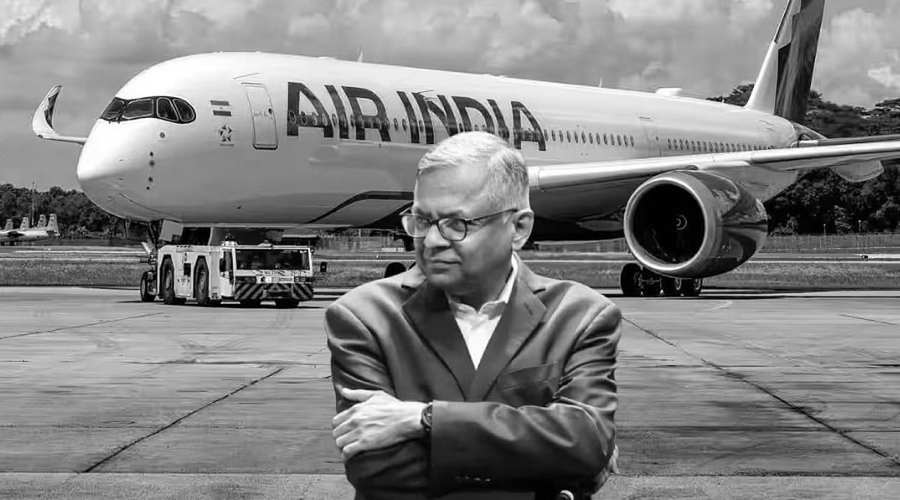
Tata Bets ₹10,000 Crore More On Air India As ₹22,238-Cr Loss Hits FY26, But There’s A Catch
When Tata Group took control of Air India in January 2022, the plan was not simply to keep the airline flying but to rebuild it into a modern global carrier. Four years later, much of that transformation is underway, but the financial numbers show that the hardest part may still lie ahead.
Air India reported a ₹22,238-crore combined loss for the Air India Group in FY26, more than double the ₹10,859-crore loss recorded a year earlier, making it the airline's most difficult year since the Tata takeover. The airline has faced higher fuel costs, longer international routes because of airspace restrictions, fleet problems, supply-chain disruptions and the fallout from the AI171 crash. The West Asia conflict also pushed up fuel costs and disrupted international operations.
Tata has responded with a costly overhaul. Air India has ordered hundreds of new aircraft, including fuel-efficient Airbus A350s and Boeing 787-9s, while spending about $400 million to refurbish older planes. The final one of 30 long-grounded aircraft inherited from the previous regime was returned to service earlier this year.
The group has also merged Air India and Vistara, while consolidating Air India Express and AIX Connect, creating a much larger airline group. Alongside the fleet changes, Tata has invested heavily in technology, maintenance, training and operational systems to address years of underinvestment.
But the strategy is now becoming more selective. Air India has rationalised some international services where airspace restrictions and high fuel prices made operations commercially difficult. It is also considering deferring some aircraft deliveries, signalling that expansion alone cannot be the answer when individual routes are under pressure.
Tata Sons has now approved, in principle, more than ₹10,000 crore in fresh capital for Air India, but the money will not come without conditions. The Tata Sons board, chaired by N. Chandrasekaran, has said Air India must present a business case when seeking the funds, signalling a sharper focus on how additional capital will translate into better performance.
The decision comes as Tata Sons weighs how much more capital the airline needs to complete its transformation while controlling the financial strain. Air India remains a long-term project, with Tata describing the rebuilding exercise as a five-to-10-year journey.
The next phase of execution will be led by Tewolde Gebremariam, who took over as CEO and managing director in August, succeeding Campbell Wilson. Wilson oversaw the initial stabilisation and integration; Gebremariam's task is to run the airline day to day, improving operations, network efficiency, costs, fleet utilisation, safety and profitability, while Tata Sons' board, not Air India's management, controls how much capital the group is prepared to commit.