
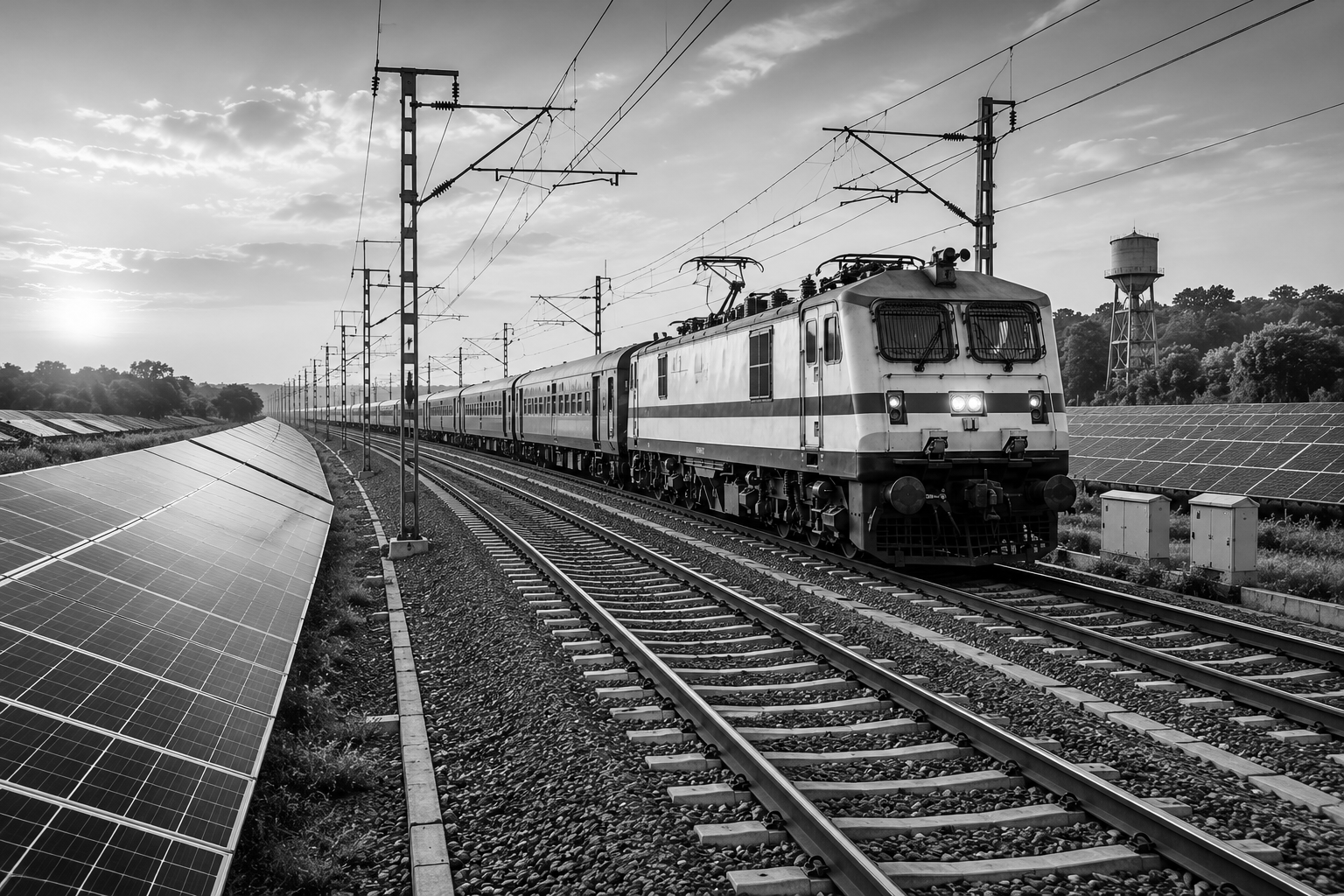
The ₹285-Crore Project That Reflects Indian Railways' New Modernisation Strategy
When people think of railway development, they often imagine new trains, additional tracks, modern stations or ambitious bullet train projects. Yet some of the most transformative investments in the railway sector are virtually invisible to passengers. The latest example is Indian Railways' ₹285.01-crore approval to upgrade the electric traction infrastructure on the Mahbubnagar–Secunderabad–Medchal section of South Central Railway, a project that could quietly unlock significant capacity on one of India's busiest rail corridors.
The sanctioned project will replace the existing 1x25 kV electric traction system with a more advanced 2x25 kV traction network across approximately 141 route kilometres . While the terminology may sound highly technical, the upgrade represents a crucial step in preparing the railway network for growing passenger demand, heavier freight traffic and a future powered increasingly by clean energy.
More Than Just Wires and Electricity
At its core, an electric traction system is the power backbone that keeps trains moving. Electricity from the grid is transmitted through traction substations and overhead wires before being collected by locomotives through pantographs mounted on their roofs. The entire system functions much like a dedicated electricity distribution network for trains.
The shift from 1x25 kV to 2x25 kV does not simply mean doubling the voltage supplied to trains. Instead, it creates a more efficient method of transmitting power over long distances. The technology reduces voltage fluctuations, improves power stability and allows multiple trains to operate simultaneously without placing excessive stress on the network.
For busy corridors carrying large volumes of passenger and freight traffic, this translates into smoother operations, higher reliability, reduced transmission losses and greater carrying capacity.
A Strategic Corridor Undergoing Transformation
The importance of the project becomes evident when examining the route itself. The Mahbubnagar–Secunderabad–Medchal section forms part of the larger Dharmavaram–Dhone–Mahbubnagar–Secunderabad–Medchal–Mudkhed–Indore–Ajmer corridor , one of the country's important High-Density Network (HDN) routes.
Every day, this corridor handles substantial passenger movement while also serving as a vital freight artery connecting industrial and commercial regions. As freight trains become longer and heavier and passenger demand continues to grow, the corridor requires a stronger and more reliable power infrastructure to sustain future traffic growth.
Railway planners increasingly view power-system upgrades as critical capacity-enhancement projects rather than mere technical improvements.
Part of a Larger ₹600-Crore Corridor Upgrade
The Telangana project is not an isolated initiative. It forms part of a broader corridor-wide modernization effort already underway across the region.
Earlier, Indian Railways sanctioned similar traction upgrades on the Medchal–Mudkhed section , covering 225 kilometres at a cost of ₹193.26 crore , and the Mahbubnagar–Dhone section , spanning 184 kilometres with an investment of ₹122.81 crore .
Together with the latest sanction, these projects cover nearly 550 route kilometres and involve investments of around ₹600 crore , reflecting a comprehensive strategy to strengthen one of southern India's most important freight and passenger corridors.
The scale of the investment suggests that Railways expects significant traffic growth along the route in the coming years.
The Shift From Expansion to Capacity Building
For decades, railway development was measured primarily by the number of new lines being laid. While expansion remains important, Indian Railways is increasingly focusing on making existing infrastructure more productive.
The national transporter is currently investing in: Track doubling, tripling and quadrupling, Dedicated Freight Corridors, KAVACH train protection technology, Advanced signalling systems, 2x25 kV traction upgrades, Digital and AI-driven operations
The objective is simple: run more trains, move more freight and improve reliability without necessarily building entirely new corridors.
This approach is helping Railways unlock additional capacity at a fraction of the cost of major greenfield infrastructure projects.
Powering One of the World's Largest Railway Networks
The significance of these upgrades becomes clearer when viewed against the scale of Indian Railways itself.
India operates the fourth-largest railway network in the world , carrying billions of passengers annually and transporting more than a billion tonnes of freight every year. The network is also one of the country's largest consumers of electricity.
Indian Railways consumes an estimated 34.5 billion units of electricity annually , equivalent to nearly 95 million units every day . The organisation spends more than ₹32,000 crore annually on traction energy, translating to approximately ₹89 crore every day simply to power trains across the country.
Electricity has now become one of the largest operating expenses for Railways, replacing diesel as the primary energy source following the near-complete electrification of the broad-gauge network.
Why Energy Efficiency Is Becoming a Priority
As electricity consumption rises, infrastructure upgrades such as the 2x25 kV traction system are becoming strategically important.
The technology enables more efficient power transmission, reduces voltage drops, improves operational stability and supports the movement of heavier freight trains. Even small improvements in efficiency can generate significant savings for an organisation that spends over ₹32,000 crore annually on electricity.
Railway experts point out that the future of rail infrastructure will depend as much on efficient energy management as on trains and tracks.
Supporting India's Green Railway Ambitions
The latest project also fits into Indian Railways' broader environmental vision.
Having electrified almost its entire broad-gauge network, Railways is now focusing on renewable energy adoption. Large-scale procurement of solar and wind power , solar installations at stations and workshops, and renewable-energy projects on railway land are becoming central components of its long-term strategy.
The organisation has set ambitious goals to move towards a net-zero carbon future , making it one of the world's largest transportation systems pursuing a clean-energy transition.
In this context, stronger traction infrastructure becomes essential because a modern railway powered increasingly by renewable energy requires a highly reliable electricity network.
Building the Railway Network of the Future
Industry experts believe the next phase of railway modernization will be defined not by individual train launches but by the creation of a high-capacity, technology-driven transportation ecosystem.
Projects involving Dedicated Freight Corridors , KAVACH , advanced signalling, renewable energy integration and traction-system upgrades are expected to reshape how the railway network operates over the next decade.
Against this backdrop, the ₹285-crore Mahbubnagar–Secunderabad–Medchal project may appear modest when compared to mega infrastructure schemes worth thousands of crores. Yet its significance lies in what it represents—a shift towards smarter infrastructure that maximizes the potential of existing assets.
Once completed, the project is expected to improve freight movement, enhance operational reliability, support future traffic growth and strengthen regional connectivity. More importantly, it demonstrates how Indian Railways is evolving from a traditional transport network into a modern, energy-efficient and future-ready mobility system capable of supporting India's expanding economy and logistics ambitions.