
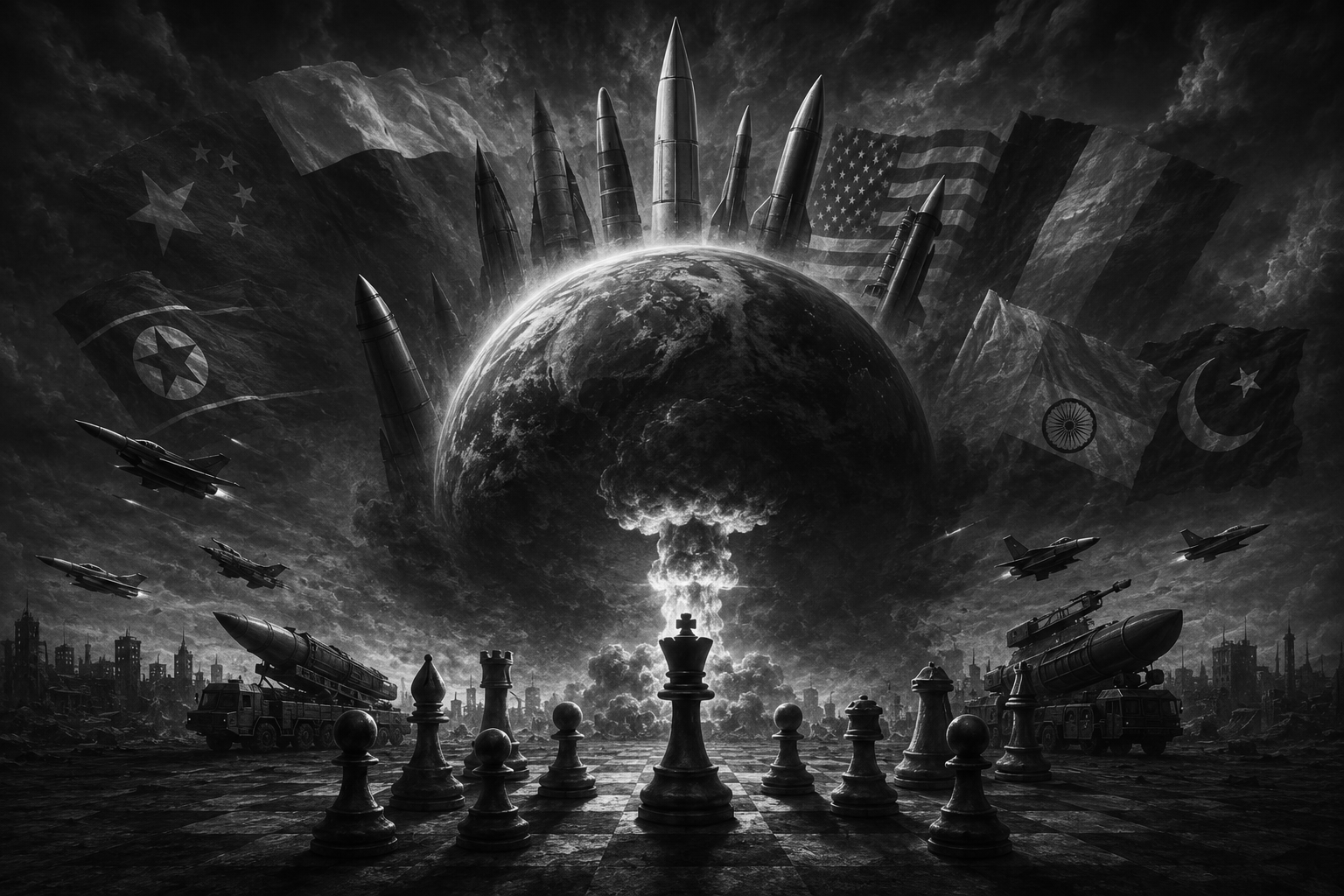
The Count Falls, the Danger Doesn't: Global Warheads Drop to 12,187 as the Leash Comes Off
The world's nine nuclear armed states held a combined inventory of 12,187 warheads as of January 2026, down from 12,241 a year earlier, with roughly 9,745 warheads kept in military stockpiles ready for potential use. The modest decline, documented in the Stockholm International Peace Research Institute (SIPRI) annual Yearbook released Monday, offers little comfort: an estimated 4,012 warheads were already deployed on delivery systems such as missiles and aircraft, and between 2,100 and 2,200 warheads were maintained on high operational alert , primarily by Russia and the United States .
The slight dip in overall numbers is largely attributable to retirement of ageing warheads in Washington and Moscow , even as all nine states continued programmes to modernise and enhance their arsenals in 2025, with most deploying new nuclear armed or nuclear capable weapon systems during the year. SIPRI's central warning is unambiguous: states are increasingly treating nuclear weapons as active instruments of national power , reversing decades of gradual drawdown.
China is expanding its arsenal faster than any other country, reaching 620 warheads , up from 600, and showcased several new nuclear systems at its 2025 military parade. By January, Beijing had loaded hundreds of missiles into three large silo fields in the north of the country while working to complete an additional 30 silos in mountainous eastern regions. SIPRI noted China could potentially match either Russia or the United States in ICBM numbers by the end of the decade.
France registered the sharpest proportional rise among established nuclear powers, with its stockpile climbing from 290 to 370 warheads , while North Korea expanded from 50 to 60. India now holds approximately 190 warheads , with its modernisation programme increasingly focused on long range weapons capable of reaching targets across China , even as planning continues around its long standing rivalry with Pakistan . Pakistan remained at 170 warheads but is developing new delivery systems and accumulating fissile material, suggesting its arsenal could grow significantly over the coming decade.
Both India and China are assessed to have possibly begun deploying warheads on high operational alert , a significant doctrinal shift that amplifies escalation risks. That concern is sharpened by Operation Sindoor . SIPRI described the May 2025 India-Pakistan conflict as a severe military crisis in which India struck Pakistani air and missile bases likely to have nuclear related roles, though both sides ultimately took steps to avoid escalation. Notably, India and Pakistan integrated cyber operations into active military conflict for the first time during the crisis, underscoring the changing nature of deterrence and warfare.
The structural collapse of arms control looms equally large. The New START treaty , the last bilateral framework limiting US and Russian strategic warheads, expired in February 2026, marking the first time since Richard Nixon met Leonid Brezhnev that the world's two largest nuclear powers have no active treaty constraining their arsenals. Compounding matters, the 2026 NPT Review Conference closed in May without a final outcome document, the third consecutive conference to do so, dealing another blow to the treaty's central bargain. Russia's Sarmat ICBM programme suffered another failed test launch in 2025, while its Burevestnik nuclear powered cruise missile reportedly completed a successful flight of more than 14,000 kilometres after multiple earlier failures.
SIPRI researchers called on all nuclear armed states to resume dialogue, warning that without new arms control frameworks , the combination of modernisation drives , eroding verification mechanisms and growing regional flashpoints leaves the world navigating its most precarious nuclear moment since the end of the Cold War .