
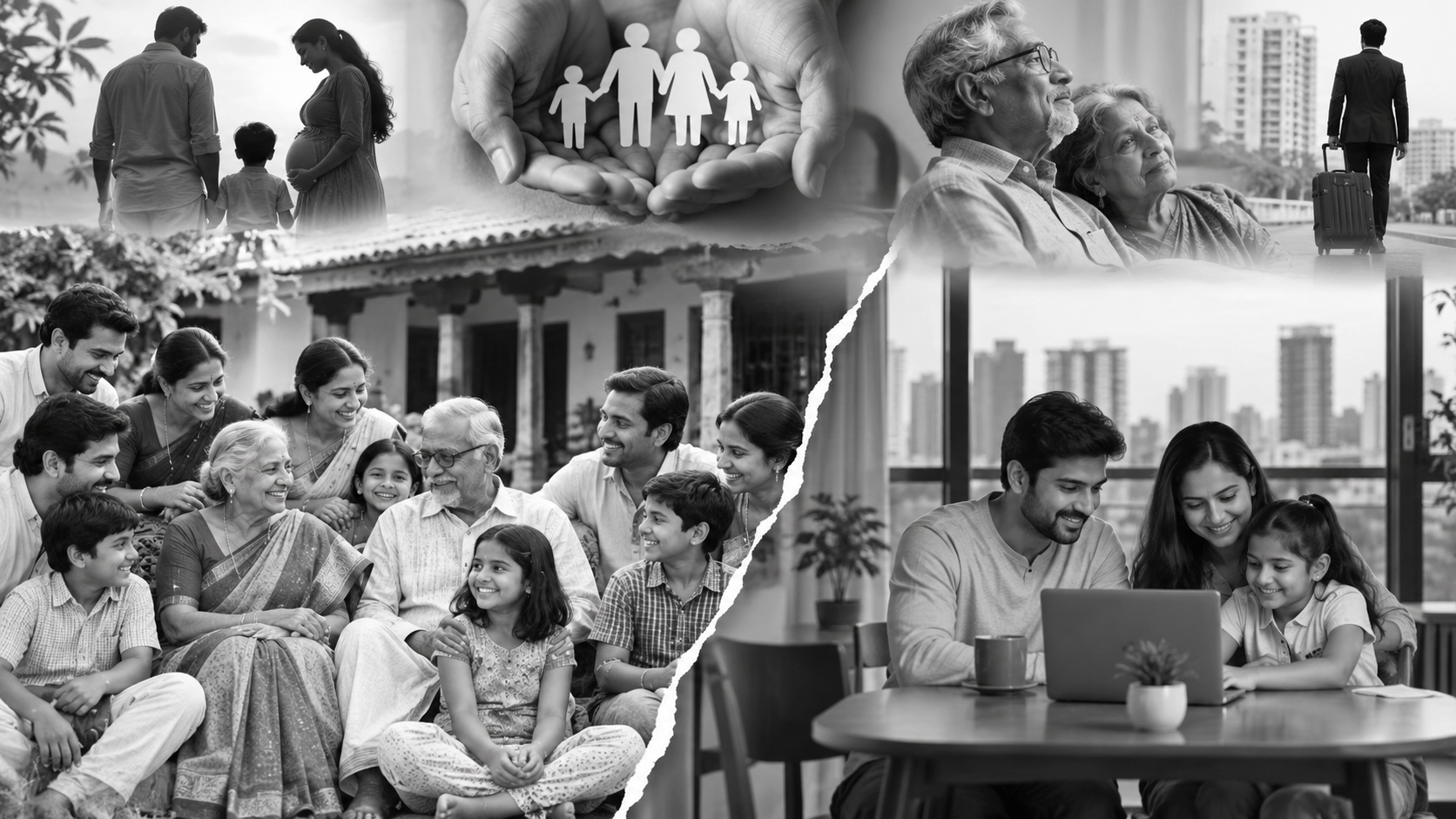
The Disappearing Joint Family: How Urban India Is Redefining Family Bonds
For generations, the Indian joint family represented more than a shared living arrangement. Grandparents, parents, children, uncles, aunts and cousins lived together, shared responsibilities and collectively managed household affairs. Family decisions were often made through discussions among elders, children grew up surrounded by multiple generations, and elderly members remained closely involved in everyday life. Beyond emotional connections, these households provided economic security, childcare, cultural continuity and support during difficult times. However, India's traditional family structure is undergoing a significant transformation as urbanisation, changing lifestyles, economic pressures and evolving reproductive choices reshape how people live and raise children.
The shift towards smaller households is particularly visible in metropolitan cities, where employment opportunities, education and professional mobility often require younger generations to move away from their ancestral homes. Rising housing costs, demanding work schedules and changing expectations surrounding marriage and parenthood have further encouraged independent living. While this transformation offers greater flexibility and personal freedom, it also raises questions about the future of intergenerational relationships and the social support traditionally provided by extended families.
From Joint Households to Nuclear Families
The changing composition of Indian households is supported by demographic research. An analysis conducted by the International Institute for Population Sciences (IIPS), using five rounds of the National Family Health Survey between 1992 and 2020, found that the average household size declined from 5.8 members to 4.5 members during the period. The proportion of households comprising three or more generations also decreased from 35.2% to 31.1%, while single-generation households increased from 8.8% to 14.9%. These findings indicate a gradual transition towards smaller household arrangements.
Historically, joint families were closely connected to India's agrarian economy, where multiple generations worked together, shared agricultural resources and collectively managed property. Industrialisation, expanding educational opportunities and the growth of urban employment gradually changed this arrangement. As younger people moved towards cities for better opportunities, maintaining a common household became increasingly difficult. Today, families may continue to share financial responsibilities and cultural traditions while living in different cities.
Family Planning and the Growing Preference for Smaller Families
One of the important developments influencing household composition is India's transition in family-planning practices. In 1952, India became the first country to introduce a national family-planning programme. Initially focused largely on reducing birth rates, the programme gradually expanded to include reproductive healthcare, contraception, maternal health and informed reproductive choices.
According to the National Family Health Survey-6 (NFHS-6), covering 2023–24, India's Total Fertility Rate remained at 2.0 children per woman, below the commonly accepted replacement-level benchmark of 2.1. The contraceptive prevalence rate increased from 66.7% in NFHS-5 to 69.1% in NFHS-6. These developments reflect wider access to contraception and changing reproductive choices among Indian couples.
For many urban households, decisions about having children are increasingly influenced by financial stability, career ambitions, housing affordability, education expenses and childcare costs. Couples often prioritise providing better healthcare, education and opportunities to fewer children rather than having larger families. However, declining fertility cannot be attributed entirely to family planning, as women's education, delayed marriages, economic uncertainty and changing social expectations also influence reproductive decisions.
Women's Independence and Changing Family Dynamics
The growing participation of women in education and employment has also transformed traditional household arrangements. Financial independence has given women greater influence over decisions concerning marriage, parenthood, household finances and childcare. Many working couples prefer independent households because they offer greater flexibility in managing professional responsibilities and personal choices.
Traditional joint households sometimes involve expectations surrounding domestic work, childcare and caregiving, which can create additional pressures on working women. Independent living may allow couples to distribute responsibilities according to their preferences. Nevertheless, both joint and nuclear families can offer supportive or challenging environments depending on how responsibilities and decisions are shared. The changing role of women should therefore be understood as part of a wider social transformation rather than a reason for the decline of traditional families.
Preserving Family Wealth, Traditions and Ancestral Legacy
Despite changing household arrangements, family legacy continues to hold considerable importance in Indian society. Large families have historically played a significant role in preserving ancestral property, agricultural land, traditional occupations, family businesses and cultural practices. Shared resources and accumulated experience have enabled several family-owned enterprises to survive across generations.
However, younger generations are increasingly reconsidering their involvement in inherited businesses and traditional occupations. A 2026 PwC Family Business Survey found that 91% of surveyed Indian family businesses reported having clearly defined family values, while 52% identified resistance from the senior generation as a major obstacle to preparing younger leaders. These findings highlight the challenges involved in balancing inherited responsibilities with changing professional aspirations.
Beyond financial inheritance, grandparents and older relatives often preserve family histories, languages, customs and traditional knowledge. Festivals, ancestral stories and community relationships are passed between generations through everyday interactions. Although geographical separation may reduce these opportunities, families can continue maintaining their identities through regular gatherings, shared celebrations and communication.
The Changing Relationship Between Grandparents and Grandchildren
The movement towards smaller households has also changed the relationship between older and younger generations. In traditional joint families, grandparents frequently participated in childcare, shared experiences and helped children understand family traditions. Their presence also reduced the responsibilities of working parents.
A HelpAge India report on intergenerational relationships published in 2025, covering 5,798 respondents across 10 Indian cities, found that 57% of young respondents and 55% of elderly respondents lived in nuclear households. Around 40% of elderly respondents lived in joint families. The study also highlighted communication gaps between generations and reported that 47% of elderly respondents experienced loneliness.
Digital communication has helped families maintain contact through video calls and messaging platforms. However, these interactions cannot always replace physical presence, particularly when elderly parents require assistance with healthcare and everyday activities. The growing distance between generations makes emotional support and regular communication increasingly important.
India's Ageing Population and the Future of Family Care
India's changing family structure is closely connected to its demographic transition. According to population projections by the Population Foundation of India and the International Institute of Migration and Development, the country's population could increase from approximately 135.6 crore in 2021 to 159 crore in 2051 under the medium-variant scenario. The proportion of people aged 60 and above is projected to rise from 9.6% to 20.4% during the same period.
This transition could increase demand for healthcare, pensions, assisted-living facilities and professional elderly-care services. Smaller families may also have fewer members available to share caregiving responsibilities when parents grow older. Research by the National Council of Applied Economic Research (NCAER) in 2026 highlighted the increasing importance of family support, individual financial resources and government assistance in addressing the needs of elderly citizens.
Declining fertility, however, does not mean India's population will immediately decrease. Population momentum will continue supporting growth for several decades, even as average family size becomes smaller. Regional differences in fertility and migration will also influence the availability of workers and the distribution of elderly populations.
Can Family Bonds Survive Changing Households?
The transformation of Indian families does not necessarily indicate the disappearance of traditional values. Younger generations may increasingly prefer independent living while continuing to maintain emotional, cultural and financial connections with relatives. Families living separately can still share responsibilities, preserve ancestral traditions and support elderly parents.
The future may therefore involve more flexible arrangements that combine individual independence with intergenerational support. Preserving family values will require greater attention to elderly care, equal domestic responsibilities, children's well-being and meaningful communication between generations.
Ultimately, the strength of a family cannot be measured by the number of people living under one roof. It depends on whether generations continue to support one another, preserve their shared identity and take responsibility for each other's well-being. As India moves towards smaller households and an ageing population, the real challenge is not simply preserving the traditional joint family, but ensuring that the bonds, responsibilities and values it represented survive in a rapidly changing society.