
The Groundwater Crisis Beneath India’s Farms and the Watershed Solution Taking Shape
For decades, India's response to water scarcity has largely revolved around large dams, canals, and irrigation projects. Yet as climate change intensifies, groundwater levels decline, and rainfall patterns become increasingly unpredictable, policymakers are looking toward a quieter but potentially transformative solution: watershed management .
The renewed focus was evident at the recent national consultation organized by the National Rainfed Area Authority (NRAA) and the Department of Land Resources (DoLR) under the World Bank-assisted REWARD Programme . The meeting was convened to finalize draft National Technical Guidelines (NTG) for Improved Watershed Management , which could shape how India plans, funds, and monitors watershed projects for years to come.
At first glance, the consultation may appear to be a routine policy exercise. In reality, it is part of a much larger effort to strengthen India's resilience against drought, water stress, land degradation, and climate change.
Why Watersheds Matter
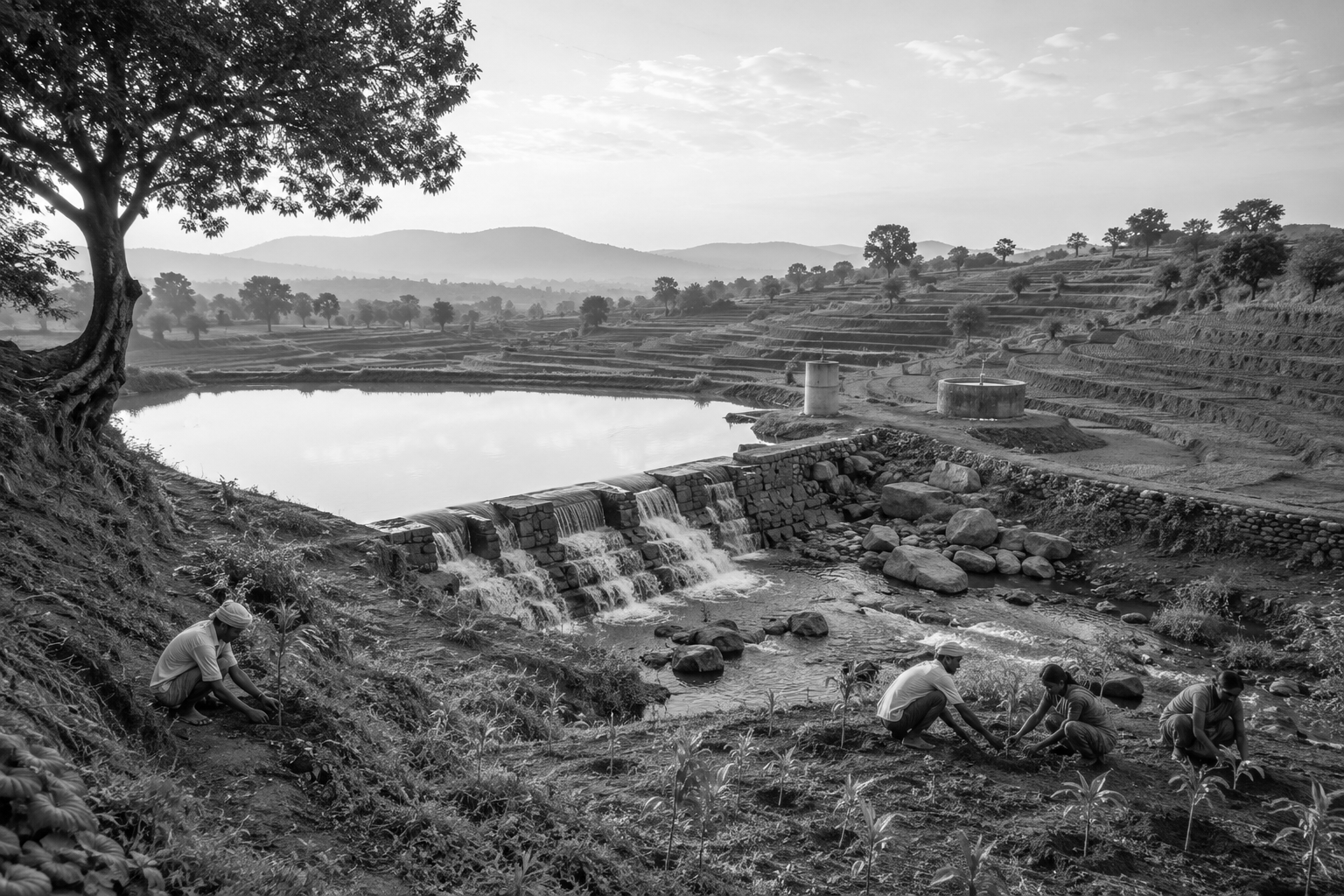
A watershed is a natural landscape where rainfall drains into a common stream, river, lake, or groundwater system. Effective watershed management seeks to conserve every drop of rain through interventions such as farm ponds, check dams, contour trenches, percolation tanks, recharge pits, and soil conservation structures.
The concept is particularly important for India because nearly half of the country's cultivated area remains dependent on rainfall. Millions of farmers in these regions face recurring droughts, declining groundwater levels, and uncertain crop yields.
Unlike large irrigation projects that transport water across regions, watershed development focuses on capturing rainwater where it falls. The objective is simple: reduce runoff, increase groundwater recharge, improve soil moisture, and enhance agricultural productivity.
Thousands of Crores at Stake
The scale of India's watershed programme is substantial.
The Government of India approved WDC-PMKSY 2.0 for the period 2021–26 with a physical target of 49.5 lakh hectares and a central financial outlay of ₹8,134 crore . The programme represents one of the country's largest investments in rainfed agriculture and natural resource management.
Parallel to this initiative is the REWARD Programme (Rejuvenating Watersheds for Agricultural Resilience through Innovative Development) , implemented between 2021 and 2026. The programme has a total budget of USD 167.71 million , including USD 115 million provided by the World Bank. It is currently being implemented in Karnataka and Odisha as a model for modern watershed management.
What makes these investments significant is that they are often combined with funding from schemes such as MGNREGA , horticulture missions, livestock programmes, and rural livelihood initiatives, multiplying their impact on the ground.
Where Does the Money Go?
Contrary to common assumptions, watershed programmes are not direct subsidy schemes.
Most funds are invested in community assets and ecological restoration. Water conservation structures account for a major share of expenditure. These include check dams, farm ponds, recharge shafts, percolation tanks, and water harvesting systems designed to retain rainfall and replenish groundwater.
Another significant portion is allocated to land development activities such as bunding, erosion control, soil-moisture conservation, and restoration of degraded lands. Livelihood components support horticulture, agroforestry, dairy farming, fisheries, self-help groups, and farmer collectives.
Increasingly, funds are also being directed toward GIS mapping, drone surveys, remote sensing, hydrological monitoring, and digital decision-support systems . These technologies are expected to improve planning accuracy and enhance accountability.
The Climate Change Connection
What differentiates the current generation of watershed programmes from earlier efforts is the growing emphasis on climate resilience .
The World Bank notes that Indian agriculture faces mounting challenges from land degradation, soil erosion, water scarcity, climatic uncertainties, and declining productivity. Watershed management is now viewed as a critical strategy for helping farmers adapt to these pressures.
Officials involved in the REWARD programme believe that science-based watershed planning can improve groundwater recharge, reduce soil loss, increase crop productivity, and strengthen farmers' ability to cope with erratic rainfall and prolonged dry spells.
This shift explains why the new guidelines place significant emphasis on technology, data analytics, and evidence-based planning rather than traditional construction-focused approaches.
Successes and Persistent Challenges
India's watershed initiatives have delivered notable successes in several states. Improved groundwater levels, increased cropping intensity, higher agricultural productivity, and diversification into horticulture and allied activities have been reported in many project areas.
Yet challenges remain.
One of the biggest concerns is the long-term maintenance of watershed assets. While thousands of structures are built every year, many deteriorate once project funding ends. Experts argue that sustainability and community ownership have often received less attention than construction targets.
Groundwater extraction also continues to outpace recharge in several regions. In many areas, farmers respond to improved water availability by drilling additional borewells, creating a cycle that can undermine conservation gains.
Institutional fragmentation presents another obstacle. Agriculture, water resources, forestry, rural development, and local governance departments frequently operate independently, limiting the effectiveness of integrated watershed planning.
The Technology Revolution in Watershed Development
The most significant outcome expected from the new National Technical Guidelines is the modernization of watershed governance.
Officials have called for greater use of artificial intelligence, chatbots, drone technology, hydrological modelling, GIS-based planning, remote sensing, and technology-enabled monitoring systems . The objective is to create a transparent, data-driven framework capable of delivering measurable outcomes.
The proposed framework also seeks stronger participation from local communities, Panchayati Raj Institutions, technical service providers, and civil society organizations to ensure that assets remain productive long after project implementation ends.
Beyond Water Conservation
The broader significance of watershed management lies in its ability to address multiple national priorities simultaneously.
A well-designed watershed can improve groundwater recharge, enhance agricultural productivity, create rural employment, support livestock development, restore degraded landscapes, and strengthen climate resilience. It can also reduce migration pressures by creating more sustainable livelihoods in rural areas.
For this reason, watershed development is increasingly being viewed not simply as an environmental programme but as a cornerstone of India's rural development strategy.
The discussions taking place under the NRAA-led consultation are therefore about much more than technical guidelines. They are about determining how India will invest thousands of crores of rupees in protecting its most valuable natural resources over the coming decade.
As climate uncertainties grow and water stress deepens across many regions, the success of these efforts may prove crucial to the future of Indian agriculture. The question is no longer whether watershed management is important. The real question is whether India can scale, sustain, and modernize it quickly enough to meet the challenges ahead.