
The Long Road to Nirmal Ganga: Progress, Pitfalls and the Rivers Still Waiting
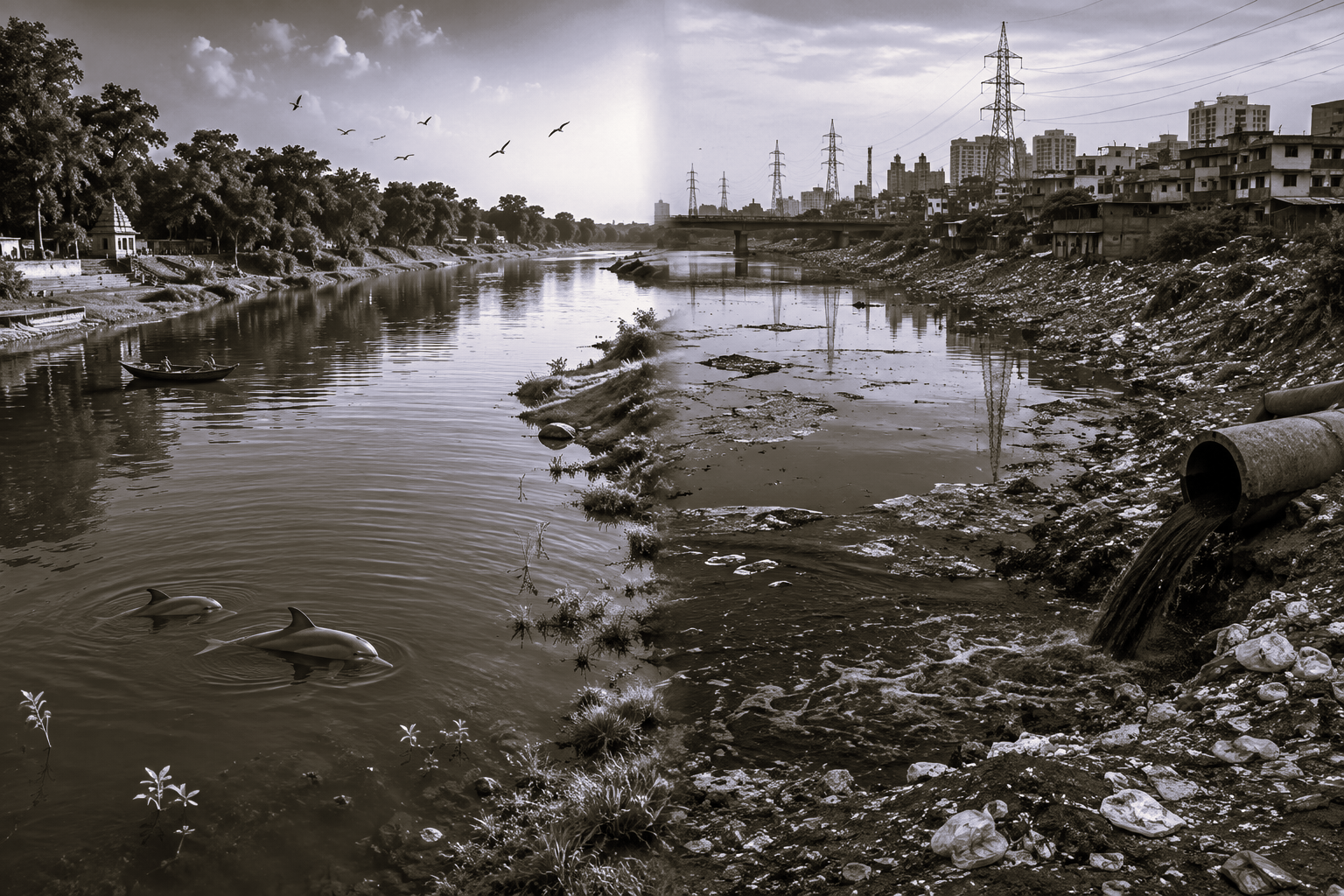
For centuries, India's rivers have been the cradle of its civilization, sustaining agriculture, ecosystems, trade and faith. Yet today, many of these lifelines are battling an unprecedented crisis. Rapid urbanisation, untreated sewage, industrial effluents, plastic waste, disappearing wetlands and rampant encroachments have transformed several rivers into polluted channels struggling to support life, a crisis visible in the Ganga, Yamuna and Hyderabad's Musi.
A Crisis of Staggering Scale
The scale of the problem is staggering. According to the Central Pollution Control Board (CPCB), urban India generates nearly 72,368 Million Litres per Day (MLD) of sewage against a treatment capacity of only 31,841 MLD a daily gap of over 40,000 MLD, or roughly 26.4 trillion litres annually, much of which ends up in rivers and wetlands.
From Ganga Action Plan to Namami Gange
Efforts to save the Ganga date back to 1985, when Prime Minister Rajiv Gandhi launched the Ganga Action Plan, followed by Ganga Action Plan-II and the National Ganga River Basin Authority in 2009. These programmes built infrastructure but were undone by fragmented planning and poor maintenance. In June 2014, the government launched Namami Gange, with an initial outlay of ₹20,000 crore, adopting an Integrated River Basin Management (IRBM) approach built on five pillars Nirmal Ganga (pollution control), Aviral Ganga (uninterrupted flow, backed by e-flow norms notified in 2018), Jan Ganga (public participation), Gyan Ganga (research) and Arth Ganga (livelihoods). A key innovation was the Hybrid Annuity Model (HAM), under which private developers build and operate Sewage Treatment Plants (STPs) for 15 years, tying payment to performance.
Mission-I: Laying the Foundation
Namami Gange Mission-I (2014–2021) laid the foundation, sanctioning hundreds of projects, protecting the Gangetic Dolphin, gharial, turtles and native fish, and establishing the National Centre for River Research at the Wildlife Institute of India. But rejuvenating a river supporting nearly 40% of India's population demanded more.
Mission-II: Chasing Measurable Outcomes
Mission-II, extended till March 2026 with an added ₹22,500 crore taking the total commitment to ₹42,500 crore, plus ₹3,100 crore in the 2026-27 Budget shifted focus from infrastructure to measurable outcomes. In 2025, 70 sewerage projects were implemented, including 25 new STPs; by June 2026, the mission had created 4,263 MLD of treatment capacity. Overall, 219 sewerage projects worth ₹35,970 crore have been sanctioned to build 6,610 MLD capacity, with 146 completed. Across Namami Gange, 524 projects worth ₹43,030 crore have been sanctioned, of which 355 are complete.
Signs of Improving Water Quality
Water quality data shows encouraging trends. The CPCB found the Haridwar–Sultanpur stretch in Uttarakhand removed entirely from its Polluted River Stretches (PRS) list, with improvements in Uttar Pradesh and West Bengal, though parts of Bihar remain a concern. Bio-monitoring across 50 Ganga locations and 26 Yamuna locations in 2024-25 found Biological Water Quality mostly "Good" to "Moderate."
Biodiversity: The Mission's Strongest Achievement
Biodiversity restoration stands out as the mission's strongest achievement. Surveys across 7,680 km documented 3,037 gharials, feeding into a National Gharial Conservation Action Plan. Four Aquatic Animal Rescue and Rehabilitation Centres and India's first Dolphin Rescue Ambulance have helped rescue nearly 6,800 aquatic animals, while breeding programmes produced over 1,500 turtle hatchlings, with 711, 893 and 1,899 turtles and gharial yearlings released into the wild alongside conservation of the Critically Endangered Red-crowned Roofed Turtle. Fisheries data lists 215 fish species ( 206 native, 9 exotic), with 2.05 crore fish seeds released via ICAR-CIFRI. Beyond the river, seven Ganga Biodiversity Parks, afforestation across 33,024 hectares, over 5,500 Ganga Praharis, and 20 newly notified wetlands in Uttar Pradesh mark landscape-level gains. India's first dolphin census estimated the Gangetic Dolphin population at 6,327.
Beyond the Ganga: Yamuna and Musi
Yet experts caution the Ganga is only part of a larger crisis. In Delhi, the Yamuna's 22-km stretch under 2% of its length contributes 70–80% of its total pollution load, prompting an integrated push of new STPs, interceptor sewers and floodplain restoration. A similar model now drives the 55-km Musi Rejuvenation Project in Hyderabad, backed by ₹7,345 crore from the Telangana government.
The Encroachment Problem
Encroachment compounds the crisis. A Delhi Development Authority survey found 76% ( 7,362.56 hectares) of the Yamuna's floodplain encroached upon, prompting repeated National Green Tribunal interventions. The Musi faces similar pressures, with rehabilitation of riverside families now a contentious part of its restoration.
Rally for Rivers and Cauvery Calling
Beyond government efforts, Sadhguru Jaggi Vasudev's Rally for Rivers ( 2017) mobilised over 162 million people across 9,300 km, advocating catchment restoration through agroforestry rather than river-linking, and produced a 760-page policy submitted to the Prime Minister. It evolved into Cauvery Calling ( 2019), aiming to plant 2.42 billion trees in the Cauvery basin through CSR and public funding though scientists stress plantation alone cannot revive sewage-choked urban rivers like the Yamuna, Musi and Mithi.
Shortcomings and Criticism
Namami Gange itself hasn't escaped criticism. Implementation delays pushed several Mission-I projects into Mission-II; sewage generation continues to outpace treatment capacity; and a Comptroller and Auditor General audit in Uttarakhand flagged delayed execution, defective STP designs and untapped drains. Experts also want a sharper focus on industrial pollution, sand mining, plastic waste and climate-driven monsoon volatility.
The Road Ahead
Still, there is broad consensus that Namami Gange has reshaped India's river conservation philosophy from engineering fixes to Integrated River Basin Management influencing newer efforts on the Yamuna and Musi alike. As India eyes Viksit Bharat 2047, the health of its rivers remains a defining test: restoring not just clean water, but the ecosystems, livelihoods and communities that depend on them.