
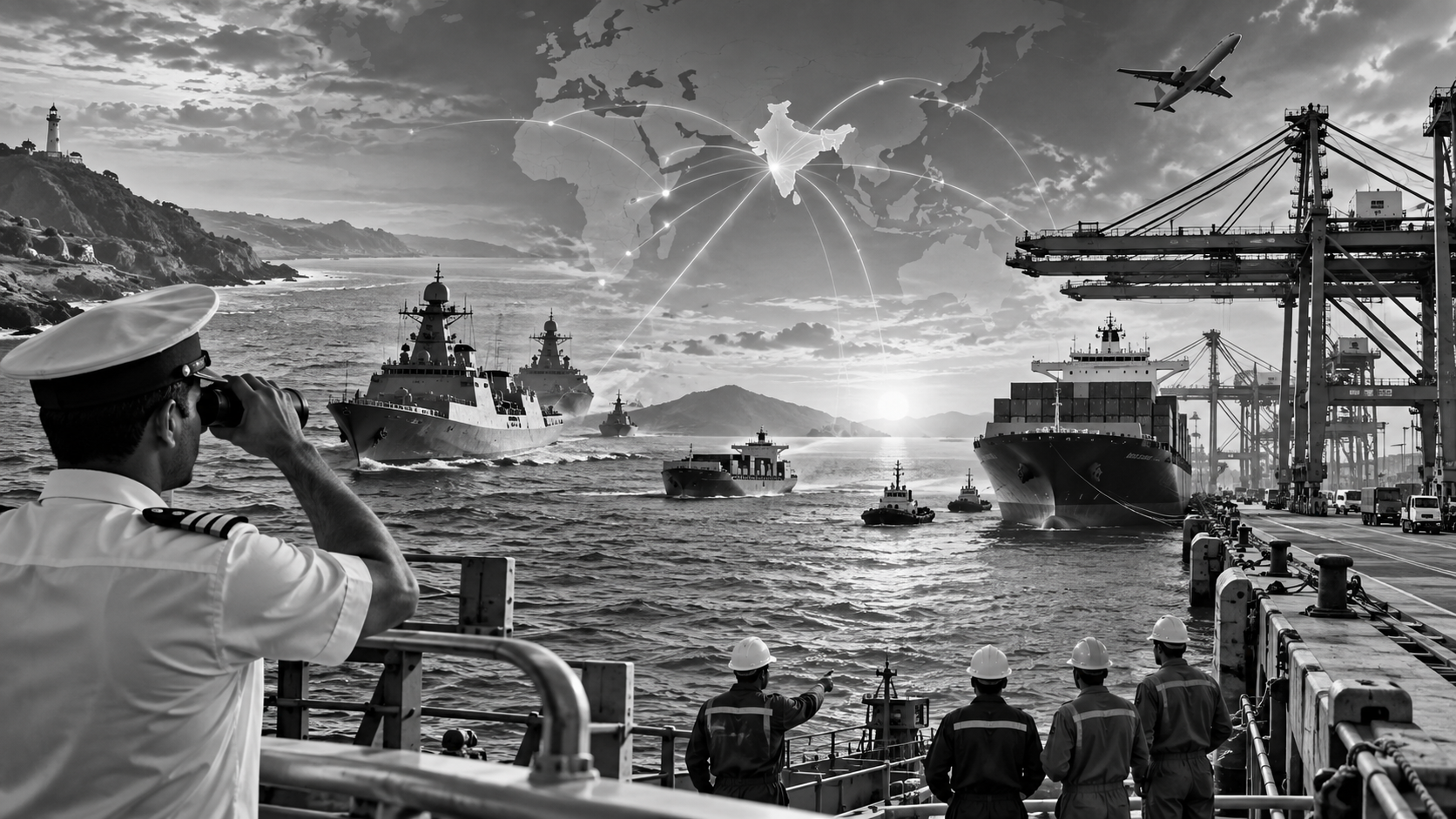
The New Maritime India: Ships, Ports, People and Partnerships
As the world marks World Maritime Day on September 24, India’s maritime journey presents a story of expanding ports, stronger naval capabilities, growing international partnerships and a rapidly rising pool of seafarers. The International Maritime Organization’s theme for 2026 and 2027 - “From Policy to Practice: Powering Maritime Excellence” - is particularly relevant to India, where the focus is increasingly shifting from announcing maritime ambitions to delivering capacity, connectivity and competitiveness on the ground.
A Maritime Geography Turning into a Maritime Strategy
With a coastline of more than 11,000 km, extensive inland waterways and the vast Indian Ocean on its doorstep, India has long been a maritime geography. Nearly 95% of the country’s trade by volume and around 70% by value moves through the sea, making ports and shipping central to the economy.
Over the past decade, however, the emphasis has moved beyond simply handling cargo. Through Sagarmala, port modernisation, multimodal connectivity and coastal development, India has attempted to build an integrated maritime economy. Port capacity has expanded dramatically, while major ports handled a record volume of cargo in 2025-26. Coastal shipping and inland-waterway cargo have also increased substantially, indicating a gradual shift towards alternative transport routes.
The next challenge is to ensure that capacity translates into internationally competitive turnaround times, lower logistics costs, seamless rail-road-port connectivity and greater participation in global shipping.
From SAGAR to a Wider Maritime Network
India’s maritime diplomacy has expanded alongside its infrastructure. The SAGAR - Security and Growth for All in the Region - approach has increasingly been expressed through naval cooperation, humanitarian assistance, training, surveillance and connectivity projects across the Indian Ocean.
India now maintains diplomatic relationships with 32 of the 35 Indian Ocean littoral countries, according to a Parliamentary Standing Committee assessment. The committee has also called for deeper strategic engagement, stronger maritime-domain awareness, intelligence sharing, joint patrols and better coordination among Indian agencies.
This network extends beyond naval diplomacy. India has provided development assistance and Lines of Credit worth billions of dollars to countries across Asia, Africa and other regions. While these funds cover sectors far beyond maritime infrastructure, port, transport, connectivity and coastal projects form part of the broader economic network through which India engages partner countries.
Chabahar, Sittwe and the Search for Strategic Connectivity
India’s maritime outreach has also moved beyond its own coastline. At Chabahar Port in Iran, India signed a long-term contract in 2024 to operate the Shahid Beheshti terminal for 10 years. The port provides India with a route towards Afghanistan and Central Asia and forms an important element of the International North-South Transport Corridor.
On the eastern side, India Ports Global Limited began operating Sittwe Port in Myanmar in 2024. The port is part of the Kaladan Multimodal Transit Transport Project, intended to create an alternative connectivity route between India’s eastern seaboard and the Northeast.
Meanwhile, the BIMSTEC Maritime Transport Cooperation Agreement, signed in 2025, seeks to improve maritime movement, documentation and coordination among seven member states. The India-UAE framework for the India-Middle East-Europe Economic Corridor (IMEC) adds another long-term dimension to India’s ambition to become a major connectivity hub. These initiatives are still developing, but together they show a broader maritime strategy linking ports with diplomacy, trade and regional integration.
A Navy Built Increasingly at Home
India’s naval transformation is perhaps the most visible part of its maritime rise. More than 177 ships and submarines have been built and commissioned domestically, while a large proportion of current naval orders are being executed by Indian shipyards.
The Navy has expanded its fleet of destroyers, frigates, submarines and specialised vessels, while indigenous programmes have strengthened domestic design and manufacturing capabilities. The commissioning of platforms such as INS Vikrant, India’s first indigenously designed and built aircraft carrier, marked an important milestone in this process.
The transformation is continuing. Indigenous platforms such as the stealth frigate Dunagiri, hydrographic survey vessel Sanshodhak and anti-submarine warfare vessel Agray entered the commissioning pipeline in 2026, reflecting the expanding range of capabilities being produced domestically.
Yet modernisation remains necessary. Parliamentary data has noted that the Navy operates 137 ships and submarines and 264 aircraft, with more than half of its vessels being over 15 years old. The fleet therefore needs continuous replacement as well as technological upgrading.
The Seafarer Advantage
India’s strongest maritime asset may not be a ship or port, but its people. According to the BIMCO-ICS Seafarer Workforce Report 2026, India has become the world's second-largest supplier of seafarers, with 311,936 maritime professionals, accounting for 12.16% of the global seafaring workforce. Indian officers alone represent 13.41% of the world's officer workforce.
This gives India an opportunity to move beyond supplying crews. Maritime education, ship management, marine engineering, naval architecture, maritime law, insurance, classification, digital shipping and other high-value services could turn the country's human-resource advantage into a broader maritime-services industry.
Shipbuilding: The Biggest Unfinished Opportunity
India's naval shipbuilding capabilities have grown, but its commercial shipbuilding presence remains much smaller than its maritime potential. The government has therefore introduced a ₹69,725-crore maritime and shipbuilding package, including a ₹24,736-crore Shipbuilding Financial Assistance Scheme, a ₹25,000-crore Maritime Development Fund and a ₹19,989-crore Shipbuilding Development Scheme. The latter aims to expand domestic shipbuilding capacity to 4.5 million gross tonnes annually.
Greenfield shipbuilding clusters have also received in-principle approval in Andhra Pradesh, Gujarat and Tamil Nadu, while brownfield expansion of existing yards is being supported. In March 2026, 288 contracts covering 456 vessels had received in-principle approval under the earlier financial assistance policy.
The objective now is to build not merely more ships, but a complete ecosystem involving marine equipment, engines, specialised steel, electronics, financing, insurance, repair and maintenance.
From Port Expansion to Global Competitiveness
India has also used international maritime summits to attract investment and establish partnerships. At India Maritime Week 2025, more than 85 countries participated and over 600 MoUs worth more than ₹12 lakh crore were signed across ports, sustainability, shipbuilding, port-led industrialisation and trade facilitation.
The scale of these announcements demonstrates investor interest, but the more important test is implementation. The IMO's 2026 theme captures this challenge precisely: maritime policies must ultimately become operational capacity.
What India Must Do Next
India's maritime future will depend on whether it can convert its geographical advantage, naval strength and large seafarer workforce into greater commercial maritime power. Increasing Indian ownership of merchant vessels, expanding commercial shipbuilding, developing ship repair and transshipment facilities, improving maritime finance and attracting global shipping services are key priorities.
At the same time, ports will need to become greener and more digital, while shipping must prepare for alternative fuels and stricter environmental standards. Maritime-domain awareness, cybersecurity, autonomous systems, drones and satellite-based surveillance will become increasingly important.
The final challenge is integration. India has built ports, ships, corridors, naval capabilities, international partnerships and human capital. The next phase is to make these pieces work as one maritime ecosystem.
That is ultimately what “From Policy to Practice” means for India. The country has moved considerably beyond viewing the ocean merely as a trade route. Its next test is whether it can turn its maritime network into sustained economic value, technological capability, regional connectivity and global influence - while keeping its seas safe, secure and environmentally sustainable.