
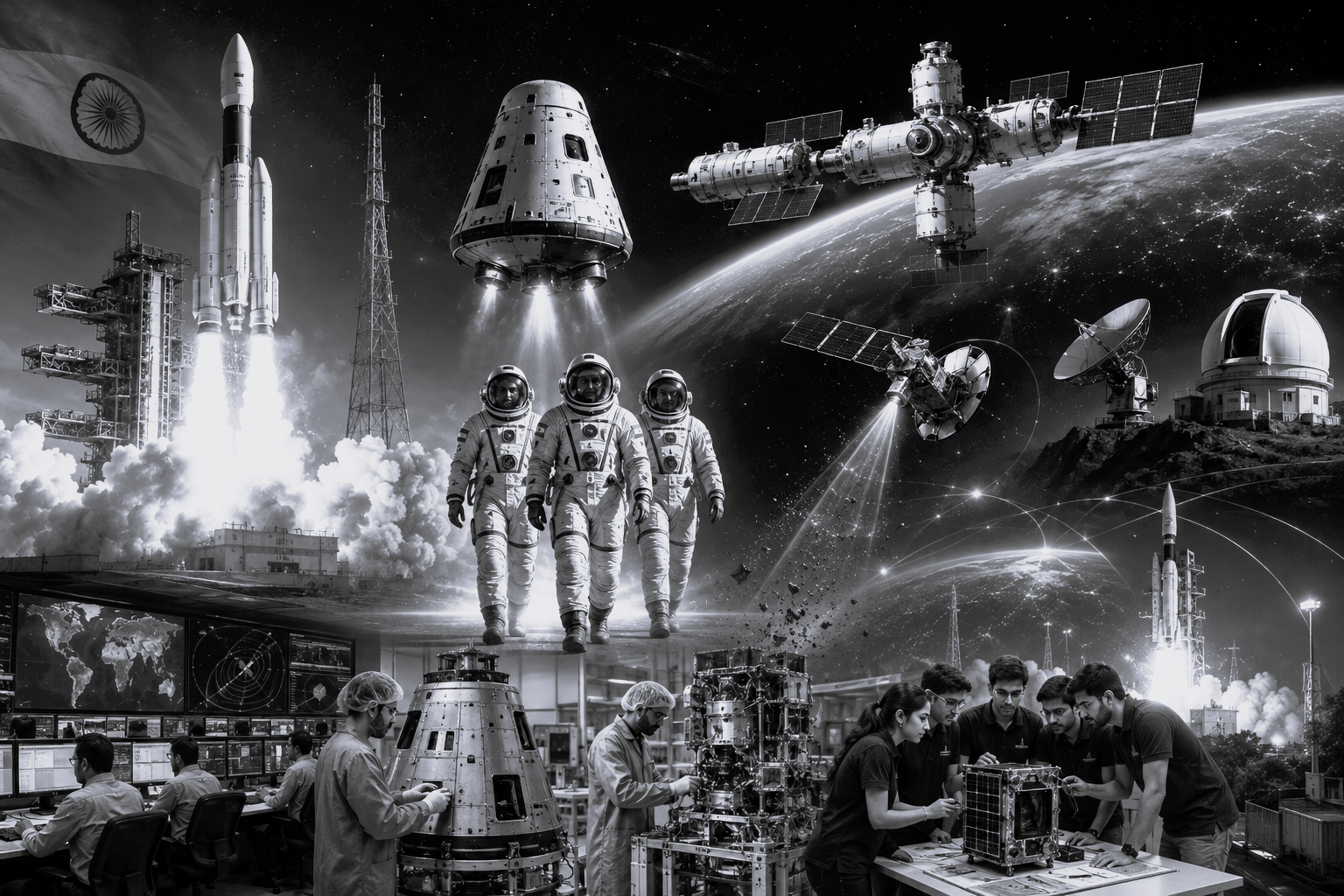
The New Space Age Is Indian
India is entering a defining decade in its space journey. Having earned global recognition through landmark missions such as Chandrayaan-3, Aditya-L1 and SPADEX, the country is now pursuing an ambitious roadmap that extends beyond satellite launches to human spaceflight, a national space station, commercial space innovation, and responsible space operations. Together, these initiatives form the foundation of Space Vision 2047, which seeks to transform India into one of the world's leading space powers while expanding the country's space economy from about $8 billion today to nearly $44 billion by 2033, increasing India's share of the global space economy from around 2% to 8%.
The latest updates presented by Union Minister of State (Independent Charge) for Science and Technology, Earth Sciences, Atomic Energy and Space Dr. Jitendra Singh in Parliament reveal that India is advancing on multiple fronts simultaneously preparing astronauts for space, building indigenous orbital infrastructure, safeguarding satellites from growing orbital congestion and nurturing a vibrant private space ecosystem.
Gaganyaan Enters Advanced Stage
India's first indigenous human spaceflight mission, Gaganyaan, has crossed several critical development milestones and is steadily progressing toward its historic launch. Once completed, India will become only the fourth nation after the United States, Russia and China to independently send humans into space using its own launch vehicle and spacecraft.
The mission aims to place three Indian astronauts in Low Earth Orbit (LEO) for nearly three days before safely bringing them back to Earth through a controlled splashdown in the Indian Ocean.
At the heart of the programme is the Human Rated Launch Vehicle (HLVM3), whose propulsion stages and structural systems have completed development and ground qualification. The Orbital Module, consisting of the Crew Module and Service Module, has also witnessed major progress, with propulsion systems successfully developed, tested and qualified.
ISRO has realised the engineering model of the Environmental Control and Life Support System (ECLSS), which will provide astronauts with breathable air, regulate cabin temperature and pressure, remove carbon dioxide and ensure a safe environment during the mission. The spacecraft's Thermal Protection System, Crew Module Uprighting System, deceleration system and end-to-end avionics have also undergone successful testing.
The Crew Escape System (CES), one of the mission's most crucial safety features, has completed development and qualification of all five motor variants, while associated structures have also been successfully tested.
Supporting infrastructure has expanded significantly with the establishment of the Orbital Module Preparation Facility, Gaganyaan Control Centre, Crew Training Facility, dedicated mission control infrastructure and modifications to the Second Launch Pad at Sriharikota.
Uncrewed Missions Before Astronauts Fly
Before astronauts board the spacecraft, ISRO plans a series of progressively complex validation missions.
The TV-D1 mission successfully demonstrated the in-flight performance of the Crew Escape System, while Integrated Air Drop Test-01 (IADT-01) and Integrated Air Drop Test-02 (IADT-02) validated the parachute-based recovery and deceleration systems using simulated crew modules.
Preparations are currently underway for the TV-D2 mission.
The first uncrewed experimental mission, targeted for the fourth quarter of 2026, will carry Vyommitra, ISRO's half-humanoid robot designed to simulate human responses in space. Vyommitra will evaluate life-support systems, crew interfaces, mission operations and onboard technologies that are being deployed for the first time.
Two more uncrewed missions in the same configuration as the final crewed flight will follow before India's first human spaceflight mission, targeted for 2027.
Parallelly, ISRO continues extensive ground qualification tests for newly developed human spaceflight technologies. Biomedical and life-support systems being developed for Gaganyaan are expected to have significant civilian applications in healthcare, emergency medicine and life sciences after successful validation.
Bharatiya Antariksh Station: India's Orbital Laboratory
Beyond Gaganyaan, India has set its sights on creating its own permanent orbital outpost.
The proposed Bharatiya Antariksh Station (BAS) is targeted to become operational by 2035. ISRO has finalised the overall configuration comprising five interconnected modules, while the government has already approved development and launch of the first module, BAS-01.
Overall system engineering and subsystem development are progressing across various ISRO centres.
Once operational, BAS is expected to support three to four astronauts on long-duration missions in Low Earth Orbit, enabling continuous research in microgravity science, biotechnology, pharmaceuticals, advanced materials, agriculture, robotics and space medicine. It will also serve as a crucial stepping stone toward India's long-term objective of sending astronauts to the Moon by 2040.
The Union Cabinet had earlier approved ₹20,193 crore in September 2024 for the execution of eight major human spaceflight missions, underscoring the government's long-term commitment to indigenous human space exploration.
Global Partnerships Strengthen India's Human Spaceflight Programme
Although Gaganyaan is fundamentally an indigenous programme, ISRO is leveraging international expertise in specialised areas.
The European Space Agency (ESA) is providing support for mission tracking and communication networks. The Australian Space Agency (ASA) is collaborating on crew and crew module recovery operations, while France's CNES has trained ISRO flight surgeons and ground support personnel.
ISRO has also signed a Memorandum of Understanding with Russia's Roscosmos, facilitating astronaut training at the Gagarin Cosmonaut Training Centre and enabling procurement of specialised hardware, including crew seats, viewports, flight suits and wind tunnel testing support.
Growing Space Activity Brings New Challenges
While India prepares for human spaceflight, it is simultaneously addressing one of the fastest-growing concerns in modern space operations— orbital debris.
With the rapid increase in global satellite launches, Low Earth Orbit, extending up to 2,000 kilometres, has become the most crowded orbital region. International tracking networks currently monitor more than 40,000 sizable objects, while millions of smaller fragments remain too small to track. Travelling at speeds exceeding 27,000 kilometres per hour, even tiny debris can critically damage satellites or spacecraft.
India currently operates 22 active satellites, of which 20 are located in Low Earth Orbit, making them particularly vulnerable to collision risks.
To protect these national assets, ISRO executed 20 Collision Avoidance Manoeuvres (CAMs) during 2025 and has already carried out nine manoeuvres in 2026.
Towards Debris-Free Space Operations
India is strengthening indigenous Space Situational Awareness (SSA) capabilities through the Network for Space Object Tracking and Analysis (NETRA) programme.
The existing Multi-Object Tracking Radar (MOTR) at Sriharikota already tracks large objects in Low Earth Orbit. Complementing this capability, an advanced optical telescope at Hanle, Ladakh, nearing completion, will monitor objects measuring 30 centimetres or larger in Geostationary Earth Orbit (GEO).
On the policy front, IN-SPACe has prepared a framework dealing with State liability and insurance for third-party damages arising from Indian space objects. The policy is currently under government consideration.
India also remains an active participant in global space governance through organisations including the Inter-Agency Space Debris Coordination Committee (IADC), the United Nations Working Group on Long-Term Sustainability (UN-LTS), the Space Situational Awareness Expert Group, the International Academy of Astronautics Space Traffic Management Working Group, and the International Astronautical Federation's Space Debris Working Group.
ISRO has contributed significantly to the revision of international debris mitigation guidelines and, in 2024, announced the Debris Free Space Mission (DFSM) initiative. The programme aims to achieve zero debris generation by all Indian government and private space missions through responsible spacecraft disposal, passivation of rocket stages and controlled de-orbiting practices.
Private Space Sector Emerges as Growth Engine
Alongside scientific missions, India is rapidly building a commercial space ecosystem.
The establishment of the Indian National Space Promotion and Authorization Centre (IN-SPACe) and implementation of the Indian Space Policy 2023 have opened the sector to private participation, enabling startups to design satellites, launch vehicles and downstream applications.
The government expects India's space economy to grow rapidly over the next decade through greater private investment, technological innovation and expanded commercial opportunities.
Antariksh Venture Capital Fund Backs New-Age Space Companies
A key pillar of this strategy is the Antariksh Venture Capital Fund (AVCF), India's first dedicated venture capital fund focused exclusively on the space sector.
Operational since receiving SEBI approval on October 31, 2025, the SEBI-registered Category II Alternative Investment Fund has been created to provide equity funding for emerging space-tech startups, enabling them to develop technologies, commercialise innovations and scale operations.
As of July 24, 2026, IN-SPACe has contributed ₹188.93 crore to the fund, including ₹182.87 crore during FY 2026-27, in accordance with the contribution agreement.
The Investment Committee has already selected three startups for investment.
The fund's primary investment objective is to provide much-needed equity capital to emerging space-tech startups at various stages of development, helping them scale operations, commercialise new technologies and contribute to India's broader space ambitions. Investments are made in accordance with the fund's investment objectives and strategy while complying with SEBI's Alternative Investment Fund Regulations.
Although the government has not yet quantified the fund's direct contribution to India's space economy, officials said its long-term impact will be assessed based on the commercial success and growth of the portfolio companies.
A New Chapter in India's Space Journey
India's space programme is no longer centred solely on launching satellites. It is evolving into an integrated ecosystem encompassing human spaceflight, orbital infrastructure, commercial innovation, space sustainability, advanced research and international collaboration.
From preparing astronauts for the country's maiden crewed mission and building the Bharatiya Antariksh Station, to safeguarding satellites against orbital debris and financing the next generation of private space enterprises, India is laying the foundation for a self-reliant and globally competitive space sector.
If these initiatives progress as planned, the coming decade could see India emerge not only as a leading spacefaring nation but also as one of the world's fastest-growing space economies, where government missions, private innovation and international partnerships collectively drive scientific discovery, economic growth and strategic capability.