
There Is No Way To Peace, Peace Is The Way: Jaishankar’s Final Message After Warning Pakistan At UNGA
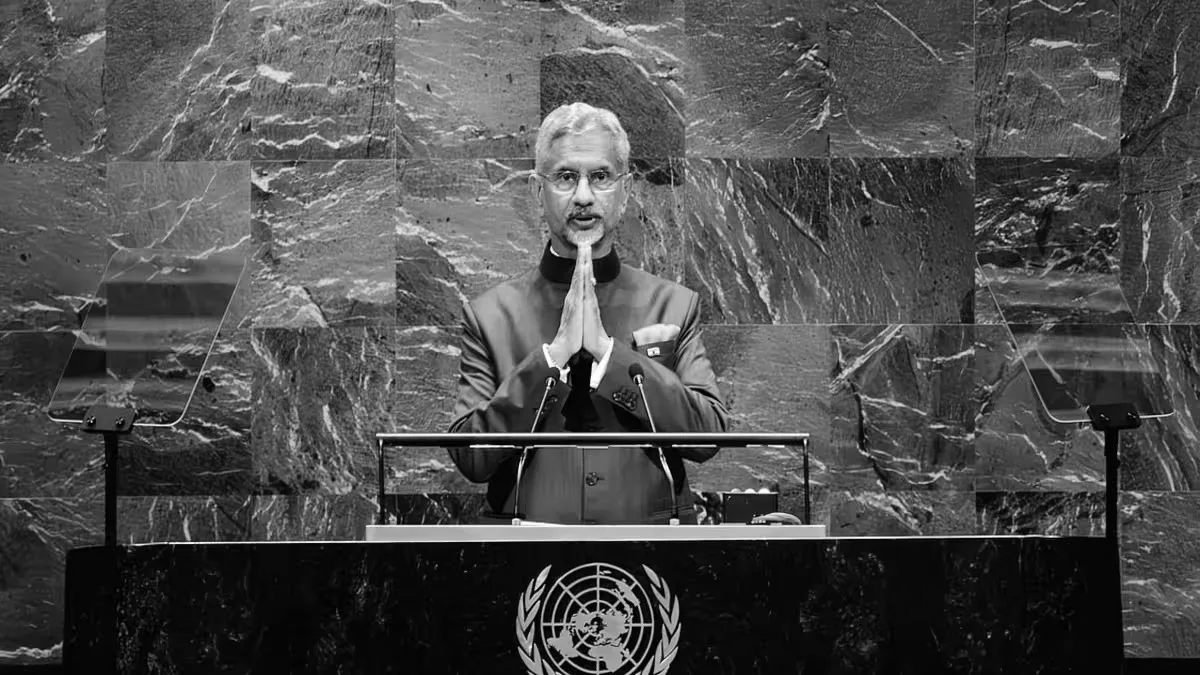
External Affairs Minister S Jaishankar on Saturday outlined India’s position on global conflicts, terrorism, maritime security, artificial intelligence, the Global South and UN reforms in his address to the 81st UN General Assembly (UNGA) in New York.
Opening with “Namaskar from 1.4 billion people of Bharat”, Jaishankar said the UN is entering its ninth decade amid conflicts and confrontations despite being founded to maintain international peace and security. Wars, he said, undermine security, threaten progress and retard development, with even countries far from conflict zones facing their consequences.
On the Gulf conflict, Jaishankar expressed deep concern over continuing hostilities and said attacks on commercial shipping and seafarers using international waterways are “simply unacceptable”. India called for restraint, de-escalation, civilian protection and uninterrupted energy and commerce.
On Ukraine, now in its fifth year, he echoed Prime Minister Narendra Modi’s call that “endless war must give way now, to an end to war”. India supports peace initiatives and stressed the need to protect seafarers and ensure food-grain and energy supplies.
On West Asia, Jaishankar said durable peace requires a Two-State solution, while India continues humanitarian assistance and relief for Palestinians. He said peace is more than the absence of war and warned that constant threats and pressures leave the world “on the edge of an abyss”, making stability, security and predictability essential.
He criticised the growing “weaponization of everything”, saying extreme competition is creating chokepoints in finance, market access, supply chains and technology. Resources and connectivity are increasingly being leveraged, forcing countries towards de-risking and diversification and weakening trust.
Jaishankar said the Global South faces a “4F crisis” of food, fuel, fertilizer and finance. A “Super El Nino”, fertilizer shortages and impediments to grain movements are causing alarm, while SDG progress remains under pressure. He also said the Global South’s right to industrialise is being undermined by non-market practices and market denial, while misuse of AI is sharpening bias and diluting mutual respect.
Terrorism, he said, remains a persistent threat, particularly when it is state-sponsored and cross-border. Governments engaging in it must be held accountable, while India will maintain zero tolerance and work to expose and counter terrorism financing.
A day after Pakistan Prime Minister Shehbaz Sharif’s UNGA address, Jaishankar said, “Yesterday, a serial practitioner of terrorism, misrepresented facts before this Assembly.” He accused Pakistan of seeking to “normalize terrorism” and claim immunity from its consequences.
“That will not stand,” he said, asserting that India’s right to defend itself against terrorism “will be exercised”. “Friendship and goodwill cannot co-exist with terrorism,” Jaishankar said, adding that “it is for the perpetrator of terrorism to mend its ways”.
Turning to India’s global role, he said inclusive growth has advanced the prospects of one-sixth of humanity, with progress in health, nutrition, education, drinking water, electricity, roads and housing also contributing to global SDG outcomes. He highlighted India’s digital public infrastructure, infrastructure expansion, improving ease of doing business and living, startup ecosystem and sectoral missions.
India, he said, has undertaken 600 major development projects in 78 nations, spanning infrastructure, manufacturing, agriculture, IT and capacity building. Climate initiatives include clean energy and water projects, sustainable agriculture and technology sharing, with African nations and Small Island Developing States among preferred partners. He cited the International Solar Alliance, Coalition for Disaster Resilient Infrastructure and Global Biofuels Alliance.
India has also provided medical assistance to conflict, epidemic and disaster zones, including the Nepal flash floods and Venezuela earthquake, while supporting limb-fitment camps, food, medicine, energy, fertilizer and livelihood needs. Capacity-building programmes have particularly benefited the Global South and Africa.
On peacekeeping, Jaishankar said India has contingents in nine of 11 UN mandates and remains a major contributor. He also noted that an Indian woman combat helicopter pilot received the UN 2025 Military Gender Advocate of the Year award.
He condemned attacks on shipping and seafarers from the Gulf and Red Sea to the Black Sea, noting that Indian and other seafarers have been killed. India has joined Liberia and 23 other partners to rally global opinion against such targeting and stressed adherence to international law.
On AI, Jaishankar highlighted India’s AI Impact Summit in February and said the technology can drive human empowerment, prosperity and population-scale solutions. Every nation, he said, should be able to develop its own AI ecosystem, models and deployment strategies according to national priorities. AI will also be part of India’s Global South partnerships.
He said technological democratisation must be accompanied by mutual respect and appreciation of different cultures, heritage and traditions. Economic and political rebalancing is underway, he said, but “cultural rebalancing” must follow.
Jaishankar then said, “We are now well on our way, towards a multi-polar world. The post-1945 order is giving way to new realities.” He called for civil conversations, broad consultations and transparent decision-making, saying “large sections of humanity” cannot be excluded and that “the case for reformed multilateralism only gets stronger day after day”.
He also thanked UN Secretary-General Antonio Guterres, who is completing a decade in office, highlighting his contributions and support for Mission LiFE.
Concluding, Jaishankar said peace, development and prosperity must become a mindset rather than something imposed or negotiated. Invoking Mahatma Gandhi’s words inscribed on the UN lawns, he ended: “there is no way to peace; peace is the way.”