
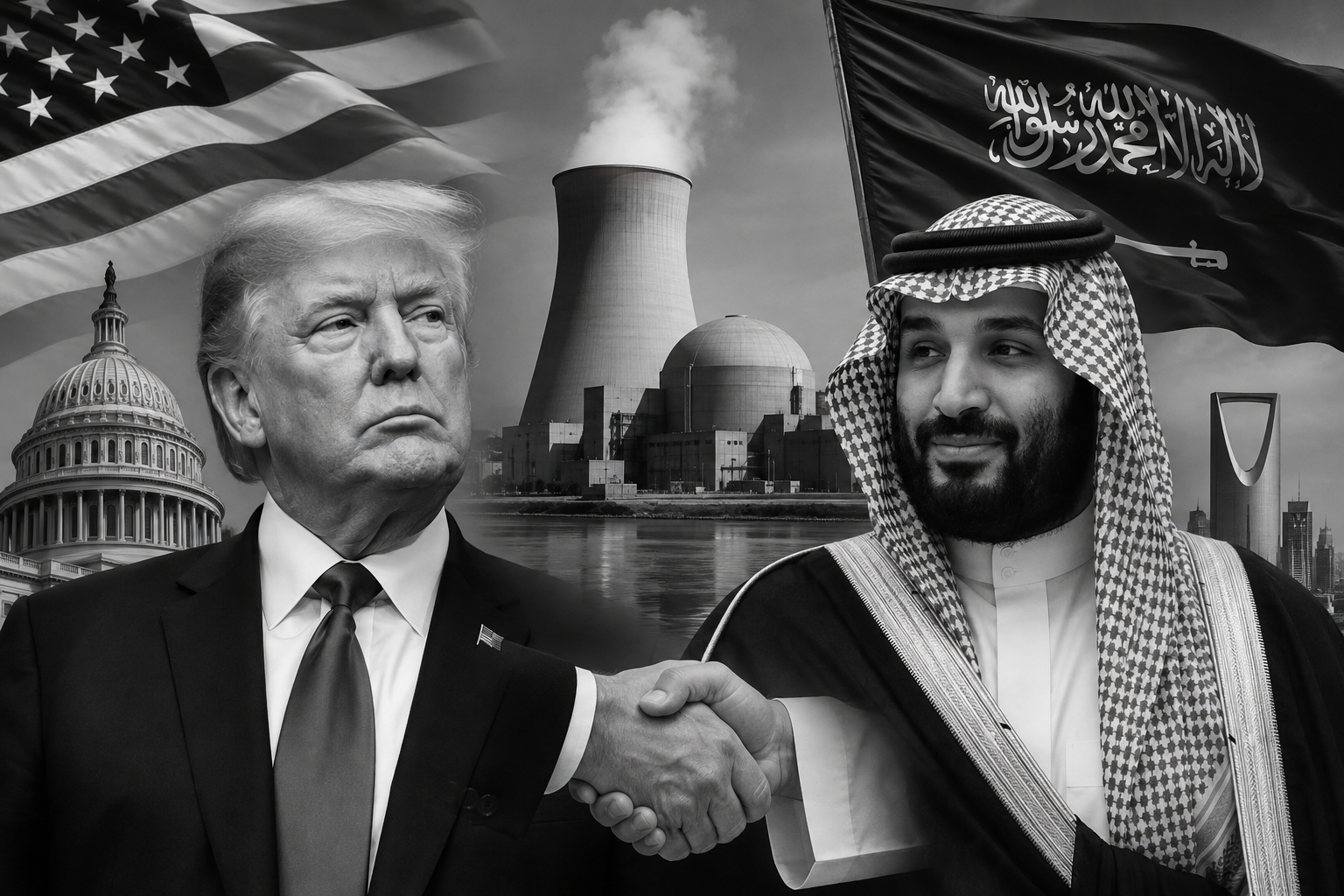
Trump Sends Saudi Civil Nuclear Deal to Congress, Ties Pact to Israel Normalisation
President Donald Trump has formally submitted a proposed civilian nuclear cooperation agreement with Saudi Arabia to the US Congress for review, setting in motion a statutory process that could open the kingdom to major American nuclear technology and investment. But the pact now faces an unusual complication: Trump has insisted that it will not move forward unless Riyadh agrees to normalise relations with Israel through the Abraham Accords.
The classified agreement was transmitted to Capitol Hill on Monday, August 24, as required under the US Atomic Energy Act. Signed last month by US Energy Secretary Chris Wright and Saudi Energy Minister Prince Abdulaziz bin Salman, it would establish a framework for a 30-year US-Saudi civilian nuclear partnership, potentially creating major opportunities for American nuclear companies.
Under the Section 123 process, Congress has 90 days of continuous session to review the pact. Unless lawmakers pass a joint resolution of disapproval, it can take effect without an affirmative vote by either chamber. If Congress rejects it, Trump could veto the resolution, requiring a two-thirds majority in both chambers to override him.
The agreement follows years of negotiations over Saudi Arabia's nuclear ambitions, particularly its desire to develop a domestic fuel cycle. The most sensitive issue is uranium enrichment, which has legitimate civilian uses but can also produce material suitable for nuclear weapons. Reports indicate the pact could permit a joint US-Saudi study into enrichment and potentially provide a pathway toward a domestic facility.
That has raised concerns among US lawmakers and nonproliferation experts, especially because Saudi Arabia would not be required to permanently renounce enrichment and reprocessing as the UAE did under its 2009 “Gold Standard” agreement. The pact also does not require Riyadh to adopt the IAEA Additional Protocol, although a bilateral safeguards arrangement is included.
The issue carries wider regional implications because Saudi Crown Prince Mohammed bin Salman has previously indicated Riyadh could pursue nuclear weapons if Iran obtained them, raising fears of a Middle Eastern nuclear race.
Meanwhile, Trump's Israel condition has complicated the agreement's diplomatic future. Saudi Arabia has said normalisation with Israel requires a credible pathway to Palestinian statehood, while Israeli Prime Minister Benjamin Netanyahu opposes Palestinian statehood.
The agreement's unusually classified status adds another layer of uncertainty, as it remains unclear whether Trump's Israel condition is contained in the document submitted to Congress.
If approved, the pact could expand US nuclear exports, strengthen American companies' position against Chinese and Russian competitors, and transform Saudi Arabia's civilian nuclear sector. But its fate will ultimately depend on congressional scrutiny, nuclear safeguards and whether Washington and Riyadh can bridge their differences over Israel and Palestinian statehood.