
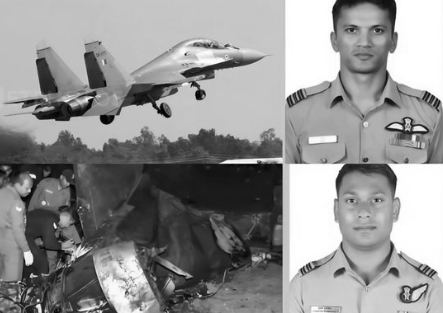
Two IAF pilots killed as Sukhoi Su-30MKI crashes in Assam's Karbi Anglong
A Sukhoi Su-30MKI fighter jet of the Indian Air Force crashed in Assam's Karbi Anglong district on Thursday evening, killing both pilots on board . The aircraft lost radar contact at 7:42 pm , shortly after taking off from Jorhat air base on a training sortie. Local residents in the Chokihola area reported hearing a loud explosion from the hills and seeing smoke rising shortly after.
Search teams from the IAF, assisted by civil administration, police, and local villagers, located the wreckage around 1:00 am on Friday , approximately 60 kilometres from Jorhat , near Inglong Ekopi in the remote forested hills of Karbi Anglong.
The IAF confirmed both pilots, Squadron Leader Anuj and Flight Lieutenant Purvesh Duragkar , both of the 47 Squadron, had been killed. Purvesh, 28 , was from Nagpur and had taken part in Operation Sindoor , India's strikes on terror bases in Pakistan following last year's Pahalgam attack. He had visited his family just ten days before the crash and had spoken to his father, retired railway employee Ravindra Duragkar, as recently as Wednesday. "My son was extremely proud to be part of the Indian Air Force," Ravindra told. Purvesh is survived by his parents and a sister settled in the US.
Defence Minister Rajnath Singh, Assam Chief Minister Himanta Biswa Sarma, and Jharkhand Chief Minister Hemant Soren all offered condolences, stating that the pilots' service to the nation will not be forgotten. The IAF has ordered a Court of Inquiry to determine the cause of the crash. Recovery of flight data recorders and other evidence from the site is ongoing.
The Su-30MKI is a twin-engine, two-seater, long-range multirole fighter jet originally developed by Russia's Sukhoi and forms the backbone of the Indian Air Force's combat aviation capability. India was among the first countries to place large-scale orders for the platform, with the aircraft first entering IAF service in 1997 . The first Russian-built Su-30MKI was formally accepted into the IAF in 2002 , with HAL-assembled jets following from November 2004, meaning most aircraft in the fleet are now over two decades old . The IAF today operates a fleet of more than 260 Su-30MKI jets , most manufactured domestically under licence by HAL, with each aircraft valued at approximately ₹350-400 crore depending on configuration.
This is not an isolated incident. While the IAF has generally regarded the Su-30MKI as a reliable platform, the aircraft has been involved in a series of accidents since its induction. The first crash occurred in April 2009 in Rajasthan, where one of the two ejecting pilots later succumbed to injuries. A second crash followed later that same year when an engine fire during a training sortie over the Pokhran range forced both pilots to bail out safely. Further accidents occurred between 2011 and 2017, variously attributed to technical defects and human error, with pilots surviving in most cases. More recently, a Su-30MKI crashed near Tezpur in Assam in 2019, followed by crashes in Gwalior in January 2023 and in Nashik in June 2024, where the pilots escaped without fatal injury. In total, prior to the Assam crash, 13 Su-30MKIs had been lost in accidents since induction, with three pilot fatalities recorded. The March 2026 crash is among the few fatal accidents involving the type in recent years, and is expected to intensify scrutiny of the fleet's airworthiness, maintenance protocols, and the risks of high-performance training missions over challenging terrain.