
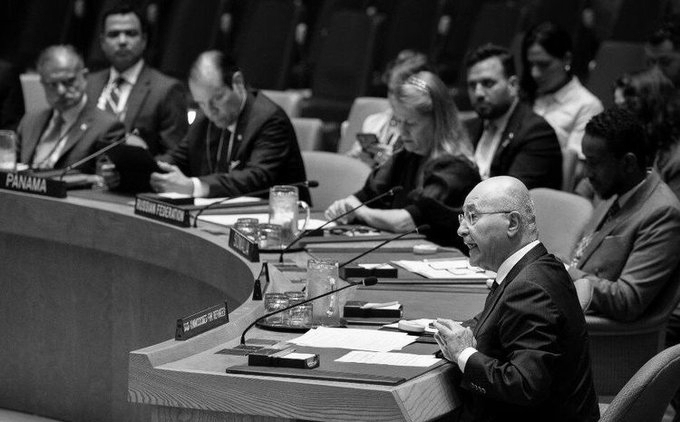
UN Refugee Chief Urges Security Council To Stop Displacement From Crossing Generations
More than 117 million people have been forced from their homes by conflict, violence, persecution and other threats, and UN refugee chief Barham Salih has urged the UN Security Council to act against the conflicts driving the crisis.
Speaking to the 15-member Security Council on Friday, Salih said it has a “unique responsibility to help make peace possible”, arguing that humanitarian agencies can protect displaced people and ease suffering but cannot create peace.
In his first Security Council briefing since becoming UN High Commissioner for Refugees, Salih said the responsibility for maintaining international peace and security rests with the Council under the UN Charter. He warned that displacement is increasingly outpacing efforts to find lasting solutions.
The former Iraqi president and former refugee pointed to several major crises. Sudan remains the world's largest displacement crisis, with around 12 million people displaced inside and outside the country. “As long as this war continues, people will continue to flee,” he said.
In the Democratic Republic of Congo, Salih said generations have lived through cycles of conflict and violence, now compounded by an escalating Ebola crisis. In Ukraine, the war has displaced millions within the country and forced millions more to seek safety abroad.
He also highlighted the decades-long displacement of Western Saharan refugees living in camps around Tindouf in neighbouring Algeria. Generations have grown up there facing uncertainty and limited prospects while awaiting a political solution, he said. The UN refugee chief separately warned that humanitarian needs there remain significantly underfunded.
In the latest Yemen crisis, UNHCR has mobilised resources to assist more than 130,000 Yemenis displaced inside the country, while more than 3,700 have crossed into Djibouti seeking safety. Recent fighting has therefore added another layer to an already severe regional displacement crisis.
Salih said his “50 by 35” initiative aims to halve by 2035 the number of refugees in long-term displacement who depend on humanitarian assistance. The goal is not simply to reduce aid but to expand opportunities for self-reliance, employment and inclusion, alongside voluntary return, third-country pathways and local integration where possible.
He acknowledged that the target is ambitious but said it must be. Keeping people alive year after year while they remain unable to rebuild their lives, he argued, cannot be the ultimate measure of success.
“Success must ultimately mean creating the conditions in which people no longer need us,” Salih said, calling for efforts to prevent displacement, resolve existing displacement and help people rebuild their lives in safety and dignity.