
Under Watch: India’s Expanding CCTV Network and the Future of Policing
From community-funded cameras in Telangana to integrated command centres across major cities, surveillance is reshaping law enforcement. But can more cameras deliver safer streets while protecting citizens’ privacy?
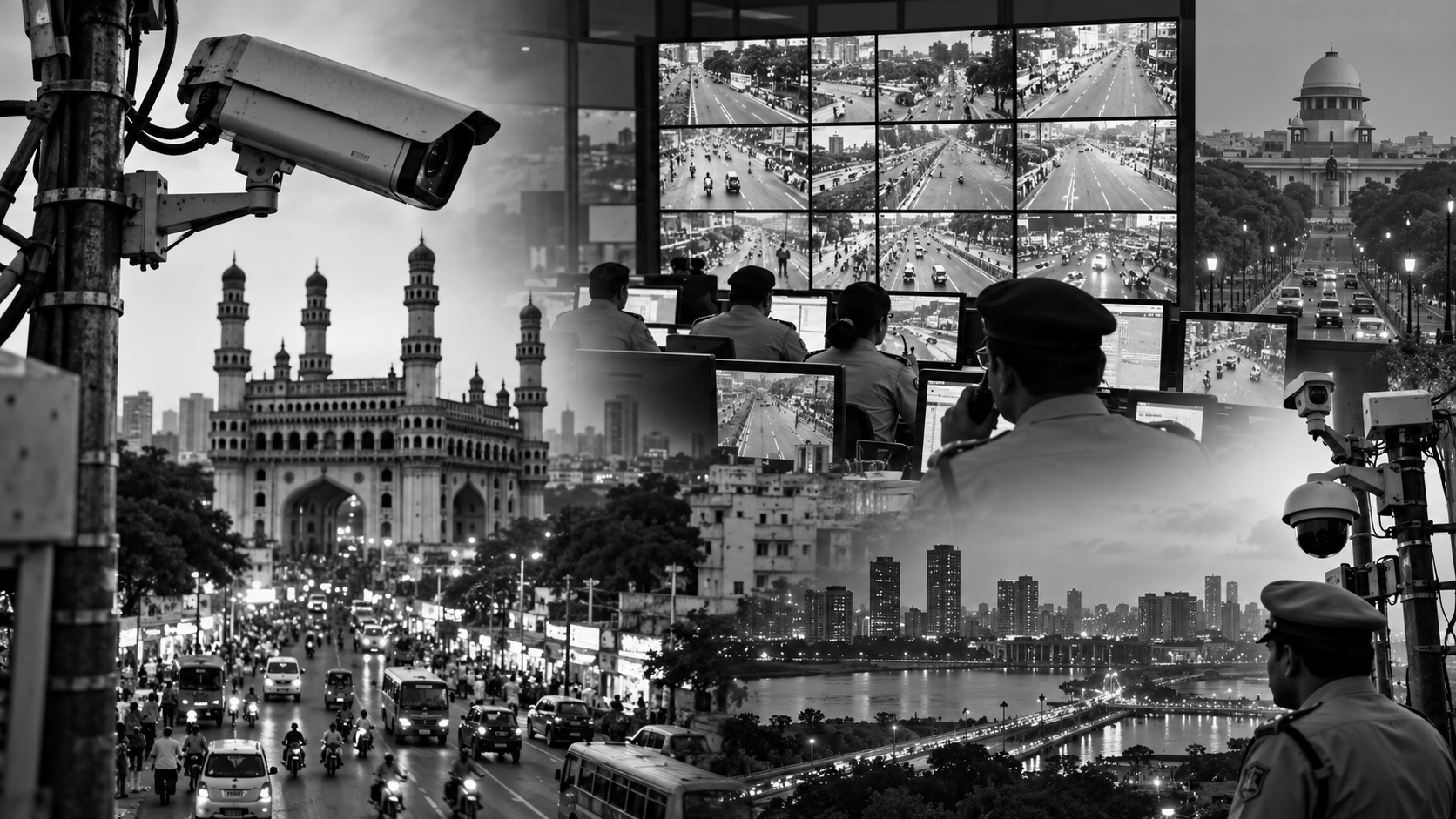
A camera overlooking a busy junction in Hyderabad can help investigators reconstruct a suspect’s movements, trace a stolen vehicle or establish what happened during a road accident. Across India, CCTV surveillance is becoming an integral part of modern policing, extending the reach of law enforcement beyond conventional patrols and police stations. What began primarily as a recording mechanism has evolved into a wider technological ecosystem involving command centres, traffic monitoring, digital investigations and automated video analytics. Telangana offers a compelling example of this transformation, combining community-funded cameras, government infrastructure and technology-assisted investigations. Yet the expansion raises a fundamental question: Does a larger surveillance network necessarily translate into safer streets and more effective policing?
Telangana’s Community-Driven Surveillance Model
Telangana’s surveillance programme developed through a combination of public-safety legislation, community participation and police modernisation. The Public Safety (Measures) Enforcement Act, 2013, originally enacted in undivided Andhra Pradesh, established requirements for specified establishments to maintain CCTV systems and comply with applicable public-safety measures. Community participation subsequently became an important component of the state’s approach. The Telangana government’s Socio-Economic Outlook 2021 reported 6.59 lakh community-installed CCTV cameras across the state as of December 2020, highlighting the scale of citizen participation in surveillance.
Initiatives such as Nenu Saitam encouraged residents and establishments to install cameras, while community surveillance projects brought together neighbourhoods, businesses and other contributors. The state also promoted the Hawk Eye mobile application, which recorded approximately 31.2 lakh downloads by March 2020, alongside crime mapping, geographical information systems and camera geotagging. A Bureau of Police Research and Development (BPR&D) document identifies Nenu Saitam, Community CCTV Surveillance and Safe and Smart City as three components of Telangana’s surveillance programme. Together, these initiatives illustrate a hybrid system extending beyond cameras purchased directly by police.
Hyderabad Emerges as a Surveillance Hub
Hyderabad’s expanding network has attracted national and international attention. A 2021 analysis by cybersecurity research firm Comparitech estimated approximately 3.75 lakh CCTV cameras in the city, placing it fourth among Indian cities by camera density per square mile. A subsequent study by Common Cause and Lokniti–CSDS, published in 2023 using Comparitech data from July 2022, estimated 4,40,299 cameras in Hyderabad. These estimates demonstrate the scale of surveillance but should not be treated as a definitive annual growth series because they use different reporting periods and may include privately owned equipment.
Official police inventories measure another category. BPR&D’s Data on Police Organizations 2024 reported 2,82,558 cameras available with Telangana Police as of January 1, 2024, the highest figure among states in that inventory. The distinction matters because cameras estimated across a city, cameras accessible to police and cameras owned by government are not interchangeable measures. Hyderabad’s Integrated Command and Control Centre brings surveillance into a broader operational framework involving police coordination, traffic management, emergency response and information systems. Hyderabad Police’s IT Cell manages CCTV infrastructure, data analysis and technical integration.
In November 2025, police announced the Advanced City Surveillance Grid Management Protocol and EYES maintenance teams. The announcement cited more than 16,000 police-owned street cameras, over 50,000 community and privately contributed feeds, and more than one lakh Nenu Saitam cameras. These figures cover different categories and should not be added together without checking for overlap. The initiative nevertheless highlights the growing importance of camera maintenance, reliable footage and coordinated access.
Does Surveillance Reduce Crime?
The effectiveness of CCTV cannot be established through camera counts alone. Hyderabad recorded 35,944 registered cases in 2024, falling to 30,690 in 2025, a decrease of approximately 14.6%. However, the 2025 total remained above the 2023 figure of 25,488. These changes do not prove that surveillance caused crime to decline, as reporting practices, enforcement, staffing and other policing measures also influence recorded crime.
There is evidence of investigative use. Hyderabad City Police’s 2024 annual report recorded 725 cases detected through CCTV in its West Zone. Yet case detection does not automatically mean conviction or demonstrate that an offence was prevented. Property-crime statistics offer another caution: the reported detection rate fell from 67% in 2023 to 59% in 2024, even though the number of cases detected increased. International research reaches a similarly qualified conclusion. A systematic review by Brandon Welsh and David Farrington, published in Justice Quarterly, found that CCTV can reduce crime in some settings, but effectiveness varies by location and offence type. The evidence does not support assuming that every additional camera produces a predictable reduction in crime.
A National Transformation with Uneven Coverage
BPR&D’s 2024 inventory reported 2,82,558 cameras available with Telangana Police, compared with 17,004 in Delhi, 3,066 in Uttar Pradesh and 135 in Bihar, as of January 1, 2024. These figures highlight differences in reported police infrastructure, not total surveillance coverage. Community and privately installed cameras may be counted differently across jurisdictions. A separate BPR&D-based comparison reported 1,533 police stations with CCTV in Uttar Pradesh, 1,021 in Bihar, 904 in Telangana and 181 in Delhi, illustrating why station coverage and camera inventories must be treated as distinct measures.
Surveillance is also expanding alongside other policing challenges. NCRB data published in 2026 recorded 27,230 cybercrime cases in Telangana in 2024, up from 18,236 in 2023. While CCTV can help reconstruct physical movements, cybercrime requires digital forensics, financial tracing and coordination with banks and payment providers. Modern policing therefore depends on integrating physical surveillance with specialised investigative capabilities.
The Privacy and Accountability Challenge
Surveillance raises questions about access to footage, retention, facial recognition and data security. A 2025 academic paper by Rakshit Kweera, examining CCTV policies in Telangana and Delhi, explores the institutional and legal development of state-led surveillance. Research published in The Asia Pacific Journal of Anthropology in 2024 also examined the social consequences of Hyderabad’s expanding surveillance infrastructure.
In September 2026, The Times of India reported that an RTI response identified 5,548 government-installed cameras across 71 Hyderabad police-station limits and reportedly found none in its scope equipped with AI or facial-recognition technology. The response excluded community-driven installations such as Nenu Saitam. These findings should not be interpreted as proof that police never use facial-recognition applications separately or that no other cameras have advanced capabilities.
The Supreme Court’s 2017 K.S. Puttaswamy judgment recognised privacy as a fundamental right. Surveillance must therefore be assessed against legality, legitimate purpose and proportionality, particularly when monitoring extends towards identifying or tracking individuals.
Measuring Success Beyond Camera Numbers
India’s CCTV expansion demonstrates how technology and community participation can extend the reach of policing. Telangana illustrates the potential of this model, but its effectiveness must be assessed through evidence of operational reliability and investigative outcomes. Police departments should publish comparable figures on camera uptime, CCTV-assisted investigations, chargesheets, convictions and recoveries. Independent studies comparing similar areas before and after installation would offer stronger evidence of crime-prevention effects.