
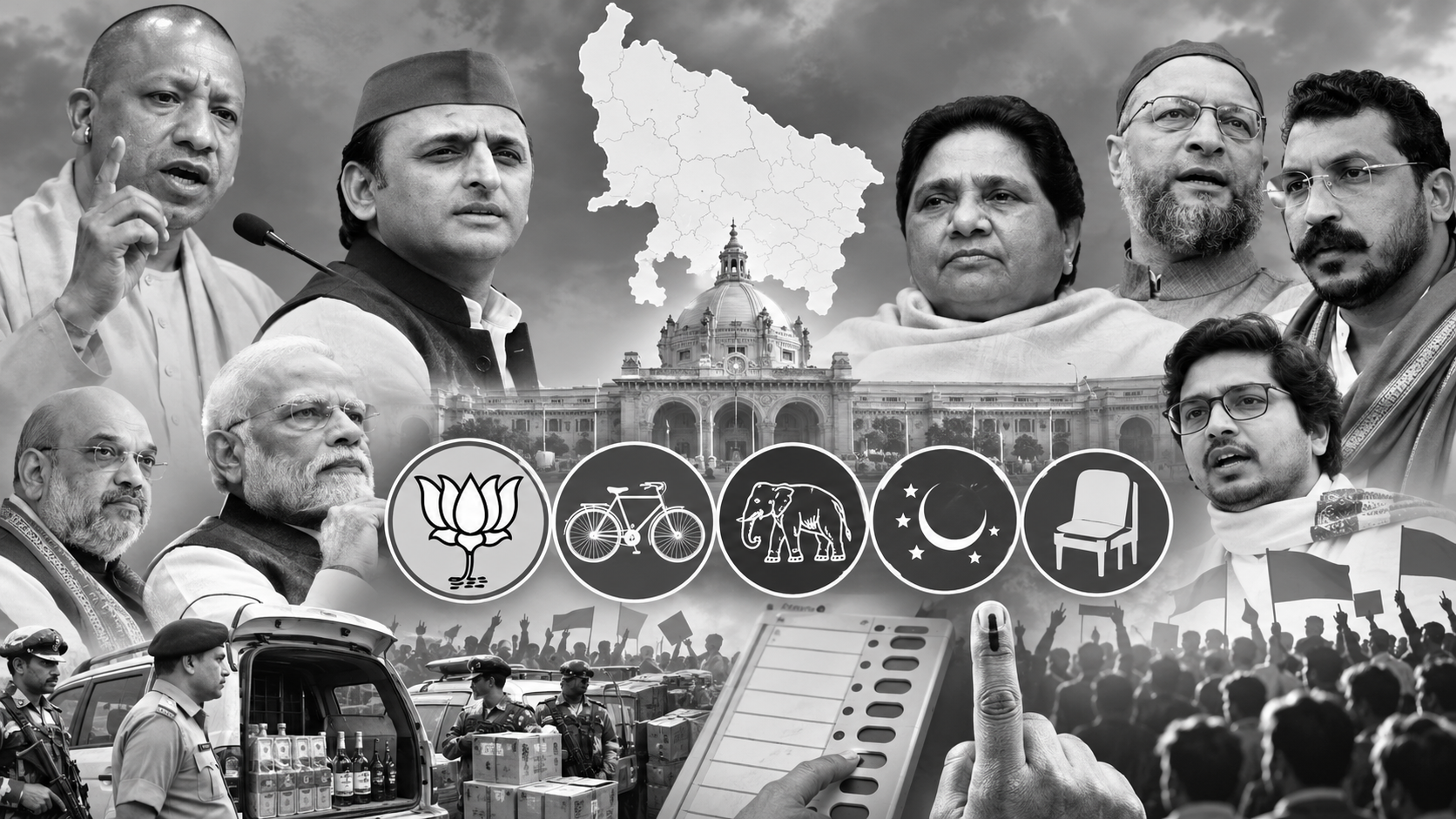
UP Polls: 23 Agencies to Track Cash, Liquor and Freebies Ahead of 2027 Battle
The Uttar Pradesh Election Commission has assigned 23 Central and state enforcement agencies to monitor the movement of cash, liquor, narcotics, precious metals and other inducements ahead of the 2027 Assembly elections. Chief Electoral Officer Navdeep Rinwa has directed coordinated surveillance, including border checks, monitoring suspicious financial transactions and identifying expenditure-sensitive constituencies using previous election seizure data.
The preparations come as the BJP, Samajwadi Party (SP) and Bahujan Samaj Party (BSP) intensify their electoral strategies in a state with 403 Assembly and 80 Lok Sabha constituencies.
The BJP and RSS have reportedly conducted four parallel assessments covering legislators' performance, organisational strength, caste equations, governance and candidate prospects. One internal survey reportedly projects potential losses in 52–67 seats and recommends replacing nearly 35% of sitting MLAs. The assessment categorises approximately 180 constituencies as relatively safe, 80 as high-risk or narrow-margin seats and around 140 as areas facing stronger anti-incumbency or opposition advantages.
The reported exercises involve the BJP organisation, the state government under Yogi Adityanath, Amit Shah's team and RSS ground-level cadres. The party is also strengthening booth mobilisation across six RSS regions — Kashi, Awadh, Gorakhpur, Kanpur, Meerut and Braj. A five-member central team led by Vinod Tawde, including Jagdish Ishwarbhai Patel, Pradeep Verma, Anant Ojha and Medha Kulkarni, is coordinating regional preparations.
The BJP's electoral position, however, must be viewed against its previous results. In the 2022 Assembly elections, it won 255 seats with 41.29% votes, while the SP secured 111 seats with 32.06%. The BSP won just one seat despite polling 12.88%, while Congress secured two seats with 2.33%. BJP allies Apna Dal (Soneylal), Nishad Party and SBSP won 12, six and six seats respectively. The RLD won eight seats with 2.85%.
The 2024 Lok Sabha results exposed a different electoral picture. The SP won 37 of Uttar Pradesh's 80 parliamentary seats with 33.60% votes, while the BJP secured 33 seats despite receiving the highest individual party vote share of 41.36%. Congress won six seats with 9.46%, RLD two with 1.02%, and Apna Dal (Soneylal) one with 0.92%. The Azad Samaj Party (Kanshi Ram) also won one seat with 0.69%. The BSP failed to win any seat despite polling 9.39%.
For the SP, the 2024 gains have strengthened Akhilesh Yadav's PDA strategy, targeting backward classes, Dalits and minorities. Its proposed I-PAC arrangement ended in May 2026, after which former Chief Secretary Alok Ranjan reportedly took charge of a candidate-assessment exercise covering all 403 constituencies.
The BSP, meanwhile, is relying on Mayawati's organisational network, including Anand Kumar, Satish Chandra Mishra, Mewalal Gautam and other senior aides. Akash Anand's reinstatement as national convener has added a younger campaign face as the party attempts to rebuild its social coalition.
Another factor is the new Samajik Parivartan Morcha, formed by AIMIM's Asaduddin Owaisi and Chandrashekhar Azad's Azad Samaj Party, which has announced plans to contest all 403 seats, with Azad as its chief ministerial face.
A reported News18 survey covering 30,925 respondents across 75 districts projected 66.6% support for the NDA, 26.4% for SP-Congress and 5.4% for BSP. It also placed Yogi Adityanath at 66.2% as the preferred chief minister, while employment remained a concern.
The contrasting survey projections and election results underline the uncertainty ahead. With candidate selection, caste coalitions, employment and booth-level mobilisation likely to shape the contest, the 2027 election will test whether the BJP can retain its Assembly dominance or the opposition can convert its parliamentary gains into a wider victory.