
UP To Be Split Into Four States? Minister Om Prakash Rajbhar Revives Old Statehood Debate
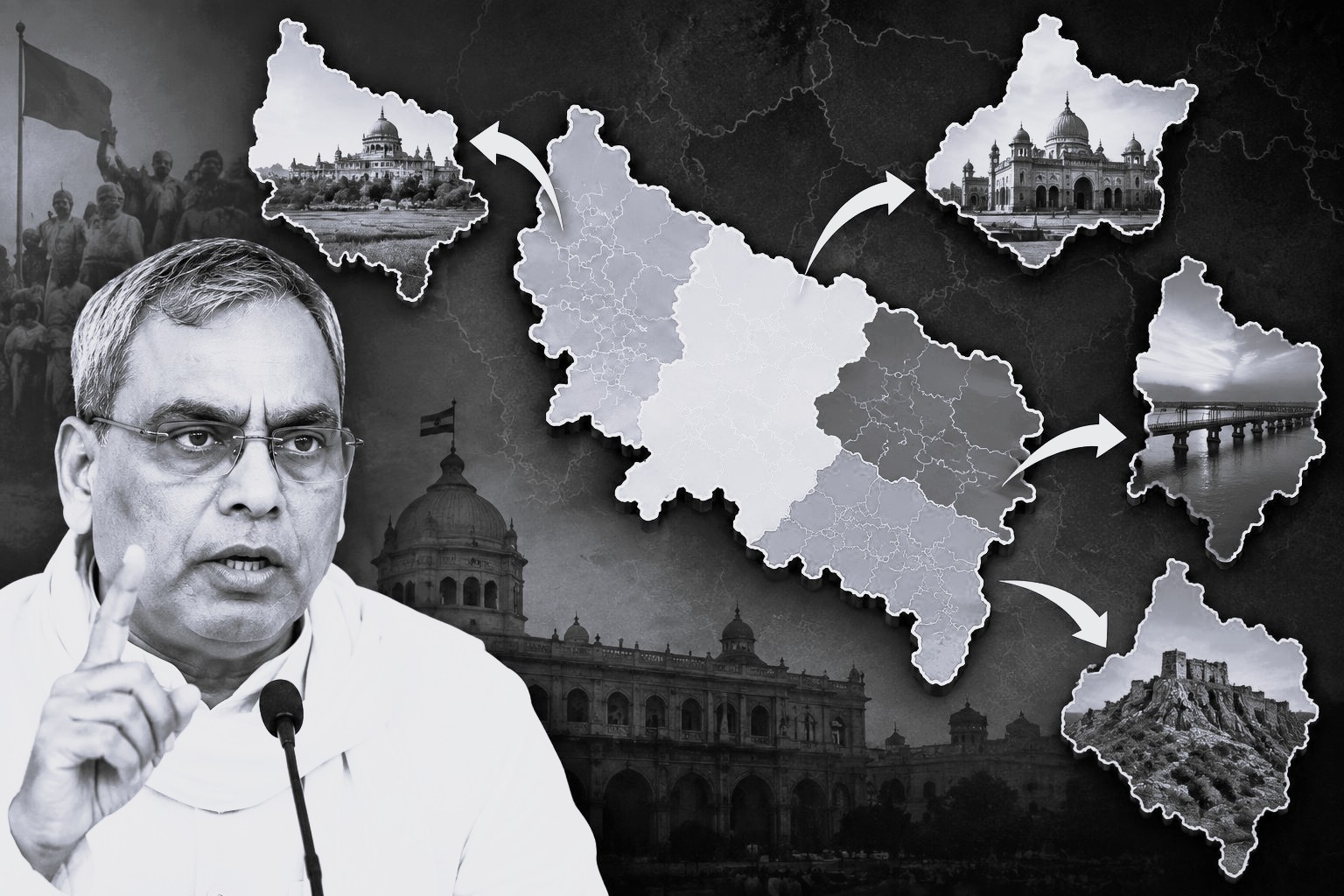
The decades-old debate over whether Uttar Pradesh should be broken into smaller states has returned with a fresh political twist after Cabinet Minister and Suheldev Bharatiya Samaj Party (SBSP) chief Om Prakash Rajbhar claimed that the state could be divided into four parts after the caste census.
Rajbhar has proposed Purvanchal, Madhyanchal, Bundelkhand and Harit Pradesh, and claimed that Prime Minister Narendra Modi assured him that there would be no difficulty in pursuing the division once the caste census was completed. There is, however, no official announcement from the Centre or BJP confirming such a plan. Rajbhar's claim therefore remains his account of the conversation, not a declared government policy.
The minister has tied the demand to OBC representation, renewing his call for sub-categorisation of the 27 per cent OBC quota so its benefits reach more backward communities. But his proposal is also explicitly political. Rajbhar has said that if Purvanchal becomes a separate state, its first Chief Minister should come from the Rajbhar community, and has described this as a condition his party would consider while entering future alliances.
The proposal has not found uniform support. BJP leader Brij Bhushan Sharan Singh has said there is no government proposal to divide UP, while NDA ally Sanjay Nishad has also opposed the division. On the other hand, Congress MP Imran Masood has backed the idea, arguing that smaller states could make administration easier, while UP Congress chief Ajay Rai criticised Rajbhar's remarks and questioned the demand for a Rajbhar Chief Minister.
The administrative argument is significant. Uttar Pradesh had nearly 20 crore people in the 2011 Census, and sends 80 MPs to the Lok Sabha and has 403 Assembly constituencies — the highest of any state. Using the 2011 population, each Lok Sabha MP represented roughly 25 lakh people on average. The issue, therefore, is not a shortage of MPs but the sheer scale and diversity of the population and territory they represent.
The four proposed regions also have distinctly different profiles. Purvanchal, with centres such as Varanasi and Gorakhpur, is densely populated but faces employment and migration pressures; Madhyanchal, including Lucknow and Kanpur, is the administrative and urban heart of the state; Bundelkhand has long faced water scarcity, drought and agricultural stress; while Harit Pradesh in western UP has stronger agricultural, industrial and urban pockets, particularly around the NCR. Exact boundaries have not been formally defined.
The idea is hardly new. In 2011, Mayawati's government passed an Assembly resolution proposing four states, Purvanchal, Bundelkhand, Awadh Pradesh and Paschim Pradesh, but the proposal did not progress. The broader argument for smaller administrative units also goes back further, including B R Ambedkar's 1955 advocacy of smaller states.